
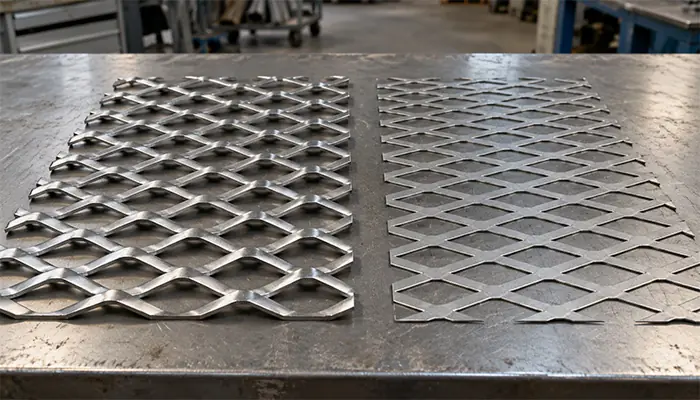
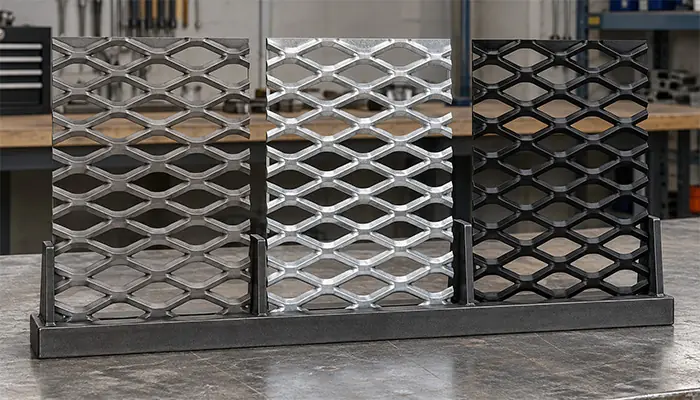
Two expanded metal panels can have similar diamond patterns yet fit very differently into the same frame. One has angled strands and a pronounced texture. The other has been rolled into a flatter profile. That difference matters when the mesh becomes a machine guard, architectural screen, shelf, or equipment cover.
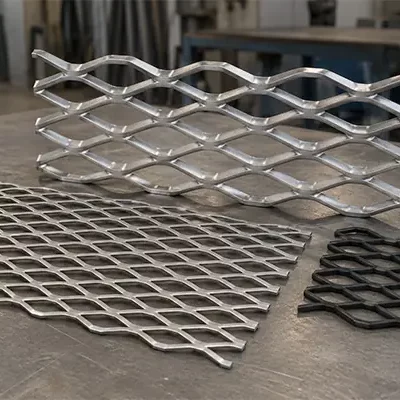
Raised expanded metal mesh retains the three-dimensional profile created during slitting and stretching. Flattened expanded metal mesh passes through an additional rolling process to reduce that profile and create a more even surface.
For importers, distributors, fabricators, and project buyers, the right choice starts with the finished assembly. Surface contact, mounting clearance, mesh dimensions, material, and service conditions all affect the decision.
This guide compares raised vs. flat expanded metal, explains the specifications behind the names, and shows how to prepare a useful enquiry. You can also browse YESON’s expanded metal mesh products when comparing product options.
Raised vs. Flattened Expanded Metal Mesh at a Glance
The main distinction is the strand profile. Both products are formed from sheet metal, and both retain an interconnected mesh structure. Flattening adds a processing step; it does not turn the mesh into a woven or welded wire product.
| Comparison Point | Raised Expanded Metal Mesh | Flattened Expanded Metal Mesh |
|---|---|---|
| Production | Slit and stretched, with the raised profile retained | Expanded mesh followed by flattening rolls |
| Surface | Angled strands and raised bonds | Flatter, more even strand profile |
| Contact with adjacent parts | Requires allowance for the profile depth | Often selected for flatter contact surfaces |
| Thickness information | Strand thickness and overall depth must be distinguished | Finished strand thickness and overall thickness must be confirmed |
| Appearance | Textured, three-dimensional effect | More planar appearance |
| Typical selection reasons | Surface texture, visual depth, or a specified raised form | Flatter fit, contact surface, or a specified flattened form |
| Performance comparison | Check the exact specification and installation | Check the exact specification and installation |
Use this table to narrow the choice. The final purchasing specification should identify the mesh geometry, material, finish, and supporting arrangement.
What Is Raised Expanded Metal Mesh?
How Raised Expanded Metal Is Made
An expanding press slits and stretches a metal sheet into a repeating open pattern. The metal between the openings forms strands, which remain connected at the bonds where adjacent diamonds meet.
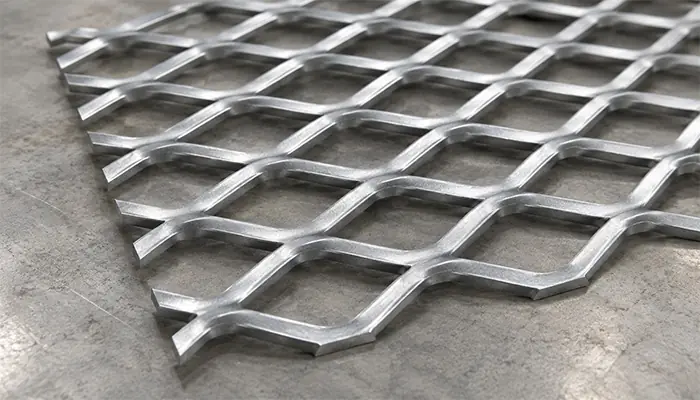
Raised expanded metal is supplied with the three-dimensional shape created by this process. The strands sit at an angle rather than lying entirely in one plane.
The mesh is made from one continuous sheet. A finished panel may subsequently be welded to a frame, but those frame welds are separate from the process that creates the mesh itself.
How to Identify the Raised Profile
A side view is often more useful than a top view. It reveals the angled strands and the depth between the upper and lower surfaces of the mesh.
This depth affects how the panel seats against a bracket, fits inside a channel, or sits behind a cover. A drawing that specifies only the strand material thickness may leave the required mounting clearance unclear.
Why It Is Also Called Standard Expanded Metal
In this product context, “standard,” “regular,” and “raised” commonly describe the unflattened form. The word “standard” does not, by itself, establish compliance with a particular technical standard. State any required specification separately in the order.
What Is Flattened Expanded Metal Mesh?
How the Flattening Process Works
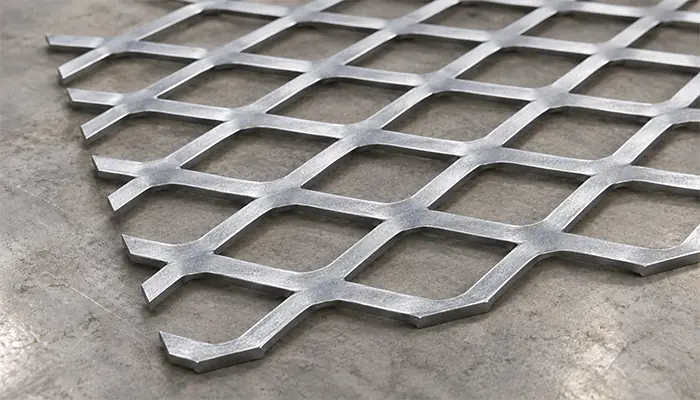
Flattened expanded metal starts as raised mesh. It then passes through rolls that compress the raised profile and produce a more even surface.
Rolling can change the strand dimensions and mesh geometry. Buyers should therefore use the finished product data when checking fit, openings, and thickness.
Flattened mesh still has openings and connected strands. It is neither a solid sheet nor a different wire-based construction.
What “Flat Expanded Metal” Means
“Flat expanded metal” is a common shortened description of flattened expanded metal. “Flat expanded steel” describes the steel version, but that wording alone does not identify the grade, pattern, or finish.
For an order, use the fuller description: flattened expanded metal mesh, followed by the material and finished dimensions.
A Flatter Surface Still Needs Defined Tolerances
Flattening describes the manufacturing process, while flatness describes the condition of the delivered panel.
For a cover that must sit neatly against a frame, agree on acceptable flatness and the condition in which it will be measured. A sample panel can also establish the expected surface and edge quality before production.
Key Differences Between Raised and Flattened Expanded Metal Mesh
Surface Profile and Appearance
Raised mesh produces visible depth and shadow along its strands. Viewed from different angles, the same panel can appear more open or more closed. This makes orientation relevant to architectural screens and visible enclosure panels.
Flattened mesh has a more planar appearance. It is often considered where the mesh should lie closer to a supporting surface or form a flatter infill.
When appearance matters, inspect a sample in the intended orientation and finish. A photograph taken straight above the mesh may hide the very difference you need to evaluate.
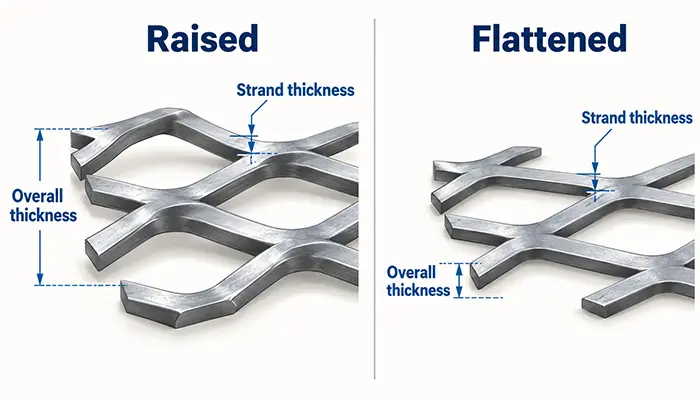
Strand Thickness vs. Overall Mesh Thickness
Three measurements can appear in an expanded metal discussion:
- Starting sheet thickness: the thickness of the material before expansion.
- Finished strand thickness: the thickness of the metal forming the strand.
- Overall mesh thickness: the total depth of the finished profile.
Raised mesh has a profile depth that is different from the thickness of an individual strand. Flattening reduces that depth, but the finished strand thickness should still be specified.
Consider a panel that must slide into an existing channel. The strand thickness helps describe the material; the overall thickness helps determine whether the panel fits. Both measurements can matter to the same purchase.
Diamond Dimensions and Open Area
Mesh dimensions describe more than the visible hole. The repeating pattern and the clear space between strands are different measurements.
Flattening can alter the finished geometry, so a raised product and a flattened product with similar nominal designations should not automatically be treated as dimensionally interchangeable.
Open area is another separate parameter. Where ventilation, drainage, or visibility matters, request the open-area percentage for the actual product. Airflow through an assembled screen also depends on the installation, rather than open area alone.
Stiffness and Load Performance
The three-dimensional geometry of raised mesh can be useful where profile depth contributes to panel stiffness. Flattened mesh offers a different geometry and may suit assemblies prioritizing a flatter face.
However, a meaningful performance comparison needs defined products. Material, strand width, strand thickness, diamond dimensions, mesh direction, support spacing, and connections all influence behavior.
For a load-bearing application, compare product data for the proposed arrangement. A mesh label or a visual impression is not a load rating.
Grip, Surface Contact, and Edges
Raised strands provide a more pronounced texture. That texture may be relevant to a walking surface, but suitability also depends on the product, footwear, contamination, drainage, and service conditions.
Flattened mesh provides a flatter contact face for items resting against it. This can help when designing shelves, partitions, or covers, although openings and cut edges remain.
Specify edge treatment separately. Trimming, deburring, edging, or framing may be needed regardless of the selected profile.
Weight and Material Use
Compare finished weight per unit area, such as kg/m² or lb/ft².
Flattening changes the geometry rather than removing metal as its purpose. Without trimming or other material removal, the same workpiece does not lose mass simply because it passes through rolls. Its area may change, which is why total sheet weight and weight per unit area must be distinguished.
For purchasing, use the supplier’s finished weight data and the agreed sheet dimensions. Do not estimate shipping weight from the words “raised” or “flattened.”
Materials and Finishes for Expanded Metal Mesh
Raised and flattened describe the surface form. Steel, stainless steel, and aluminum describe the material. Galvanizing and powder coating describe finishes. These are separate choices.
Carbon Steel and Galvanized Expanded Steel Mesh
Carbon steel is a practical option for many fabricated panels. Specify the required grade and whether the mesh will be supplied bare, coated, or as a completed assembly.
For galvanized expanded steel mesh, clarify the coating route and how cut edges and fabricated joints will be treated. The quotation should identify the finish required for the actual order.
YESON’s galvanized expanded metal mesh is a starting point for discussing mesh dimensions and coating requirements.
Stainless Steel Expanded Metal Mesh
Stainless steel may be considered where corrosion resistance or repeated cleaning is important. State the grade and describe the exposure, including moisture, salts, and cleaning chemicals where relevant.
Also identify the required surface condition. The material name alone leaves the mesh profile, dimensions, and fabrication scope unresolved.
Aluminum Expanded Metal Mesh
Aluminum has a lower density than steel, making it relevant to projects where handling weight matters. The complete panel still needs to meet the intended stiffness and fixing requirements.
Specify the alloy and temper where required, along with the mesh geometry and finish. Review YESON’s aluminum expanded metal mesh when evaluating material options.
Powder Coating and Other Finishes
For a coated panel, define the color, gloss, coating system, and preparation requirements. Make clear whether coating occurs before or after cutting and assembly.
Approve the finished appearance on a representative sample when visible surfaces are important.
Which Type Should You Choose for Your Application?
Start with what the mesh must do, then select the profile that supports that function.
Walkways, Platforms, and Ramps
Pedestrian surfaces require an appropriate product and supporting arrangement. Raised expanded metal grating may be a candidate, but ordinary raised mesh should not be assumed to provide the same performance.
Confirm loading, span, mesh direction, fixings, and required traction characteristics. The finished platform includes the mesh, frame, and connections; all need to be considered together.
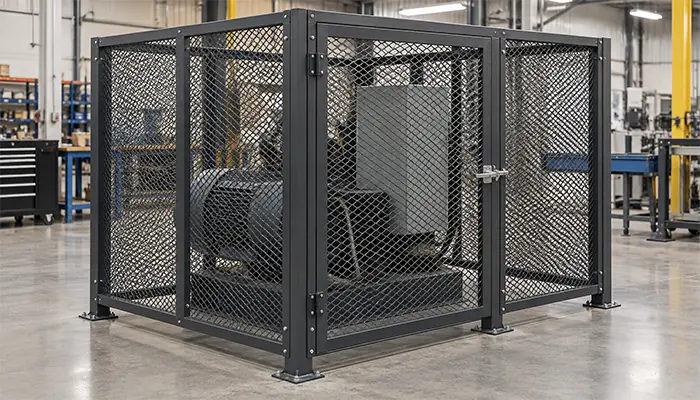
Machine Guards and Equipment Enclosures
Flattened mesh may suit a guard where a flatter face helps with installation or clearance. Raised mesh may suit an enclosure designed to accommodate its depth and texture.
Check the required openings, distance from hazards, frame rigidity, and mounting arrangement against the equipment’s requirements. Surface profile is only one part of guard selection.
Fencing and Security Screens
Either profile may be considered when the complete fence design supports it. Strand dimensions, openings, panel frames, posts, and fixings determine much of the finished system’s behavior.
For an existing fence, record the original mesh direction and attachment details before requesting replacement panels.
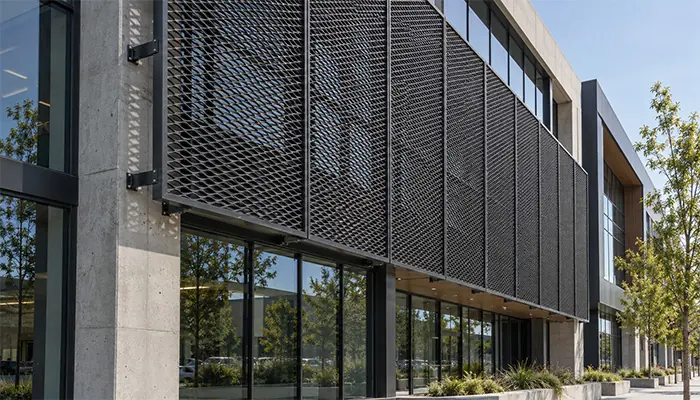
Architectural Screens and Decorative Panels
Raised mesh creates a stronger sense of depth, while flattened mesh offers a more planar effect. Pattern, viewing angle, finish, and panel orientation all influence the result.
YESON’s architectural expanded metal mesh provides options for discussing screens, cladding, ceilings, and partitions. If a larger diamond pattern is part of the design, large-opening expanded metal mesh can be included in the comparison.
Review samples with the proposed frame and joints, particularly where adjacent panels must maintain a consistent pattern.
Shelving, Cabinet Inserts, and Filter Support
Flattened mesh is worth evaluating when a flatter contact surface is desirable. Shelf loading still depends on the product and supporting frame.
For filter support, identify the required openings, material, and component dimensions. A support mesh and the filtering layer can perform different functions, so specify each clearly.
| Application | Main Selection Question |
|---|---|
| Walkway or ramp | Is the complete arrangement suitable for the specified loading and service conditions? |
| Machine guard | Do openings, clearances, and fixings meet the equipment requirements? |
| Architectural screen | Does the sample provide the intended appearance and panel fit? |
| Shelf or cabinet insert | Does the profile suit the contact surface and supporting frame? |
| Filter support | Are openings, material, and component tolerances appropriate? |
How to Read Expanded Metal Mesh Specifications
SWD and LWD: Pattern Dimensions
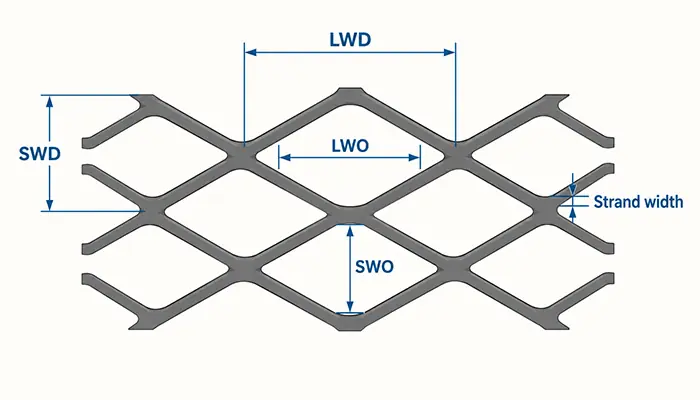
SWD and LWD commonly identify the short-way and long-way dimensions of the repeating diamond pattern.
Ask for a drawing showing the measurement points. Nominal style names and measurement conventions can vary between product ranges, so the abbreviation alone should not replace a dimensioned specification.
SWO and LWO: Clear Openings
SWO and LWO describe the short-way and long-way clear openings between strands.
If a component must pass through an opening, or the mesh must retain a particular object, state the relevant clear dimension directly. A nominal pattern designation may not answer that requirement.
Strand Width, Strand Thickness, and Overall Thickness
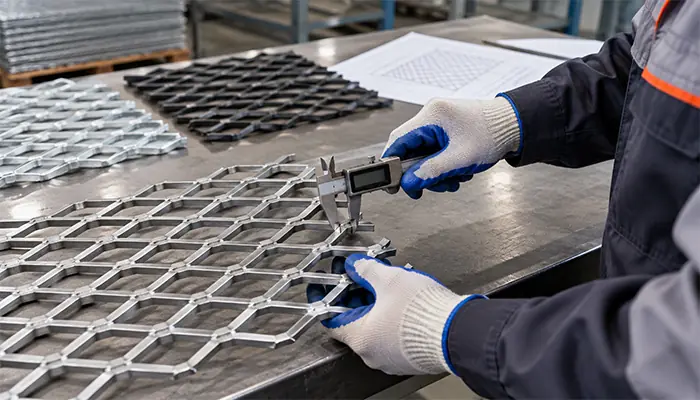
These measurements describe different features and should appear separately where they affect acceptance.
Request millimeter or inch values alongside any gauge or style designation. This makes quotations easier to compare across suppliers.
Sheet Size, Mesh Direction, and Tolerances
Sheet size is the overall panel size, not the opening size. Mark the long-way and short-way directions on the panel drawing.
A useful drawing also identifies critical dimensions, cutting requirements, flatness, and edge condition. For multi-panel orders, label each panel size and orientation.
For a broader overview of product families and terminology, see our guide to the different types of expanded metal.
What Affects the Cost of Raised and Flattened Expanded Metal Mesh?
Material, Geometry, and Quantity
Material grade, finished weight per unit area, mesh geometry, panel dimensions, and order quantity all affect the quotation.
Compare equivalent purchasing scopes. A lighter panel, different alloy, or larger opening may change the price while also changing the product you receive.
Flattening and Further Fabrication
Flattening adds processing, but it does not establish a universal price difference between all raised and flattened products.
Cutting, edging, framing, coating, inspection, and packing can have a significant effect on the final offer. Identify these operations before comparing supplier prices.
For example, a cut and framed panel should be compared with another completed panel, or the remaining fabrication cost should be added to a full-sheet offer.
Packaging and Delivered Cost
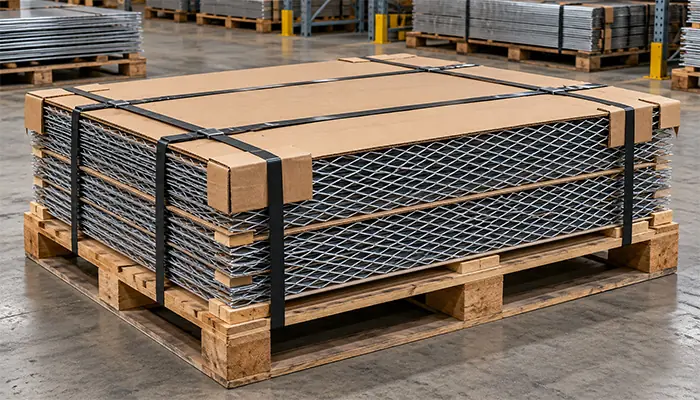
Discuss how panels will be supported and protected during transport, especially when flatness or finished appearance matters.
Compare quotations on the same delivery terms and destination. The lowest material price may not provide the lowest cost for a finished, usable component.
B2B Buying Checklist: What to Include in Your RFQ
A clear request for quotation helps suppliers price the same product and helps buyers review offers consistently.
| RFQ Item | Information to Provide |
|---|---|
| Profile | Raised / standard or flattened |
| Material | Metal type, grade, or alloy |
| Mesh geometry | Pattern dimensions and critical clear openings |
| Strand dimensions | Finished width and thickness |
| Overall thickness | Required finished profile depth |
| Panel format | Dimensions, direction, and quantity by size |
| Finish | Coating route and appearance requirements |
| Fabrication | Cutting, edging, bending, or framing |
| Application | Intended use, supports, and performance requirements |
| Acceptance | Tolerances, inspection points, and sample requirements |
| Delivery | Packaging, destination, and requested quotation terms |
For repeat orders, retain the approved drawing revision and sample reference. An old invoice description such as “diamond metal mesh” may be too broad to reproduce the required panel accurately.
When reviewing the first shipment, focus on the agreed acceptance points: product profile, dimensions, orientation, finish, edge condition, and identification of different sizes.
Frequently Asked Questions
Is Standard Expanded Metal the Same as Raised Expanded Metal?
Yes, in common product terminology, standard expanded metal generally means the raised form. Any required technical standard or certification should be listed separately.
Is Flat Expanded Metal the Same as Flattened Expanded Metal?
Usually, “flat expanded metal” refers to flattened expanded metal. Use the full product description and finished dimensions when ordering to avoid ambiguity.
Is Raised Expanded Metal Stronger Than Flattened Expanded Metal?
There is no universal ranking for every product or loading condition. Compare the actual material, mesh geometry, strand dimensions, orientation, and supports for the intended application.
Does Flattened Expanded Metal Always Weigh Less?
No. Use finished weight per unit area and supplied sheet size. Flattening changes geometry; total weight also depends on the original material and any trimming or further processing.
Can Flattened Expanded Metal Be Used for Walkways?
Only where the specific product and complete supporting arrangement meet the project requirements. A flat surface does not establish pedestrian load capacity.
Is Expanded Wire Mesh Woven or Welded?
The term “expanded wire mesh” is sometimes used commercially for expanded metal. Conventional expanded metal is formed from sheet by slitting and stretching. It is different from woven wire mesh and welded wire mesh.
Is Extruded Metal Mesh the Same as Expanded Metal Mesh?
Do not assume the names refer to the same process. Expanded metal is made by slitting and stretching sheet. If an enquiry uses “extruded mesh,” confirm the intended construction through drawings, photographs, or a sample.
Choose the Mesh Profile That Fits Your Project
The choice between raised and flattened expanded metal mesh begins with the required surface and assembly. Raised mesh retains a textured profile; flattened mesh provides a flatter face. Material, dimensions, finish, and installation requirements then define the product to purchase.
For a new project or repeat order, send the mesh profile, material, drawing, quantity, and application details to YESON. Request an expanded metal mesh quotation so the proposed supply can be reviewed against your requirements.



 EN
EN  DE
DE  FR
FR  ES
ES  AR
AR  PT
PT