
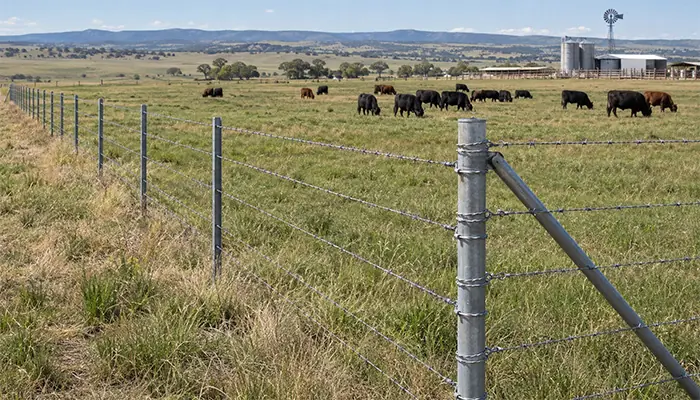
Choosing the best barbed wire for a farm is not simply a matter of finding the lowest price per roll. The wire must suit the livestock, fence layout, terrain, climate, post system, installation method, and expected service life. A product that works well on a dry cattle ranch may not be the right choice for a humid coastal pasture, a mixed-livestock enclosure, or a boundary shared with a public road.
For many cattle farms, a well-manufactured double-strand galvanized barbed wire with consistent barb spacing offers a practical balance of strength, corrosion resistance, installation efficiency, and cost. However, the correct wire diameter, tensile grade, zinc coating, barb design, and roll length must be selected as part of the complete fence system.
This guide explains the main types of agricultural barbed wire, how to compare specifications, what works best for cattle, when another fence may be safer, and what a B2B buyer should confirm before ordering in bulk.
What Is Agricultural Barbed Wire?
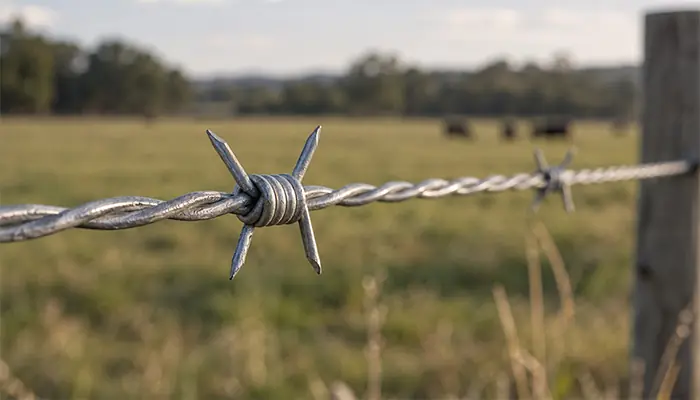
Agricultural barbed wire is a steel fencing wire made with sharp barbs positioned at regular intervals along one or more line wires. A common construction uses two line wires twisted together, with two-point or four-point barbs locked around the strands. The barbs discourage livestock from pressing against the boundary and help define a visible physical barrier across long farm or ranch fence lines.
A complete barbed wire farm fence includes much more than the coil itself. It normally requires:
- Line wire with uniformly formed barbs
- Strong end, corner, and gate posts
- Intermediate line posts
- Brace assemblies at tension points
- Staples, clips, ties, or other compatible fasteners
- Strainers, joiners, and tensioning tools
- Gates and livestock access points
Barbed wire is different from razor wire. Agricultural barbed wire uses pointed wire barbs and is widely used for livestock and rural boundaries. Razor wire uses stamped metal blades and is intended for high-security perimeter control. The two products should not be treated as interchangeable.
Why Is Barbed Wire Common on Farms and Ranches?
Barbed wire became a standard farm wire because it can cover long distances with relatively little material compared with a rigid panel fence. It also follows rolling or uneven ground more easily than many prefabricated systems. For large cattle properties, pasture divisions, crop boundaries, and ranch perimeters, these qualities can reduce both material and installation costs.
The main advantages of barbed wire farm fencing include:
- Economical coverage: it is often cost-effective for long rural boundaries.
- Adaptability: the wire can follow slopes, curves, and irregular terrain.
- Flexible fence design: buyers can choose different wire diameters, barb patterns, coatings, tensile grades, roll lengths, and packaging.
- Compatibility: barbed wire can be installed as a multi-strand fence or combined with field fence in an appropriate design.
- Repairability: a damaged section can usually be isolated, spliced, and retensioned without replacing the entire fence.
- Established installation practice: many agricultural contractors already have the tools and experience needed to work with it.
These advantages do not mean that barbed wire is suitable for every animal or every part of a property. Weak corner assemblies, poor tensioning, unsuitable post spacing, damaged coatings, or the wrong fence type can create maintenance and animal-safety problems. The final result depends on the complete system rather than the wire alone.
Types of Barbed Wire Used for Agricultural Fencing
“Barbed wire” describes a product family, not one fixed specification. Understanding the main variations makes it easier to compare quotations and avoid buying two coils that look similar but perform differently.
Low-Carbon Barbed Wire
Conventional low-carbon barbed wire is generally more flexible and easier to handle, bend, splice, and tie than a high-tensile alternative. It is familiar to many installers and can be a practical choice for general farm boundaries, shorter fence runs, and projects where ease of installation matters.
Because it can stretch more under load, the entire fence must be designed with suitable post spacing, bracing, and tension. A low purchase price does not compensate for weak wire, inconsistent diameter, loose barbs, or inadequate corrosion protection.
High-Tensile Barbed Wire
High-tensile barbed wire is produced from stronger steel and is designed to retain tension with less elongation. It can be useful for long ranch boundaries and permanent cattle fencing when installed as part of a correctly engineered system.
High-tensile wire requires the right tools, strong anchor assemblies, compatible accessories, and experienced installation. It should not be tensioned or repaired as if it were ordinary soft wire. Buyers should request the actual tensile range and wire diameter rather than relying only on the words “high tensile” in a quotation.
Hot-Dip Galvanized Barbed Wire
Galvanized wire has a zinc layer that protects the steel underneath from corrosion. For most exposed agricultural applications, hot-dip galvanized barbed wire is a common starting point because it combines a familiar product structure with weather resistance.
Not all galvanized products provide the same protection. Buyers should compare the specified zinc coating, coating uniformity, adhesion, and condition around the twists and barbs. A bright surface alone does not prove that two wires have the same coating mass or service potential.
PVC-Coated Barbed Wire
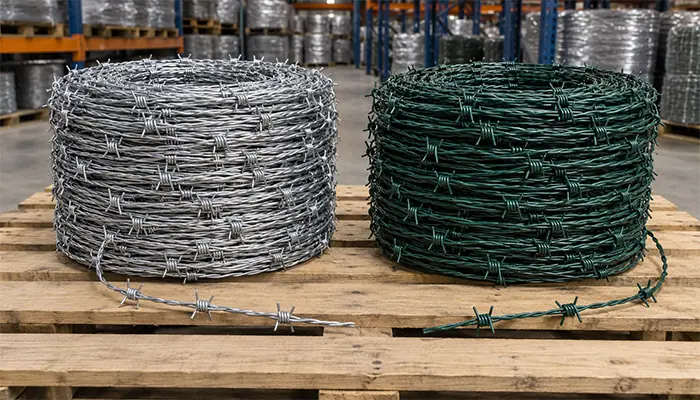
PVC-coated barbed wire has a polymer layer over the steel core, commonly in green or black. It may be chosen when the fence needs additional surface protection, a less industrial appearance, or a color that blends into the site.
When comparing PVC-coated products, confirm both the core-wire diameter and the finished outside diameter. A thick-looking coated wire may contain a smaller steel core. Coating thickness, adhesion, UV exposure, packaging, and damage during installation also affect long-term performance.
Traditional-Twist and Reverse-Twist Barbed Wire
Barbed wire can be manufactured with different strand and barb-forming methods. Traditional-twist and reverse-twist constructions describe how the line wires and barbs are combined. The names used in different markets are not always perfectly consistent, so the purchase specification should also state the number of strands, barb-point count, barb spacing, line-wire diameter, and barb-wire diameter.
Two-Point and Four-Point Barbed Wire
A two-point barb has two projecting points, while a four-point barb has four. Four-point wire is common in many livestock markets because it presents more contact points around the twisted line. Two-point wire can be easier to handle and may be preferred under certain regional practices or project specifications.
More points do not automatically make a wire correct for every fence. Animal type, visibility, local standards, installer preference, and the intended deterrent effect should all be considered.
What Is the Best Barbed Wire for Cattle?
For a typical permanent cattle boundary, a double-strand, galvanized wire with securely formed barbs, consistent spacing, suitable tensile strength, and a verified wire diameter is a sensible starting point. Four-point wire is widely used, while high-tensile construction may be advantageous on long fence runs when the posts, braces, tools, and installation method are designed for it.
There is no universal “best barbed wire for cattle” because the correct choice changes with:
- Cattle breed, age, size, and behavior
- Stocking density and pasture-management system
- External boundary or internal paddock use
- Fence length, soil, slope, and vegetation
- Pressure around gates, feed areas, and water points
- Local fencing practice and legal requirements
- Climate and corrosion exposure
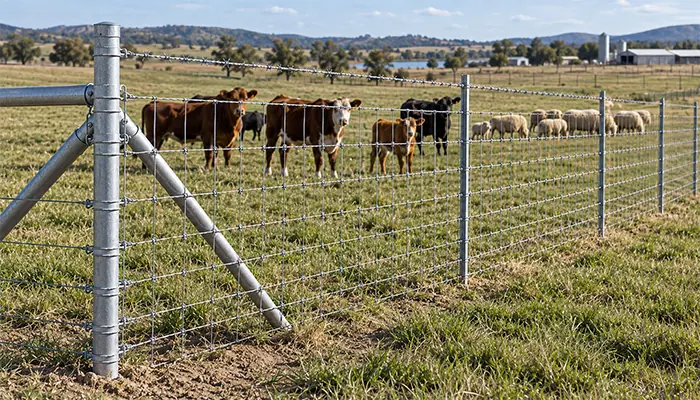
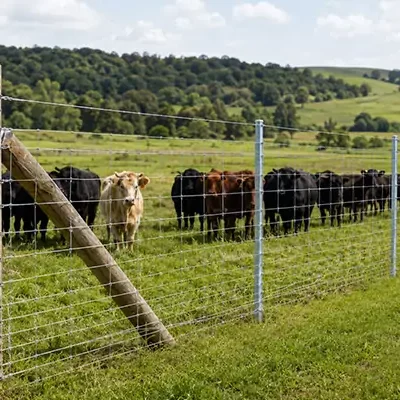
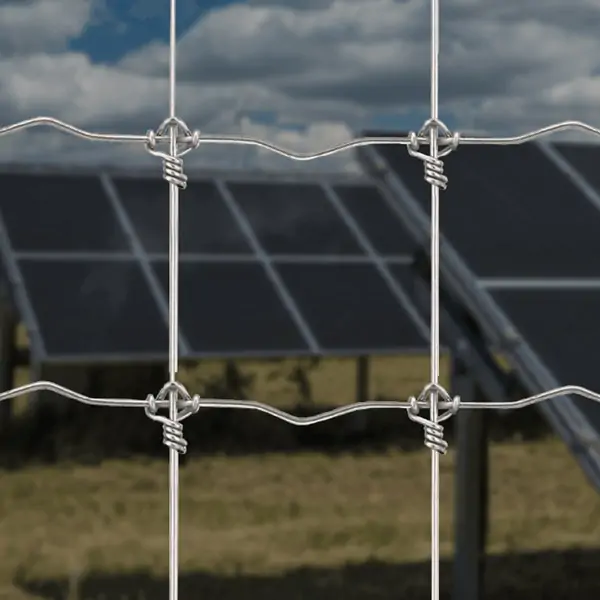
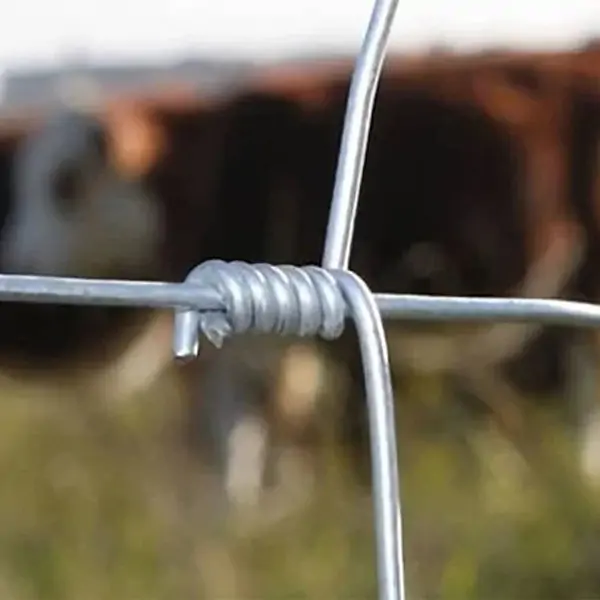
Adult cattle can often be contained by a correctly designed multi-strand barbed wire fence. Calves may pass beneath or between strands if the lower spacing is too open. In that situation, a woven field fence for cattle and livestock may provide more reliable lower-level containment. A strand of barbed wire may sometimes be used above a field fence, but the post strength, total fence height, animal contact, and local rules must be reviewed first.
Features to Check in Cattle-Fence Wire
- Uniform line-wire and barb-wire diameter
- Verified tensile grade suitable for the fence design
- Consistent barb spacing across the coil
- Barbs that remain secure on the twisted strands
- A zinc or polymer coating suited to the farm environment
- Accurate roll length and dependable weight tolerance
- Compact winding that supports safe handling and transport
- Inspection records for repeat wholesale orders
Is Barbed Wire Suitable for Every Farm Animal?
No. Barbed wire is widely used for cattle and property boundaries, but it is not the best primary fence for every species or management system.
| Animal or Application | General Suitability | Main Consideration |
|---|---|---|
| Adult cattle | Commonly suitable | Correct strand layout, visibility, tension, posts, and braces |
| Calves | Conditional | Lower openings may require closer spacing or woven field fence |
| Sheep and goats | Often better combined with woven fencing | Smaller animals may pass between widely spaced strands |
| Horses | Usually not preferred as the primary fence | Visibility and injury risk require a more horse-appropriate system |
| Pigs | Conditional | Strong lower containment is normally the priority |
| Crop boundary | Suitable in many locations | Design depends on the animals or people the boundary must deter |
| Ranch perimeter | Commonly suitable | Long runs require dependable tension, bracing, and corrosion protection |
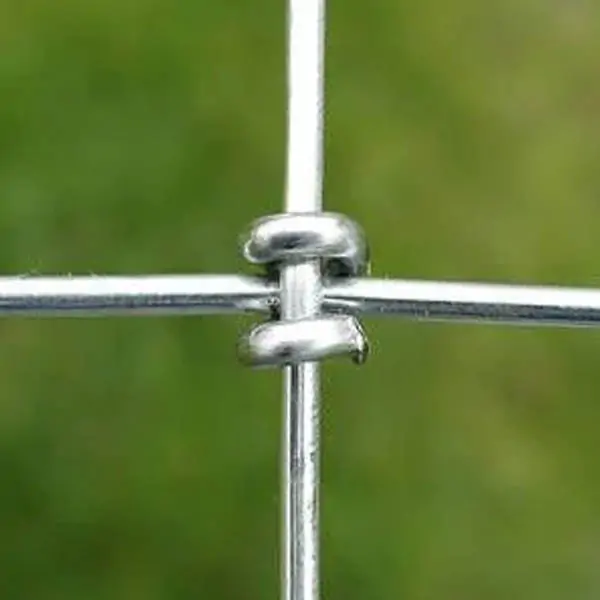
Where sheep, goats, calves, or wildlife create containment challenges, a fixed-knot fence can provide smaller openings and stronger vertical control. For horses or any high-contact enclosure, consult a local agricultural fence specialist and animal-welfare guidance before selecting a pointed wire.
How to Choose Barbed Wire for Farm Fencing
1. Define the Animals and Boundary Purpose
Start with the job the fence must perform. An external ranch boundary has a different risk profile from an internal grazing division. A fence beside a road, neighboring property, feed area, or handling facility may face more pressure than a quiet pasture line.
Record the livestock species, animal age, planned stocking conditions, fence length, number of gates, terrain, and whether the project is permanent or temporary. This information allows the supplier to recommend a specification rather than quote a generic farm-wire coil.
2. Confirm Wire Diameter, Not Only Gauge
Gauge numbers can be confusing because the relationship between gauge and diameter is inverse, and different markets may use different conventions. A lower gauge number normally represents a thicker wire within the same gauge system, but a buyer should never assume that two quotations use the same system.
Put the line-wire diameter and barb-wire diameter in millimeters on the request for quotation and purchase order. If a gauge designation is commercially important in the destination market, show it as an additional reference. For PVC-coated wire, specify both the steel core diameter and the finished coated diameter.
3. Select the Appropriate Tensile Grade
Low-carbon wire tends to be more forgiving during manual installation, while high-tensile wire offers greater strength and lower elongation. The best option depends on the fence length, post system, maintenance plan, available tools, and installer experience.
Ask for a test-backed tensile range. Do not compare products solely through marketing terms such as “heavy duty,” “premium,” or “high strength.” Those descriptions are not substitutes for measurable specifications.
4. Choose Barb Points and Spacing
Confirm whether the project requires two-point or four-point barbs and state the desired spacing between barb clusters. Closer barb spacing may increase the deterrent effect and material content, but it can also affect handling and price. Wider spacing may be accepted in some agricultural markets.
Consistency matters as much as the nominal dimension. Uneven spacing, loose barb wraps, and badly formed points indicate poor process control and can make installation unpredictable.
5. Match the Coating to the Environment
A dry inland property, a high-rainfall pasture, and a coastal farm do not expose steel to the same conditions. Humidity, salt, fertilizer, manure, soil contact, irrigation, and damaged surfaces can accelerate corrosion.
For galvanized wire, request the required zinc-coating class or coating mass and the relevant test method. For PVC-coated wire, confirm the core protection, coating thickness, color, adhesion, and intended outdoor exposure. Heavier protection may cost more initially but can lower replacement and repair costs in an aggressive environment.
6. Compare Roll Length, Net Weight, and Packaging
“Price per roll” is meaningful only when the compared rolls have the same wire diameter, construction, coating, length, and tolerance. A lighter or shorter coil can appear cheaper while delivering less fence coverage.
Confirm:
- Nominal and permitted roll-length tolerance
- Net wire weight and gross packed weight
- Coil inner and outer dimensions if handling or loading requires them
- Wrapping material and moisture protection
- Handle, spool, pallet, or loose-coil requirements
- Label language, private branding, and barcode needs
- Loading quantity based on the final approved specification
7. Match the Wire to the Post System
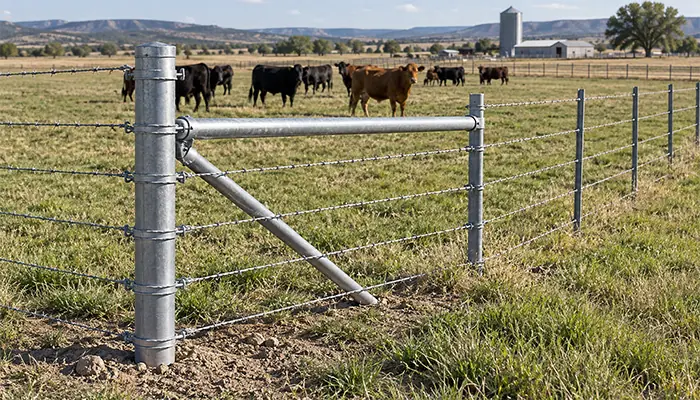
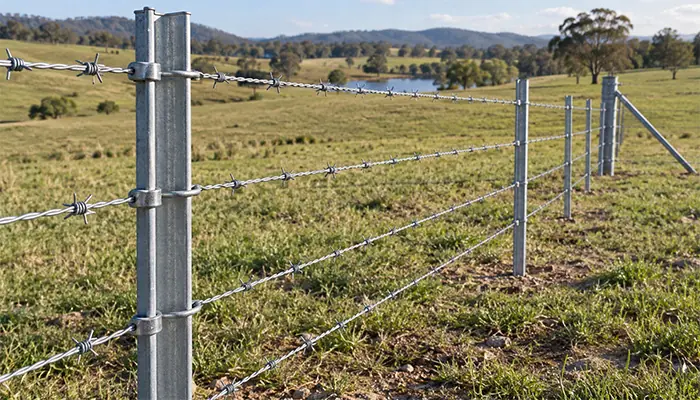
The wire, post, fastener, and brace must work as one system. A farm fence may use wood posts, steel T-posts, Y-posts or star pickets, or concrete posts, depending on the region and application. End and corner assemblies must resist the accumulated pull of the tensioned strands.
For steel-post projects, a galvanized steel Y post can support agricultural wire fencing, while compatible T-post wire clips help secure wire to a T-post. The fastener should hold the wire without unnecessarily damaging its protective coating.
Post spacing cannot be selected from one universal number. It changes with terrain, soil, fence height, wire tensile grade, number of strands, animal pressure, corners, and local building practice. Review the site conditions and consult this farm fence post spacing guide before finalizing the bill of materials.
8. Check Local Rules and Safety Requirements
Fence requirements can change across countries, states, provinces, municipalities, and road authorities. Before installation, confirm property lines, shared-boundary responsibilities, roadside restrictions, height requirements, warning or visibility rules, and animal-welfare obligations.
Workers should use suitable gloves, eye protection, long clothing, and controlled coil-unwinding methods. High-tensile wire stores considerable energy when tensioned, so installation and repair should be handled by trained personnel with appropriate tools.
Barbed Wire Specification Checklist for B2B Buyers
A complete specification makes quotations easier to compare and reduces disputes after production. The following table can be copied into an RFQ.
| Specification Item | Information to Confirm | Why It Matters |
|---|---|---|
| Application | Cattle, ranch boundary, pasture division, crop protection, or resale | Guides the complete product recommendation |
| Steel type | Low-carbon or high-tensile wire | Affects strength, elongation, handling, and installation |
| Line-wire diameter | Millimeter diameter and tolerance | Affects strength, weight, and price |
| Barb-wire diameter | Millimeter diameter and tolerance | Affects barb rigidity and material content |
| Strand construction | Single or double strand; twist method | Defines the product structure |
| Barb design | Two-point or four-point | Must match the market and application |
| Barb spacing | Nominal spacing and tolerance | Affects performance, weight, and price |
| Surface finish | Galvanized or PVC coated | Determines environmental protection and appearance |
| Coating requirement | Zinc class or mass; PVC color and thickness | Affects corrosion resistance and service potential |
| Tensile strength | Required range and test method | Supports correct installation and performance comparison |
| Roll length | Length per coil and tolerance | Required for project quantity calculations |
| Packaging | Wrapping, handles, spool, pallet, label, or custom brand | Affects storage, handling, resale, and freight |
How Much Barbed Wire Does a Farm Need?
The first estimate can be calculated with a simple formula:
Total wire length = net fence length × number of strands × allowance factor
Start by measuring the external boundary and any internal divisions. Subtract gate openings where appropriate, then multiply the net fence length by the planned number of horizontal strands. Add an allowance for corners, slopes, tensioning, joins, repairs, and site variation. Finally, divide the required wire length by the verified length of one roll and round up to complete rolls.
For example, assume a project has a net fence line of 2,000 meters and the design uses five strands. The base wire requirement is 10,000 meters before adding the project allowance. If the approved coil contains 500 meters, the theoretical base quantity is 20 rolls. The buyer must then add the agreed allowance and round up. This example is for explaining the method only; it is not a recommendation for strand count, roll size, or allowance on a particular farm.
The material schedule should also include:
- End, corner, gate, and line posts
- Brace rails, stays, or diagonal bracing
- Staples, clips, ties, strainers, and joiners
- Gates and gate hardware
- Installation tools and worker PPE
- Spare wire and repair accessories
Installation Principles for a Durable Barbed Wire Farm Fence
Plan the Fence Line Before Ordering
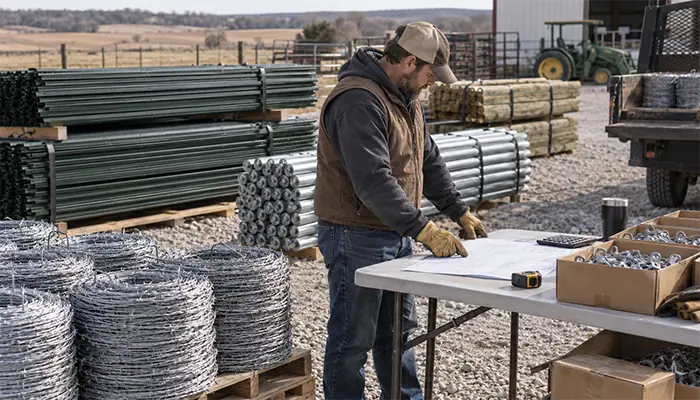
Confirm legal boundaries, underground and overhead utilities, drainage routes, road access, gates, corners, slopes, water crossings, and livestock movement. A drawing does not need to be complicated, but it should identify every point where the fence changes direction or experiences additional load.
Build Strong End and Corner Assemblies
Tension from the wire is transferred to the terminal, corner, and gate structures. If these assemblies move, every strand can lose alignment. The brace design, post depth, footing, and materials should suit the soil, wire tension, fence height, and local construction practice.
Set Line Posts for the Actual Site
Straight, level sections may support a different post arrangement from soft soil, sharp slopes, curves, dips, or high-pressure livestock areas. Extra posts or stays may be required where the ground changes. Do not use one spacing figure across an entire property without checking the terrain.
Tension the Strands Consistently
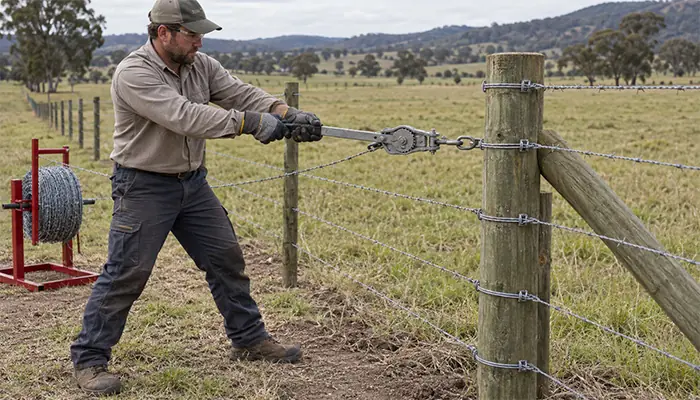
Slack wire reduces containment and can catch animals or equipment. Excessive tension can overload posts, fasteners, and joins. Use suitable strainers and follow the wire manufacturer’s recommendations, especially for high-tensile products. Each strand should be aligned and tensioned as part of the complete assembly.
Protect the Coating During Installation
Avoid dragging coated wire over abrasive ground or striking it with tools that remove zinc or polymer. Use compatible fasteners and do not crush the line wire. Inspect cut ends, joins, bends, and contact points before livestock enters the enclosure.
Common Buying and Installation Mistakes
- Comparing only the roll price: a cheaper coil may contain thinner wire, less zinc, less length, or a wider tolerance.
- Ordering by gauge alone: the gauge system may be unclear. Confirm the millimeter diameter.
- Ignoring tensile strength: wire behavior during installation and service depends on its steel grade and tensile range.
- Assuming every galvanized finish is equal: coating mass and consistency can vary.
- Using a weak corner brace: even good wire will lose tension when anchor assemblies move.
- Applying excessive tension: this can damage posts, fasteners, joins, or the wire itself.
- Using open strand spacing for small livestock: calves, goats, or sheep may require woven containment.
- Using barbed wire for an unsuitable animal: horse and high-contact enclosures need special attention to visibility and injury risk.
- Overlooking packaging: unsuitable wrapping or loading can damage coatings and complicate unloading.
- Accepting an incomplete quotation: every offer should identify material, diameter, barb design, spacing, coating, roll length, tolerance, and packaging.
Barbed Wire vs. Other Agricultural Fence Options
| Fence Type | Main Strength | Main Limitation | Typical Agricultural Use |
|---|---|---|---|
| Barbed wire | Economical coverage for long boundaries | Not suitable for every animal or high-contact area | Cattle pasture, ranch, and property boundary |
| Field fence | Graduated woven openings improve lower containment | Uses more material than simple horizontal strands | Calves, sheep, goats, deer, and mixed livestock |
| High-tensile smooth wire | Long runs and controlled tension | Requires correct system design and installation | Pasture division and selected livestock boundaries |
| Electric fence | Flexible livestock control and rotational grazing | Depends on energizer, grounding, vegetation control, and inspection | Internal paddocks and reinforced boundaries |
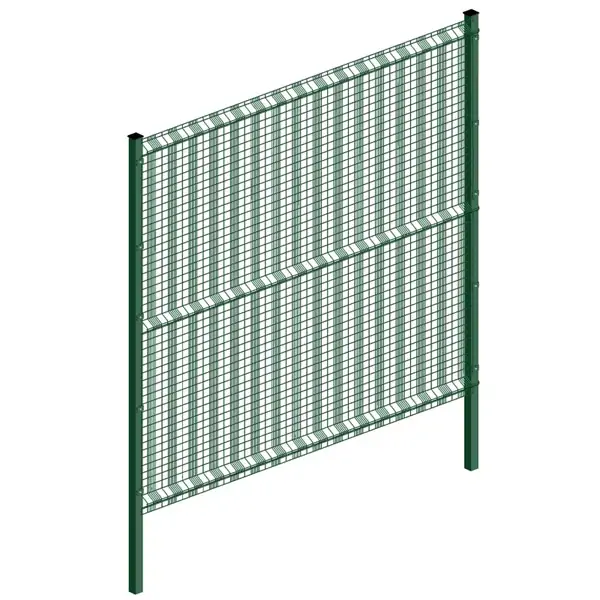
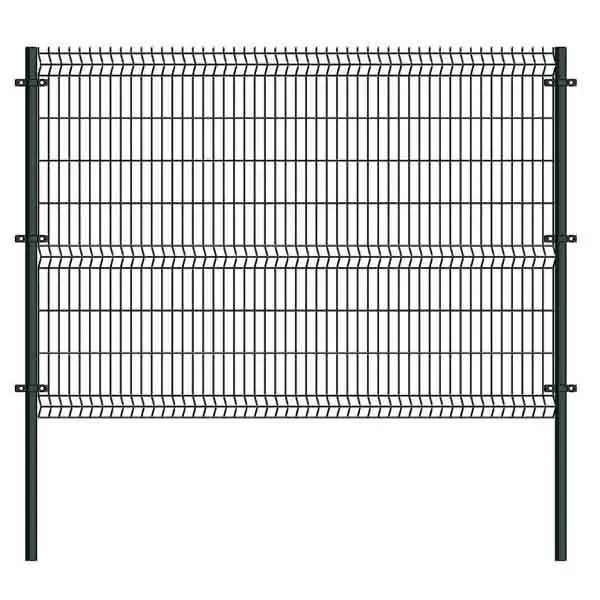
| Welded wire fence | Rigid and uniform openings | May be less adaptable to uneven terrain or repeated impact | Smaller enclosures and defined farm areas |
The best solution is sometimes a combination. A woven field fence can contain smaller livestock, while an upper or offset strand can discourage larger animals from leaning against it. Any combined design must account for animal safety, electrical components if used, post loading, total height, and local regulations.
How to Evaluate a Barbed Wire Supplier
A B2B buyer is not purchasing only a coil. The order also depends on specification control, repeatability, inspection, packing, documentation, and shipment coordination.
Check Manufacturing and Supply Capability
Ask how the supplier controls raw wire, wire drawing, twisting, barb forming, galvanizing or coating, coil winding, and final packing. If more than one facility is involved, clarify who is responsible for inspection and traceability. Capacity should be evaluated against the required quantity and delivery schedule.
Request Technical Documentation
A professional quotation should identify the steel type, line-wire diameter, barb-wire diameter, strand construction, barb-point count, spacing, tensile requirement, surface finish, coating requirement, roll length, tolerance, and packaging. Test reports or third-party inspection can be agreed where the project or buyer requires them.
Inspect Product Consistency
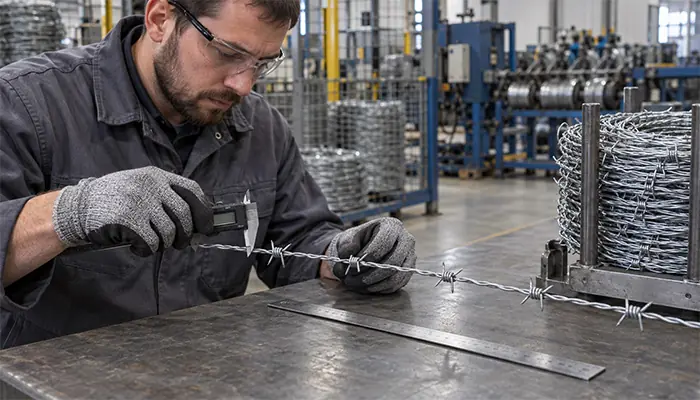
For a sample or pre-shipment inspection, check wire diameter, roll length, barb spacing, barb security, twist consistency, coating condition, coil winding, label information, and packaging. Random measurement across multiple coils is more useful than checking one display sample.
Confirm Export Packaging and Logistics
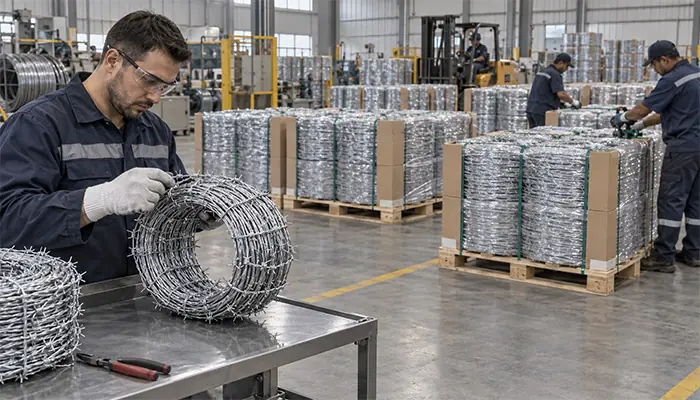
Compact coils are heavy and have sharp points. Packaging must protect the product, workers, other cargo, and coating during storage and transport. Confirm whether coils will be wrapped individually, supplied with handles, placed on pallets, loaded loose, or produced with custom labels. The final container quantity should be calculated from the approved coil size and actual weight, not from a generic catalogue estimate.
Send a Complete RFQ
To receive a useful quotation, send the supplier the following information:
- Livestock type and fence application
- Project fence length or order quantity
- Low-carbon or high-tensile requirement
- Line-wire and barb-wire diameters
- Two-point or four-point barb
- Barb spacing
- Galvanized or PVC-coated finish
- Zinc coating or polymer-coating requirement
- Length and target weight per roll
- Packaging, labeling, and pallet requirements
- Destination port and preferred Incoterm
How to Maintain an Agricultural Barbed Wire Fence
Inspect the fence at regular intervals and after storms, flooding, fallen branches, vehicle contact, or unusual livestock pressure. Pay particular attention to corners, gates, braces, low areas, water crossings, and locations where animals gather.
Look for:
- Loose, broken, or excessively tight strands
- Leaning or lifted posts
- Loose staples, clips, ties, and joiners
- Damaged galvanized or PVC-coated surfaces
- Corrosion around soil, manure, fertilizer, or irrigation exposure
- Vegetation loading the fence or hiding damage
- Sharp broken ends or repairs that could injure livestock
Retension only where necessary and according to the wire system. Replace severely corroded or repeatedly damaged sections rather than adding unsafe temporary repairs. Keeping compatible spare wire, fasteners, and joiners on the farm can reduce downtime.
Frequently Asked Questions
What is the best barbed wire for cattle?
A double-strand galvanized wire with consistent diameter, secure barbs, appropriate tensile strength, and adequate corrosion protection is a common choice for cattle. The correct barb type, strand layout, post spacing, and coating depend on the cattle, terrain, climate, boundary purpose, and local fencing practice.
Is high-tensile or low-carbon barbed wire better for a farm?
High-tensile wire can hold tension well over long runs but requires strong braces, appropriate tools, and trained installation. Low-carbon wire is generally easier to handle and splice. Neither is automatically better; select the grade that matches the complete fence design and installer capability.
How many strands of barbed wire are needed for a cattle fence?
The number of strands varies with cattle size, calf containment, fence height, terrain, animal pressure, local practice, and legal requirements. A fence professional should determine the layout for the specific property rather than applying one number to every cattle fence.
What gauge barbed wire is best for farm fencing?
Gauge names can differ by market, so the buyer should confirm the actual diameter in millimeters, along with the steel type, tensile range, coating, and tolerance. A thicker wire is not automatically the best choice if the rest of the fence system is poorly designed.
Does galvanized barbed wire rust?
Galvanizing delays corrosion by protecting the steel with zinc, but it does not make the wire permanently rust-proof. Coating mass, exposure, installation damage, contact with aggressive materials, and maintenance all affect service life.
Can barbed wire be installed above a field fence?
Yes, the combination is used in some agricultural fence designs. The posts and braces must support the complete load, and the total height, animal contact, strand position, tension, and local regulations must be considered.
How is the required number of rolls calculated?
Multiply the net fence length by the number of strands, add the project allowance, then divide by the verified length per roll. Always round up and include spare material for repairs and site variation.
What information should be included in a barbed wire RFQ?
Include the application, livestock type, steel grade, line-wire and barb-wire diameter, barb-point count, barb spacing, coating, roll length, quantity, packaging, destination port, and trade term. Clear specifications make supplier quotations comparable.
Final Recommendation
The best barbed wire for farms is the product that matches the animal, fence purpose, terrain, climate, post system, installation method, maintenance plan, and budget. For many cattle boundaries, a quality galvanized, double-strand wire is a practical solution. For calves, sheep, goats, horses, or high-contact areas, another farm fence or a combined system may be more appropriate.
Compare measurable specifications rather than price per roll alone. Confirm wire diameter, tensile strength, barb design, spacing, coating, roll length, tolerance, packaging, and inspection before placing a bulk order. Good wire still needs strong posts, dependable braces, correct tension, and safe installation.
Planning a cattle, ranch, or agricultural boundary project? Review the complete YESON barbed wire product range, or contact the YESON fencing team with your livestock type, fence length, preferred wire diameter, barb design, coating, roll length, order quantity, and destination. A specification-based quotation will give you a more accurate product, packaging, and shipping comparison.
 EN
EN  DE
DE  FR
FR  ES
ES  AR
AR  PT
PT