
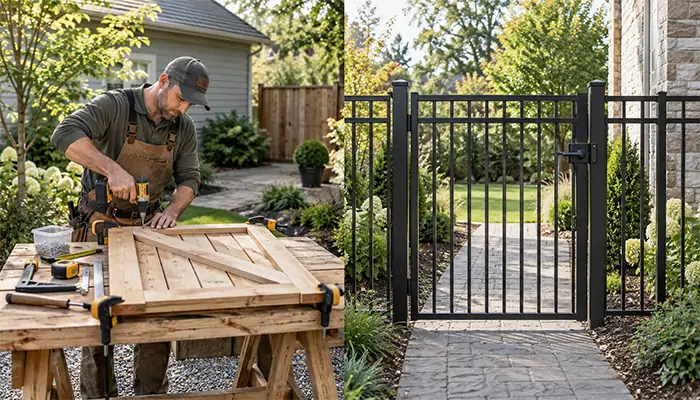
A fence gate is more than an opening in a boundary. It controls access, affects security and often receives more daily wear than any other part of a fence. A poorly built gate may sag, drag on the ground, fail to latch or place excessive stress on the gate posts.
When planning a new entrance, you normally have two options: build the gate yourself or buy a ready-made or custom gate from a manufacturer. Building may look less expensive, especially for a small residential project. Buying, however, can provide better dimensional accuracy, consistent quality and faster installation.
So, which option is better?
Quick answer: Building a fence gate can be suitable for a small garden or backyard project when you have the tools, materials and construction experience. Buying a factory-made gate is generally more practical for large openings, metal fences, security applications, commercial projects and bulk orders.
This guide compares both options based on cost, materials, installation, durability and customization.
What Is the Difference Between a Gate and a Fence?
Understanding the difference between a gate and a fence is important before comparing your options.
A fence is a fixed structure installed around a property, garden, farm, commercial facility or other controlled area. Its main functions are to define a boundary, improve security, provide privacy or contain animals.
A gate is the movable section that provides access through that fence. A complete gate system typically includes:
- A gate frame
- Infill material or pickets
- Gate posts
- Hinges
- A latch or locking system
- Fasteners and brackets
- Optional drop rods, wheels or automation components
In a gate vs. fence comparison, the gate experiences more movement and concentrated load. This means the gate posts, frame reinforcement and hardware must be designed for repeated opening and closing.
The gate should also match the surrounding fence in height, material, finish and security level. For example, a gate installed in a chain link fence system should use compatible mesh, posts, tension components and hardware.
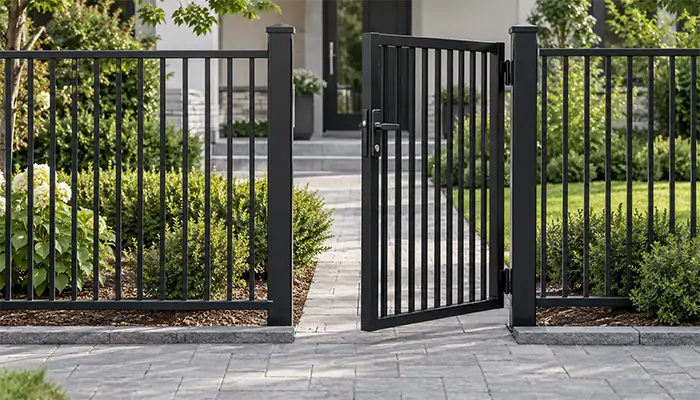
Build vs. Buy a Fence Gate: Quick Comparison
| Factor | Build the Gate Yourself | Buy a Fence Gate |
|---|---|---|
| Initial price | May be lower for simple designs | Higher upfront cost |
| Tools required | Cutting, drilling or welding tools | Basic installation tools |
| Skill level | Medium to high | Low to medium |
| Production time | Depends on experience | Manufactured before delivery |
| Size accuracy | Depends on workmanship | Controlled during production |
| Customization | Highly flexible | Available from custom manufacturers |
| Quality consistency | May vary | Better for multiple gates |
| Best application | Small DIY projects | Residential, commercial and bulk projects |
The best option is not always the one with the lowest purchase price. You should also consider installation time, maintenance, service life and the consequences of replacing an incorrectly sized gate.
Option 1: Building a Fence Gate Yourself
Building your own gate gives you direct control over its dimensions and appearance. It can be a practical choice when the opening is small, the design is simple and you already have suitable tools.
Advantages of Building a Fence Gate
Flexible Dimensions
A DIY gate can be adjusted to an existing opening, including unusual spaces where standard gate sizes may not fit.
Control Over Materials
You can choose the timber, steel tube, mesh, fasteners and finish separately. This is useful when you need to match an existing fence.
Potential Labor Savings
If you already own the tools and can complete the work correctly, you may reduce the amount spent on fabrication labor.
Suitable for Small Repairs
Building one simple back yard gate may be more convenient than replacing an entire fence section.
Disadvantages of Building a Fence Gate
It Requires the Right Skills
A wooden gate requires accurate measuring, cutting and bracing. A welded metal gate also requires suitable welding equipment and the ability to keep the frame square during fabrication.
Hidden Costs Can Increase the Budget
The total cost may include:
- Frame material
- Gate infill
- Hinges and latches
- Posts
- Concrete
- Paint or corrosion protection
- Cutting and drilling tools
- Welding equipment
- Rework and wasted material
After these costs are included, a DIY gate is not always cheaper than a factory-made product.
Gate Sagging Is a Common Risk
If the frame is not square or properly reinforced, gravity will gradually pull the free end downward. Incorrect hinge placement or weak gate posts can make this problem worse.
Surface Protection May Be Limited
Outdoor steel needs suitable corrosion protection. Applying ordinary paint to an unfinished steel frame is different from ordering a professionally galvanized or powder-coated gate.
How Do I Build a Garden Gate?
People searching “how do I build a garden gate?” should begin with the opening—not the gate itself. Accurate measurements and suitable posts determine whether the finished gate will operate correctly.
Step 1: Measure the Opening
Measure the clear distance between the two gate posts at the top, middle and bottom. Do not assume the opening is perfectly square.
Allow sufficient clearance for:
- The hinges
- The latch
- Seasonal material movement
- Uneven ground
- The required swing direction
The required allowance depends on the hinge and latch design. Confirm the hardware dimensions before cutting the gate frame.
Step 2: Select the Material
Common choices include:
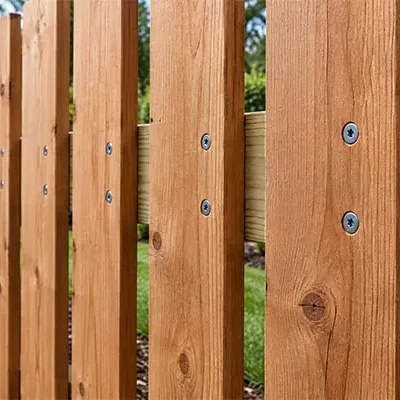
- Treated wood
- Galvanized steel tube
- Powder-coated steel
- Aluminum
- Chain link mesh
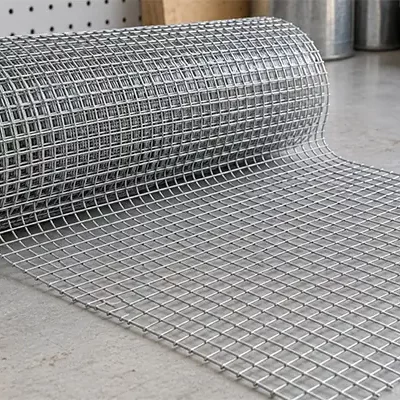
- Welded wire mesh
- Steel pickets or vertical blades
Wood is easy to cut and gives a traditional appearance. Steel offers greater structural strength, while aluminum provides a lightweight and corrosion-resistant alternative for suitable environments.
For a ready-made residential entrance, a powder-coated steel garden gate with lock can reduce fabrication work because the frame, hinges and locking hardware are designed as one system.
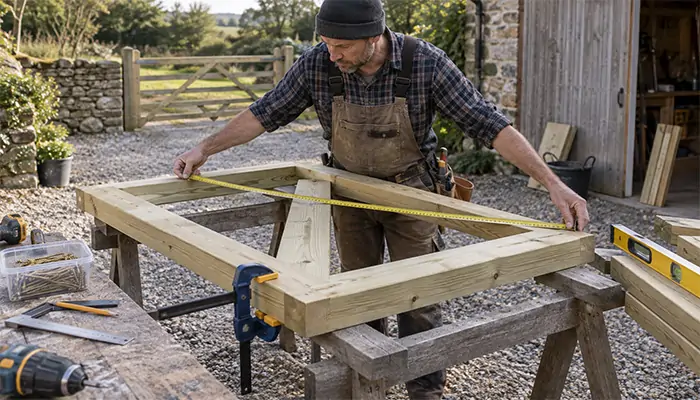
Step 3: Build a Square Frame
Construct the outer frame on a flat surface. Measure both diagonals before permanently fastening or welding the corners. When the two diagonal measurements are equal, the frame is square.
Step 4: Add Reinforcement
Install a diagonal brace or another suitable reinforcement system. On a typical braced gate, the diagonal support should transfer the load toward the lower hinge area. The reinforcement method may be different for welded steel frames.
Wide and heavy gates may require:
- Larger frame sections
- Additional horizontal rails
- Gusset plates
- Heavy-duty hinges
- A support wheel
- A double-gate configuration
Step 5: Install the Infill
Attach wooden boards, mesh, pickets or other infill material evenly. Confirm that the spacing is appropriate for the gate’s purpose, particularly when children, pets or livestock are present.
Step 6: Hang and Test the Gate
Install the hinges on a structurally adequate gate post. Check that the gate:
- Opens in the intended direction
- Clears the ground throughout its movement
- Remains level
- Does not bind against the post
- Aligns correctly with the latch
- Closes securely
Test the gate several times before completing the final adjustments.
How to Build a Gate for a Deck
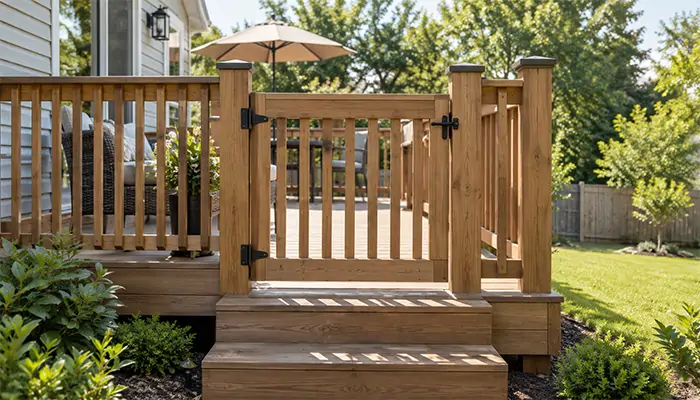
Anyone researching how to build a gate for a deck should treat safety as the main requirement. An elevated deck gate is not the same as a decorative garden entrance.
The gate must work with the existing railing system and may need to comply with local requirements governing gate height, opening direction, baluster spacing and latching position.
Consider the following points:
- Use exterior-grade, weather-resistant materials.
- Match the gate height and opening limitations to the surrounding railing.
- Avoid gaps that could create a risk for children or pets.
- Use corrosion-resistant fasteners.
- Consider self-closing hinges and a reliable latch.
- Confirm applicable building requirements before construction.
If the deck is high above the ground or used by children, professional fabrication and installation may be safer than an improvised DIY design.
Are DIY Metal Gate Kits Worth Buying?
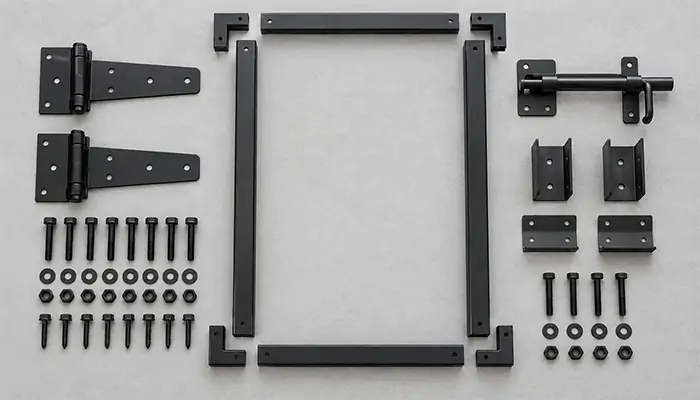
DIY metal gate kits sit between fully self-built gates and finished factory-made products. A kit may include frame components, corner connectors, hinges, fasteners and a latch.
Some kits allow the installer to cut the frame to the required width and add timber boards, metal pickets or mesh as the infill.
Benefits of a DIY Metal Gate Kit
- Less fabrication than building from raw material
- More consistent hardware compatibility
- No welding required for some systems
- Suitable for standard residential openings
- Easier transportation than a fully assembled gate
For modern residential and commercial boundaries, YESON’s blade fencing systems include panel, access-gate and hardware options, including DIY-oriented configurations.
Limitations of DIY Kits
A kit may not be appropriate when:
- The gate is unusually wide or tall.
- The opening is on a steep slope.
- A high security level is required.
- The gate will experience frequent commercial traffic.
- The frame must carry heavy infill.
- The project requires many identical gates.
- Automation will be added.
Before ordering a kit, confirm which components are included. Posts, concrete, infill material, drop rods and installation tools may need to be purchased separately.
Option 2: Buying a Ready-Made or Custom Fence Gate
Buying a gate is normally the simpler option when you need predictable dimensions, professional surface treatment or multiple matching units.
Ready-made products suit standard openings. Custom manufacturing is better when the project has specific requirements for dimensions, tube thickness, infill, color, opening direction or locking hardware.
Advantages of Buying a Fence Gate
Controlled Dimensions
Factory fabrication helps keep the gate square and ensures that repeated units have consistent dimensions. This is especially important for contractors, developers and distributors.
Professional Frame Construction
The manufacturer can select the frame sections, braces and hinges according to the gate size and intended application.
Better Surface-Treatment Options
Depending on the product, factory finishes may include:
- Hot-dip galvanizing
- Powder coating
- Galvanizing plus powder coating
- PVC coating
- Stainless steel
- Pre-treated aluminum
YESON’s tubular steel fencing range uses welded construction and offers galvanized and powder-coated options for corrosion protection.
Faster Site Installation
A preassembled gate normally requires less work on site than a gate built from individual raw materials. This can reduce installation time across large projects.
Matching Fence and Gate Systems
A supplier can manufacture the gate to match the surrounding panels, posts and finish. This is useful for ornamental boundaries, where a coordinated wrought iron fence and gate creates a more consistent appearance.
Disadvantages of Buying a Gate
- The initial purchase price may be higher.
- Custom products require production time.
- Large gates can increase freight costs.
- Incorrect measurements can still result in installation problems.
- The buyer must clearly communicate the required specifications.
These disadvantages can usually be controlled through accurate drawings, specification confirmation and suitable packaging.
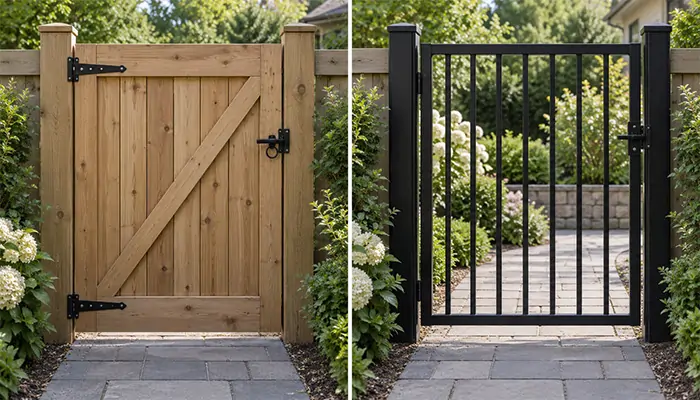
Wooden Gates vs. Metal Fence Gates
The material influences the gate’s strength, weight, maintenance and appearance.
| Feature | Wooden Gates | Metal Fence Gates |
|---|---|---|
| Appearance | Traditional and natural | Modern, decorative or industrial |
| Weight | Varies by wood and size | Varies by frame and infill |
| Maintenance | Requires sealing or painting | Generally lower with a suitable finish |
| Moisture response | May swell, warp or rot | Depends on metal and coating |
| Structural stability | Requires correct bracing | Welded frames offer good rigidity |
| Customization | Easy to cut on site | Factory customization available |
| Common applications | Gardens and backyards | Residential, agricultural and commercial sites |
When Should You Choose Wooden Gates?
Wooden gates work well when:
- The surrounding fence is made from wood.
- A traditional appearance is required.
- The gate is relatively small.
- The owner can perform regular maintenance.
- Privacy is more important than visibility.
When Should You Choose a Metal Gate?
A metal gate is often preferable when:
- Structural strength is a priority.
- The gate will be used frequently.
- The opening is large.
- Maintenance needs to be minimized.
- The project requires repeatable dimensions.
- The gate must match a metal security fence.
Is an 8ft Wooden Gate Practical?
An 8ft wooden gate can be practical, but its structure requires careful planning. A single gate leaf spanning 8 feet places considerable leverage on the hinges and gate post. Moisture changes can also affect the timber over time.
Possible solutions include:
- Use a strong metal frame behind the wood.
- Install heavy-duty adjustable hinges.
- Increase the gate-post size and foundation.
- Add effective diagonal bracing.
- Use a gate wheel where the surface permits.
- Divide the opening into two 4-foot leaves.
A double gate reduces the width and weight carried by each hinge set. For high-frequency or commercial access, a steel-frame double gate may offer better dimensional stability than a wide all-wood design.
Choosing a Gate for Different Applications
Outdoor Garden Gate
An outdoor garden gate should combine appearance, weather resistance and convenient operation. Consider whether it needs to contain pets, restrict children or provide a lockable entrance.
Powder-coated steel, galvanized mesh, aluminum and treated timber are common options. The right material depends on the local climate, surrounding fence and desired maintenance level.
Back Yard Gate
A back yard gate may be used by people, bicycles, lawn equipment or small vehicles. Before choosing the width, identify the largest item that needs to pass through the opening.
For better daily performance:
- Allow sufficient operating clearance.
- Avoid placing the gate where the ground rises in the swing direction.
- Choose a latch that can be operated from the required side.
- Use pet-safe spacing where necessary.
- Confirm privacy requirements before choosing the infill.
Agricultural Gate
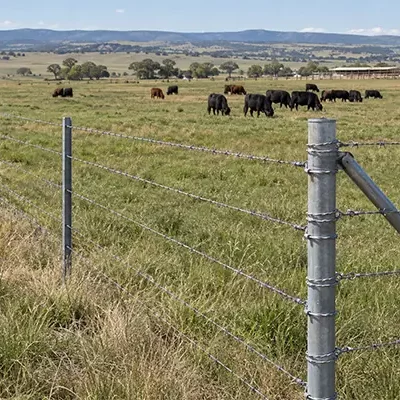
Farm gates must be selected according to the livestock, machinery and frequency of use. The posts and hinges need to resist animal pressure and repeated operation.
Buyers planning a complete agricultural boundary can combine a suitable gate with a customized field fence system.
Commercial and Industrial Gate
Commercial gates may require heavier frames, anti-climb infill, restricted-access locks or automation compatibility. They also need to withstand more frequent operation than a typical residential gate.
For these projects, purchasing a gate manufactured to an approved drawing is usually more reliable than fabricating individual gates on site.
Build vs. Buy: Which Option Costs Less?
A fair comparison should include the total installed cost—not just the gate price.
DIY Gate Cost Factors
- Raw frame material
- Timber, pickets or mesh
- Hinges and latch
- Gate posts
- Concrete
- Fasteners
- Cutting and welding tools
- Paint or surface treatment
- Labor time
- Material waste
- Repairs or adjustments
Purchased Gate Cost Factors
- Gate size
- Frame material and thickness
- Infill type
- Surface treatment
- Hardware
- Quantity
- Custom fabrication
- Packaging
- Freight
- Installation labor
Building may cost less for one small gate when the tools are already available. Buying often provides better overall value when the gate is large, the design is complex or the project requires multiple consistent units.
How to Evaluate Fence Gates for Sale
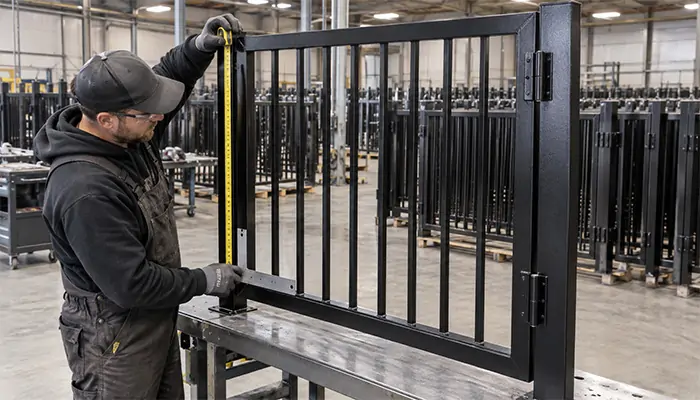
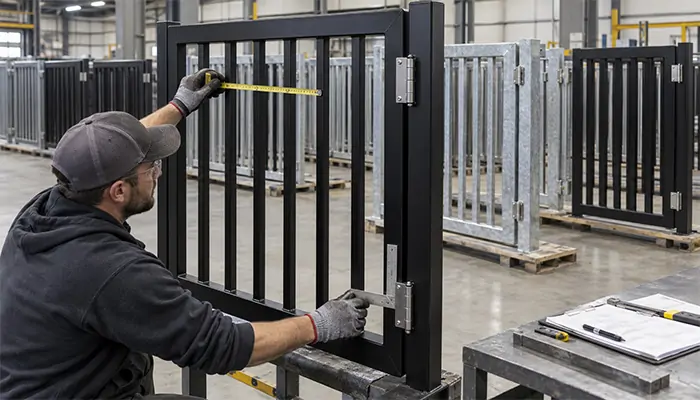
When comparing fence gates for sale, do not make a decision based only on the advertised width and price. Collect enough technical information to determine whether the gate is suitable for the complete fence system.
1. Confirm the Dimensions
Provide:
- Overall gate width
- Gate height
- Clear opening
- Single- or double-leaf design
- Ground clearance
- Opening direction
- Distance between posts
Clarify whether the stated width refers to the gate leaf, clear opening or total post-to-post dimension.
2. Specify the Frame
Confirm:
- Tube profile
- Tube dimensions
- Wall thickness
- Frame reinforcement
- Welding method
- Maximum expected load
3. Choose the Infill
Options may include chain link mesh, welded wire mesh, steel pickets, vertical blades, decorative bars, timber or sheet material.
The infill must match the required security, privacy and visibility.
4. Select the Surface Treatment
The correct finish depends on humidity, salt exposure, temperature, maintenance expectations and required color.
For chain link projects, galvanized and PVC-coated materials are common choices. Buyers can review the available specifications on YESON’s chain link fence supplier page.
5. Check the Hardware
Ask whether the quotation includes:
- Hinges
- Latch
- Lock
- Drop rods
- Gate stops
- Posts
- Post caps
- Mounting plates
- Bolts and brackets
Heavy gates require hinges and posts with suitable load capacity.
6. Evaluate the Supplier
B2B buyers should also confirm:
- Manufacturing capability
- Drawing approval process
- Quality-control procedure
- Customization options
- Minimum order quantity
- Sample availability
- Production lead time
- Packaging
- Export documentation
- After-sales support
Provide the application and expected order quantity when requesting a quotation. This helps the manufacturer recommend a suitable structure instead of quoting only the lowest-cost configuration.
Common Fence Gate Mistakes
Avoid these common problems whether you build or buy:
- Measuring the opening only once.
- Failing to allow space for hinges and the latch.
- Using undersized gate posts.
- Installing posts before confirming the gate dimensions.
- Ignoring the ground slope.
- Hanging a wide gate without adequate bracing.
- Selecting hardware based only on appearance.
- Using untreated steel outdoors.
- Ordering multiple gates without an approved drawing or sample.
- Forgetting to confirm whether the gate opens inward or outward.
If the gate will be installed with chain link mesh, follow a complete chain link fence installation guide to coordinate the gate posts, terminal posts, rails and tension components.
Final Verdict: Should You Build or Buy a Fence Gate?
Build the gate yourself when the project is small, the design is simple and you have the necessary tools and experience. A garden or back yard gate can be a manageable DIY project if the posts, frame and hardware are correctly selected.
Consider a DIY metal gate kit when you want some customization without manufacturing every component from raw material.
Buy a ready-made or custom gate when:
- The opening is large.
- The gate is heavy.
- Security is important.
- Professional corrosion protection is required.
- Several matching gates are needed.
- The project has a construction schedule.
- The gate must match a commercial fence system.
- Accurate drawings and repeatable specifications are required.
For most B2B projects, buying from a fence manufacturer offers better consistency, easier project planning and lower installation risk.
Frequently Asked Questions
Is It Cheaper to Build or Buy a Fence Gate?
Building may be cheaper for a small gate if you already own the tools. For larger or more complex gates, material waste, fabrication labor, hardware and surface treatment can make a purchased gate more cost-effective.
How Do I Build a Garden Gate That Will Not Sag?
Use a square frame, adequate diagonal reinforcement, correctly sized hinges and a strong gate post. The gate material and width must also be considered when selecting the frame.
What Is the Difference Between a Gate and a Fence?
A fence is the fixed boundary structure. A gate is the movable access point installed within that boundary. The two must be compatible in height, material, structure and security level.
Are DIY Metal Gate Kits Suitable for Commercial Projects?
They may work for light-duty, standard openings. High-traffic, heavy-duty or security projects normally require a gate designed for the specific site and operating conditions.
Is an 8ft Wooden Gate Too Wide?
An 8-foot single wooden gate can be vulnerable to sagging. Strong bracing, heavy-duty hinges and a reinforced post are required. A double-gate configuration or metal supporting frame may be more reliable.
What Is the Best Material for an Outdoor Garden Gate?
Treated wood provides a traditional look, while galvanized steel, powder-coated steel and aluminum generally require less maintenance. The best choice depends on the climate, gate size, surrounding fence and expected use.
Can Fence Gates Be Customized for Bulk Orders?
Yes. A custom manufacturer can normally adjust the size, frame, infill, surface treatment, color, hardware and packaging. Buyers should supply drawings, application details and quantities to receive an accurate proposal.
Request a Custom Fence Gate Quote
The right fence gate should fit the opening, support the required level of security and operate reliably throughout its service life.
YESON supplies fence and gate solutions for residential, agricultural, commercial and industrial projects. Custom dimensions, materials, finishes and accessories are available according to project requirements.
Contact YESON with your gate width, height, material, quantity, application and preferred surface treatment to request a customized quotation.
 EN
EN  DE
DE  FR
FR  ES
ES  AR
AR  PT
PT