

In laboratories, construction sites, food factories, mining plants, and agricultural processing lines, one simple tool plays a critical role in particle size control: the sieve.
Whether you are grading sand, testing cement, classifying minerals, analyzing powders, or controlling flour quality, understanding how a sieve works — and how to select the right one — directly affects accuracy, efficiency, and product quality.
This practical guide explains what a sieve is, how sieving works, sieve sizes, sieve numbers, mesh openings, materials, standards, and how to choose the correct sieve for your application.
Definition of a Sieve (What is a Sieve?)
A sieve is a precision tool used to separate, classify, or grade particles by size using a wire mesh or perforated plate with uniform openings.
The process is called sieving.
As material passes over the mesh surface:
- Particles smaller than the openings pass through
- Particles larger than the openings are retained
Sieving is one of the oldest and most reliable particle size analysis methods used in science and industry.
Sieve vs Mesh vs Screen
| Term | Meaning |
|---|---|
| Sieve | Complete tool (frame + mesh) used for particle separation |
| Mesh | Woven wire grid inside the sieve |
| Screen | General industrial term, often for large-scale separation |
How a Sieve Works: Structure and Sieving Principle
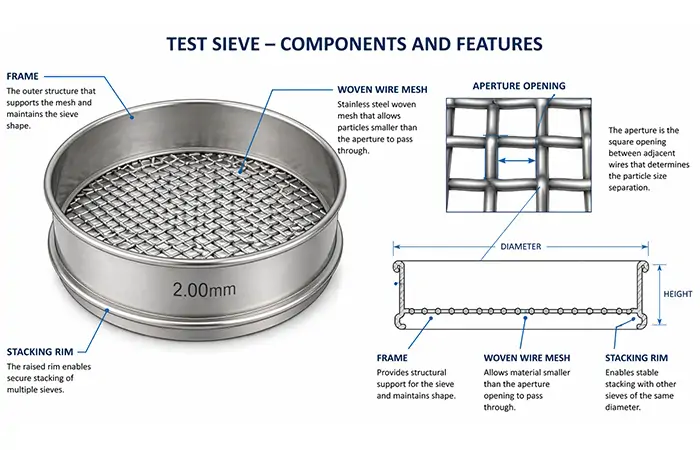
A standard sieve consists of:
- Frame – usually stainless steel or brass
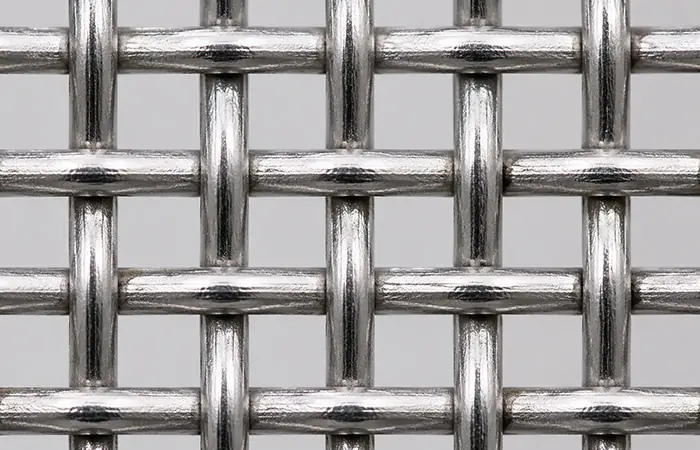
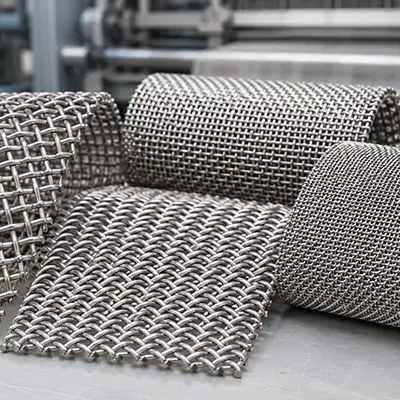
- Woven wire mesh – precisely manufactured openings
- Uniform aperture size – controlled by standards
- Stackable design – for multi-level separation
When material is agitated manually or mechanically, particles orient and pass through the square openings based on size.
Key Concept: Aperture (Sieve Opening)
The aperture is the clear square space between wires. This is what determines particle separation — not the number of wires.
Types of Sieves Used in Industry and Laboratories
1. Laboratory Test Sieve
Used for precise particle analysis in labs.
2. Mechanical / Vibratory Sieve
Used with sieve shakers for automated testing.
3. Fine Mesh Sieve
For powders, flour, chemicals, and fine particles.
4. Industrial Sieves
Larger diameter for bulk materials like sand, gravel, minerals.
5. Hand Sieves
Manual operation for simple grading.
Understanding Sieve Mesh, Opening, and Sieve Number
This is where most confusion occurs.
What is Sieve Number?
The sieve number represents how many openings exist per linear inch of mesh.
Example:
100 mesh sieve = 100 openings per inch.
However, sieve number alone does NOT define the opening size.
Relationship Between Mesh, Wire Diameter, and Opening
Opening size depends on:
This is why two sieves with the same mesh count but different wire thickness have different openings.
Sieve Size Chart (Mesh, Opening, and Standards)
Sieve sizes are standardized by ASTM International under ASTM E11.
| Sieve No. | Opening (mm) | Opening (µm) |
|---|---|---|
| 4 | 4.75 | 4750 |
| 10 | 2.00 | 2000 |
| 20 | 0.85 | 850 |
| 40 | 0.425 | 425 |
| 60 | 0.250 | 250 |
| 100 | 0.150 | 150 |
| 200 | 0.075 | 75 |
How to Read the Chart
- Larger sieve number → smaller opening
- Smaller sieve number → larger opening
This chart is essential when selecting sieves for particle testing.
Sieve Materials: What Metal is Used for Making a Sieve?
Material selection depends on environment, corrosion resistance, and industry.
| Material | Use Case |
|---|---|
| Stainless Steel 304 | General laboratory and industrial use |
| Stainless Steel 316 / 316L | Chemical, marine, corrosive materials |
| Brass | Traditional lab sieves, non-sparking |
| Nylon / Synthetic | Food, pharmaceuticals, fine powders |
Stainless steel is the most common due to durability and corrosion resistance.
Standard Dimensions and Construction of a Sieve
Common standard diameters:
- 8 inch (203 mm)
- 12 inch (305 mm)
- 200 mm (metric standard)
Standard features:
- Uniform frame height for stacking
- Tight mesh tension mounting
- Smooth interior to prevent material retention
Sieves are designed to be stacked into a sieve set for graded separation.
Order of Sieves in Sieving (Correct Sieve Stack Arrangement)
Proper stacking order is critical.
Rule: Arrange from largest opening at the top to smallest at the bottom.
Example stack:
This allows progressive separation of particles by size.
Sieve Uses Across Industries
Construction
- Sand grading
- Cement testing
- Aggregate classification
Food Industry
- Flour sieving
- Powder sugar
- Grain grading
Mining & Minerals
- Ore classification
- Mineral particle testing
Agriculture
- Seed cleaning
- Soil analysis
Laboratories
- Particle size distribution analysis
How to Choose the Right Sieve (Practical Buying Guide)
Step 1 — Identify Particle Size Range
Know the approximate smallest and largest particles.
Step 2 — Select Correct Sieve Numbers
Use ASTM sieve chart to match openings.
Step 3 — Choose Material
Corrosive? Food-grade? General use?
Step 4 — Select Diameter
Lab testing → 8 inch or 200 mm
Industrial → 12 inch or larger
Step 5 — Decide: Single Sieve or Sieve Set
Particle analysis requires a full stack.
Frequently Asked Questions About Sieves
Is “seive”, “sive”, or “siv” correct?
No. Correct spelling is sieve.
Is sieve size the same as mesh size?
No. Mesh count ≠ opening size.
Can sieve size determine particle size?
Yes. It defines the maximum particle that can pass.
What is a lab test sieve?
A precision sieve manufactured to ASTM E11 standards for accurate particle testing.
Conclusion: Correct Sieve Selection Improves Testing Accuracy
A sieve may appear simple, but selecting the wrong sieve number, material, or size leads to inaccurate results, wasted time, and inconsistent product quality.
Understanding:
- Sieve opening
- Sieve number
- Mesh vs aperture
- ASTM standards
- Proper stacking order
ensures reliable particle size control across construction, food processing, mining, agriculture, and laboratories.
When chosen correctly, a sieve becomes a precision measurement instrument, not just a mesh tool.

 EN
EN  DE
DE  FR
FR  ES
ES  AR
AR  PT
PT