
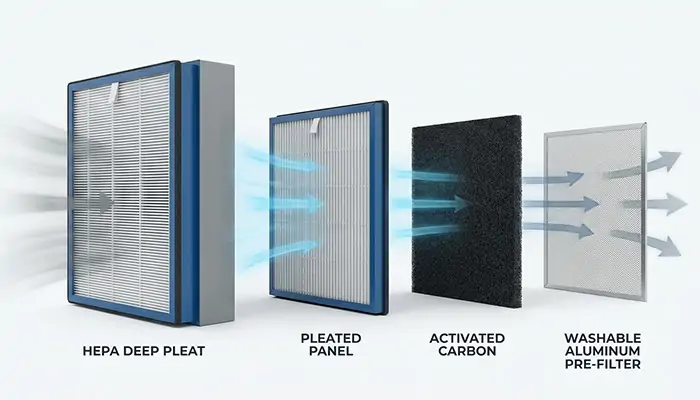
Air filters are fundamental components in ventilation, HVAC, air purification, industrial processing, and automotive systems. Whether the goal is protecting human health, safeguarding equipment, or meeting clean-air standards, selecting the correct filter type and filter media determines overall system performance.
This guide explains what air filters are, how they work, what they are made of, the different types available, and how to choose the right one for each application.
What Is an Air Filter? (Definition)
An air filter is a device designed to remove solid particles and contaminants from the air stream before the air reaches a room, machine, engine, or clean environment.
Air filters are used to remove:
- Dust and suspended particles
- Pollen and allergens
- Mold spores and bacteria
- Smoke and fine particulates (PM2.5 / PM10)
- Odors and chemical vapors (with carbon media)
Air filtration differs from air purification. Filtration physically traps particles through media structure, while purification may involve UV, ionization, or chemical treatment.
How Does an Air Filter Work? (Air Filtration Process)
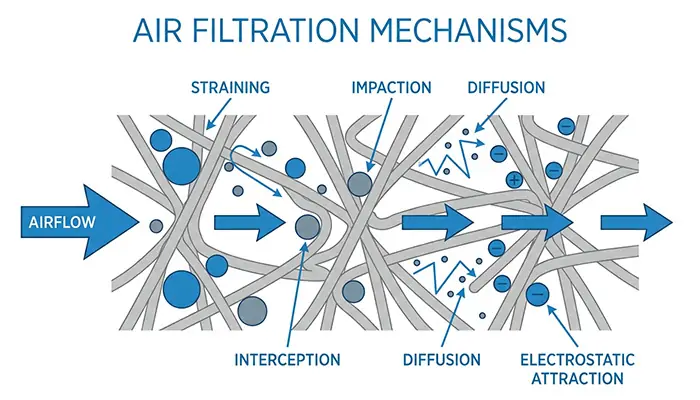
Air filters rely on a combination of mechanical and physical capture principles:
- Straining (Sieving) – Large particles are blocked by openings in the media.
- Interception – Particles following airflow paths touch fibers and stick.
- Impaction – Heavier particles cannot follow airflow and collide with fibers.
- Diffusion – Very fine particles move randomly and are captured by fibers.
- Electrostatic Attraction – Charged fibers attract dust particles.
The smaller the particle size, the more important diffusion and electrostatic effects become—this is how HEPA-class filters capture ultrafine particles.
Parts of an Air Filter
A typical air filter consists of:
- Frame – Cardboard, metal, or plastic structure holding the media
- Filter Media – The material that captures particles
- Support Mesh / Backing – Prevents media deformation under airflow
- Seal / Gasket – Prevents air bypass leakage
Understanding these parts is important when selecting filters for HVAC systems, air purifiers, or industrial ventilation.
What Are Air Filters Made Of? (Filter Media & Materials)
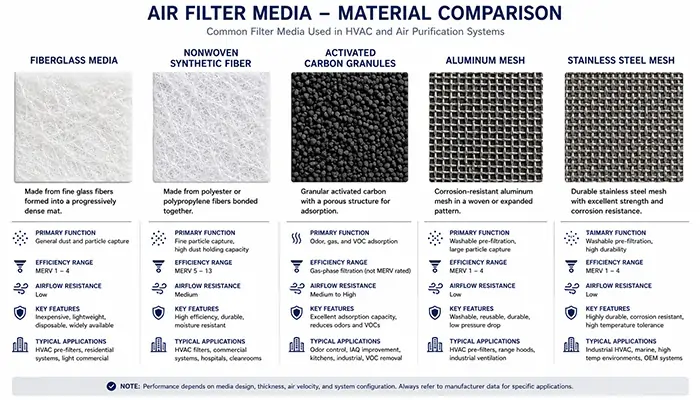
Filter performance is primarily determined by the filter media.
Common air filter materials include:
| Filter Media | Characteristics | Typical Use |
|---|---|---|
| Fiberglass | Low cost, basic dust capture | Furnace / basic HVAC |
| Synthetic fiber (non-woven) | Higher efficiency, longer life | HVAC, ventilation |
| Pleated polyester/cotton | Large surface area, good airflow | Home & commercial HVAC |
| Activated carbon | Odor and gas adsorption | Air purifiers, kitchens |
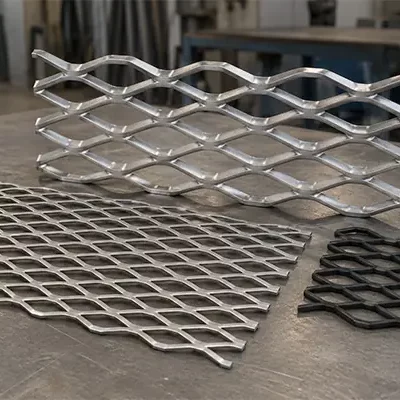
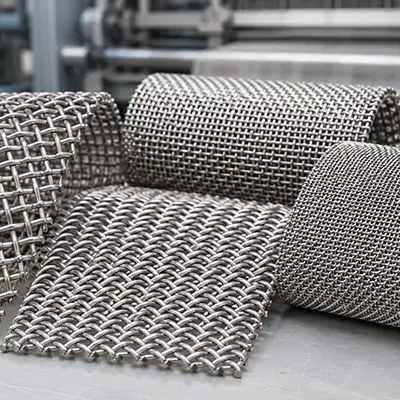
| Aluminum / stainless steel metal mesh | Washable, reusable, pre-filtration | HVAC pre-filters, industrial systems |
| HEPA micro-glass fiber | Ultra-fine particle capture | Cleanrooms, medical, labs |
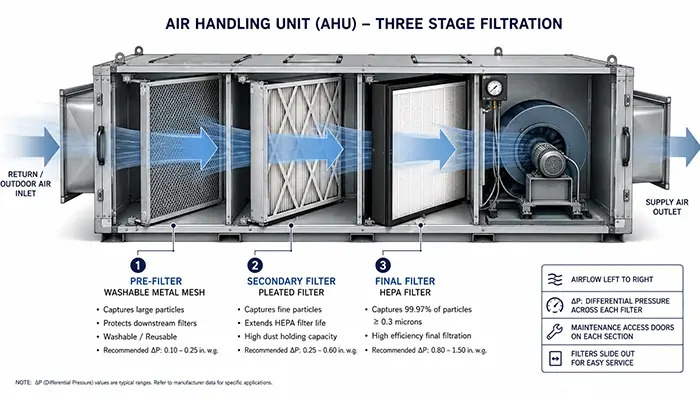
Metal mesh filter media is widely used as a washable pre-filter to capture large particles before air reaches fine filters, significantly extending HEPA/HVAC filter lifespan.
Different Types of Air Filters (Main Classification)
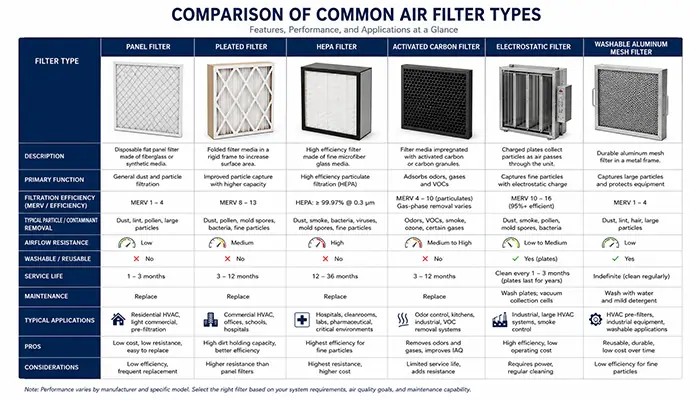
Air filters can be categorized into:
1. Panel Filters
Flat, simple filters for basic dust removal.
2. Pleated Filters
Folded media increases surface area and efficiency.
3. HEPA Filters
Capture 99.97% of particles ≥0.3 microns.
4. Washable / Metal Mesh Filters
Reusable filters used as primary or pre-filters.
5. Electrostatic Filters
Use static charge to attract particles.
6. Carbon Filters
Remove odors, fumes, and gases.
HEPA, HVAC, and Ventilation Air Filters Explained
In ventilation systems, filters are often classified by MERV or HEPA standards:
- MERV 1–8: Basic residential dust control
- MERV 9–13: Commercial buildings, better fine particle capture
- MERV 14–16: Hospitals, laboratories
- HEPA: Cleanrooms, medical, pharmaceutical environments
HVAC systems typically use a metal mesh pre-filter + pleated filter + optional HEPA stage for optimal lifespan and performance.
Air Filters by Application (Where They Are Used)
Air filters are selected based on the environment:
| Application | Recommended Filter Type |
|---|---|
| Home HVAC / Furnace | Pleated + carbon optional |
| Commercial HVAC | Metal mesh pre-filter + pleated |
| Cleanrooms / Hospitals | HEPA + pre-filtration |
| Industrial ventilation | Washable metal mesh + pocket filters |
| Automotive engine | Specialized automotive panel media |
| Air purifiers | HEPA + carbon |
What Do Air Filters Actually Remove?
Air filters can remove:
- Dust and sand particles
- Pollen and allergens
- Mold spores
- Bacteria and fine aerosols
- Smoke particles (PM2.5)
- Cooking odors and VOCs (with carbon)
Air Filter vs Air Purifier
| Air Filter | Air Purifier |
|---|---|
| Passive particle removal | May include UV / ionization |
| Installed in HVAC / systems | Standalone device |
| Focus on airflow filtration | Focus on room air treatment |
Most air purifiers still rely on HEPA and carbon filters, meaning filtration remains the core technology.
How to Choose the Right Air Filter (Buying Guide)
When selecting an air filter, consider:
- Particle size to be removed
- Airflow resistance (pressure drop)
- System type (HVAC, purifier, industrial, automotive)
- Filter media material
- MERV or HEPA rating
- Washable vs disposable
- Replacement cycle and maintenance cost
For HVAC and industrial systems, using a washable metal mesh pre-filter can reduce operating cost by protecting expensive secondary filters.
FAQs About Air Filters
What is an air filter made of?
Typically fiberglass, synthetic fiber, carbon, or metal mesh depending on purpose.
How many types of air filters are there?
Panel, pleated, HEPA, carbon, electrostatic, and washable metal mesh filters are the main types.
How does an air filter work?
By trapping particles through interception, impaction, diffusion, and electrostatic attraction.
Are HEPA filters worth it?
Yes, for environments requiring ultra-clean air such as medical or laboratory use.
What is filter media?
The core material inside the filter responsible for capturing contaminants.
Conclusion
Air filters play a critical role in maintaining air quality, protecting equipment, and improving health outcomes. Understanding types, materials, and applications allows engineers, contractors, and buyers to select the most cost-effective and efficient solution.
For HVAC and industrial ventilation systems, combining metal mesh pre-filters with high-efficiency secondary filters is a proven strategy to improve performance and reduce maintenance cost.




 EN
EN  DE
DE  FR
FR  ES
ES  AR
AR  PT
PT