
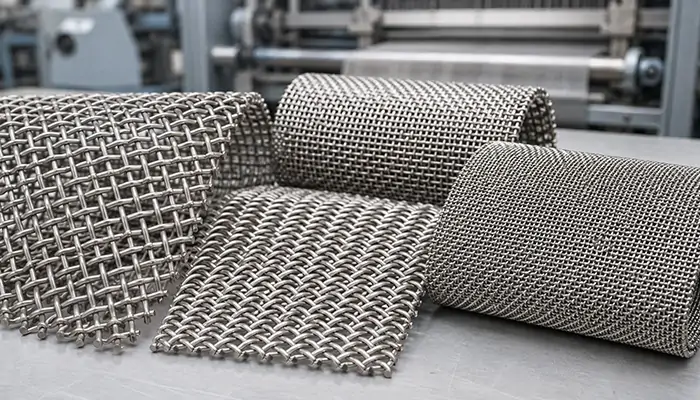
Wire cloth may look simple, but its performance depends heavily on how the metal wires are woven. Two meshes made from the same stainless steel and with a similar mesh count can behave very differently when their weave patterns change.
The weave determines the opening structure, filtration accuracy, mechanical strength, flexibility, open area and resistance to pressure. Selecting the wrong pattern can result in insufficient flow, premature mesh failure, excessive pressure drop or inaccurate particle separation.
This guide explains the main types of wire cloth weaves, including plain weave, twill weave, Dutch weave, reverse Dutch weave and crimped patterns. It also provides a practical selection process for industrial buyers, engineers and equipment manufacturers.
If you first need a broader introduction to terminology, materials and manufacturing, read our guide to wire cloth types, uses and production processes.
Table des matières
ToggleQuick Answer: Which Wire Cloth Weave Should You Choose?
The right choice depends on the material being processed and the required performance:
- Choose plain weave for general screening, sieving and applications requiring regular square openings.
- Choose twill weave when a finer mesh or heavier wire is required at a similar mesh count.
- Choose plain Dutch weave for controlled liquid or gas filtration.
- Choose twilled Dutch weave for finer filtration and greater strength under pressure.
- Choose reverse Dutch weave for continuous filtration belts and polymer extrusion.
- Choose crimped wire mesh for mining, quarrying, aggregate screening and other heavy-duty applications.
There is no single best wire cloth weave for every project. Filtration accuracy, flow rate, pressure, material, wire diameter and operating environment must be evaluated together.
What Is a Wire Cloth Weave?
Wire cloth is produced by interlacing metal wires in a repeated pattern. It is also commonly called woven wire mesh, wire fabric, industrial wire cloth or metal cloth.
The longitudinal wires are known as warp wires. The wires running across the width are called weft, fill or shute wires. During production, the shute wires pass over and under the warp wires according to a specified sequence.
The basic principle is similar to traditional fabric weaving patterns, but weaving with metal requires specialized looms, controlled wire tension and precise wire diameters. Small changes in the wire pattern can significantly alter the finished mesh.
Wire cloth should not be confused with welded wire mesh. In woven mesh, the wires interlock mechanically. In welded mesh, intersecting wires are permanently joined by welding. Woven wire cloth is generally more flexible and can be produced with much finer openings, making it particularly suitable for filtration, sieving and particle separation.
Why Do Wire Weave Patterns Matter?
Different weave patterns are not merely visual variations. They determine how the mesh performs inside a filter, sieve, screen or processing machine.
Opening Size and Particle Retention
In square woven mesh, the clear opening between adjacent wires determines the size of particles that can pass through. The opening is affected by both mesh count and wire diameter.
A higher mesh count does not automatically mean better performance. If the wire diameter changes, two meshes with the same mesh count can have different aperture sizes and open areas.
Dutch weave products do not have simple square openings. Their wires create an indirect filtration path, so they are generally specified by nominal or absolute micron rating rather than only by mesh count.
Open Area and Flow Rate
Open area is the percentage of the mesh surface available for air, liquid or particles to pass through. A larger open area normally supports a higher flow rate and lower initial pressure drop.
However, maximizing open area is not always the correct objective. A mesh with very high open area may use thinner wires, reducing mechanical strength and service life. A dense weave may provide better particle retention but create greater resistance to flow.
The selection process must therefore balance filtration accuracy, flow capacity and structural stability.
Strength and Dimensional Stability
Wire diameter, material and weave structure all affect strength. Twill and Dutch weaves can accommodate combinations of wire diameter and mesh count that may not be practical with a standard plain weave.
For coarse screening applications, pre-crimped wires help prevent movement at the intersections. This keeps large openings stable when the screen is exposed to vibration, impact or heavy material.
Flexibility and Fabrication
Fine woven wire cloth can be rolled, cut, stamped, pleated or formed into filter elements. The weave must remain stable during these operations.
A highly rigid mesh may be suitable for a flat screen but difficult to form into a cylindrical filter. A very flexible mesh may be easy to shape but require a support layer to resist operating pressure.
Surface Characteristics and Cleaning
Some woven patterns have a smoother working surface than others. Surface structure affects material movement, clogging, abrasion and cleaning.
For example, flat top crimped mesh provides a relatively smooth surface on one side, while dense Dutch weave produces a fine filtration structure without conventional square openings.
Main Types of Wire Cloth Weaves
1. Plain Weave
Plain weave is the most widely used wire cloth pattern. Each shute wire passes alternately over one warp wire and under the next. The following row repeats the sequence in the opposite position.
This creates a balanced structure with square or rectangular openings.
Advantages of Plain Weave
- Simple and economical construction
- Uniform and measurable openings
- Relatively high open area
- Good flow characteristics
- Suitable for a wide range of materials
- Easy to inspect and specify
Limitations of Plain Weave
At very high mesh counts, there may not be enough space to use the required wire diameter. A thinner wire can increase open area, but it may also reduce strength.
In these situations, a twill weave may allow a more suitable combination of mesh count and wire diameter.
Applications typiques
Plain weave wire cloth is commonly used for:
- General sieving and screening
- Particle grading
- Insect screens
- Machine guards
- Filtration de l'air et des liquides
- Tamis de laboratoire
- Food processing screens
- Filter support layers
Plain weave is often the starting point when a project requires precise square openings without unusually high pressure or mechanical load.
2. Twill Weave
In a twill weave, each shute wire passes over two and under two warp wires. The pattern is offset in each successive row, creating a diagonal appearance.
Because the wires pass over and under pairs of adjacent wires, twill weave can accommodate heavier wire diameters at a given mesh count. This can produce a stronger and denser woven structure.
Advantages of Twill Weave
- Allows heavier wires in relatively fine mesh
- Higher mechanical strength than comparable plain weave
- Good stability under load
- Suitable for finer openings
- Greater flexibility in mesh-count and wire-diameter combinations
Limitations of Twill Weave
The more complex structure may reduce open area compared with an equivalent plain weave. It may also have a different surface profile and pressure-drop characteristic.
Applications typiques
Twill weave is used for:
- Fine industrial screening
- High-load sieving
- Maille de support du filtre
- Petroleum processing
- Filtration chimique
- Applications requiring fine mesh with improved strength
When plain weave cannot accommodate the desired wire diameter, twill weave is often the next option to evaluate.
3. Plain Dutch Weave
Plain Dutch weave uses different wire diameters and mesh counts in the warp and shute directions. The warp wires are normally coarser, while finer shute wires are woven tightly together.
Instead of creating straight square openings, the closely spaced wires form an indirect filtration path. This makes plain Dutch weave suitable for controlled particle retention.
Advantages of Plain Dutch Weave
- Fine filtration capability
- Strong and stable structure
- Good resistance to deformation
- Surface lisse
- Consistent filtration performance
- Suitable for liquid and gas processing
Limitations of Plain Dutch Weave
The dense structure produces less open area than standard square mesh. It may therefore create a higher pressure drop and require careful evaluation of the required flow rate.
Applications typiques
- Oil filtration
- Fuel filtration
- Systèmes hydrauliques
- Traitement chimique
- Food and beverage filtration
- Water treatment
- Pressure and vacuum filters
For detailed specifications, available mesh combinations and filtration ratings, see our stainless steel Dutch woven filter mesh.
4. Twilled Dutch Weave
Twilled Dutch weave combines the dense construction of Dutch weave with the over-two, under-two sequence of twill weaving.
This structure allows finer shute wires to be packed closely while maintaining support from stronger warp wires. It can achieve finer filtration ratings and greater mechanical strength than many plain Dutch constructions.
Advantages of Twilled Dutch Weave
- Very fine particle retention
- Résistance mécanique élevée
- Suitable for higher operating pressure
- Stable under demanding processing conditions
- Available in fine micron ratings
Limitations of Twilled Dutch Weave
Its dense structure can create a relatively high pressure drop. Cleaning may also be more difficult when sticky, fibrous or highly contaminated materials become trapped in the filtration paths.
Applications typiques
- Fine oil filtration
- Hydraulic and fuel systems
- Chemical fiber production
- Aerospace filtration components
- Polymer processing
- High-pressure process filters
- Pharmaceutical and food-processing equipment
A trial sample or filtration test is recommended when flow rate and pressure drop are critical.
5. Reverse Dutch Weave
Reverse Dutch weave reverses the wire arrangement used in conventional Dutch mesh. It generally contains many fine warp wires and fewer, heavier shute wires.
The heavier wires provide strength across the width, while the numerous warp wires create elongated filtration paths. Reverse Dutch mesh is frequently manufactured as continuous filter belts.
Advantages of Reverse Dutch Weave
- High mechanical stability
- Good resistance to pressure and abrasion
- Suitable for continuous operation
- Accurate belt width and stable edges
- Can withstand the tension of automatic filtration equipment
Applications typiques
- Plastic and rubber extrusion
- Continuous screen changers
- Polymer melt filtration
- Pressure leaf filters
- Automatic filtration belts
- Industrial process filtration
When selecting reverse Dutch weave, buyers should specify not only mesh count and wire diameter but also belt width, edge treatment, roll length, tensile requirements and equipment type.
6. Crimped Wire Weave Patterns
Crimped wire mesh is generally used for larger openings and heavier wire diameters. The wires are formed into regular bends before or during weaving, helping them remain in position.
YESON supplies treillis métallique ondulé en acier inoxydable in different materials and crimping patterns for screening, guarding and industrial processing.
Double Crimp
In double crimp mesh, the warp and shute wires are crimped at their intersections. It is suitable when the opening size is relatively small compared with the wire diameter.
Typical uses include general industrial screening, guards and partitions.
Lock Crimp
Lock crimp wire mesh uses defined crimps at each intersection to lock the wires firmly in place. The pattern produces stable openings and good dimensional control.
It is commonly used for mining screens, vibrating screens, aggregate processing, architectural panels and heavy-duty guards.
Intercrimp
Intercrimp mesh has additional crimps between wire intersections. This construction is useful when a relatively large opening must be produced with a smaller wire diameter.
The extra crimps help maintain the position of the wires and improve opening consistency.
Flat Top Weave
Flat top mesh has most of its wire crimps positioned on one side, leaving the opposite side relatively smooth.
The smooth working surface can improve material movement and reduce abrasion or clogging in certain screening and conveying applications.
7. Stranded or Multiplex Weave
Stranded weave uses multiple smaller wires together instead of one individual wire in each direction. It may be produced in a twill-style arrangement to create a flexible but strong mesh structure.
This is a specialized weave used in selected filtration and forming applications. Because its performance depends on the number of strands, wire diameter and weaving sequence, it is normally manufactured to a confirmed specification.
Plain vs. Twill vs. Dutch Weave: Key Differences
| Type de tissage | Opening Structure | Relative Strength | Flow Characteristics | Typical Uses |
|---|---|---|---|---|
| Tissu uni | Square or rectangular | Moyen | High open area and good flow | General screening and filtration |
| Tissu sergé | Square with diagonal pattern | Haut | Medium to high flow | Fine mesh and higher loads |
| Plain Dutch weave | Dense indirect flow path | Haut | Moderate flow | Fine liquid and gas filtration |
| Twilled Dutch weave | Very dense filtration structure | Très élevé | Lower flow and higher pressure drop | High-pressure fine filtration |
| Reverse Dutch weave | Elongated filtration paths | Très élevé | Suitable for continuous processing | Polymer extrusion and filter belts |
| Crimped weave | Large, mechanically stable openings | Haut | Very high flow through coarse openings | Mining and heavy-duty screening |
The table provides a general comparison. Final performance still depends on material, mesh count, wire diameter, open area, manufacturing tolerance and operating conditions.
How to Choose the Right Wire Cloth Weave
1. Define the Function
Begin by deciding what the wire cloth must do:
- Separate particles by size
- Remove solids from liquid
- Filter dust from air
- Support another filter medium
- Withstand pressure inside a filter
- Screen abrasive aggregates
- Protect machinery
- Form a continuous extrusion belt
This first step helps separate filtration requirements from screening or structural requirements.
2. Identify the Particle or Retention Size
For square mesh, specify the required clear opening or particle size. For fine filtration, define whether the micron rating is nominal or absolute.
Do not rely only on a product name such as “fine mesh.” Different suppliers may interpret this description differently.
Where possible, provide information about the processed material, particle distribution and acceptable level of retention.
3. Calculate the Required Flow Rate
A finer opening or denser weave does not automatically produce a better filter. The mesh must pass the required volume of liquid or gas without creating unacceptable pressure loss.
For critical systems, consider:
- Required flow per unit area
- Fluid viscosity
- Operating temperature
- Initial pressure drop
- Maximum allowable pressure drop
- Contaminant loading
- Available filtration surface area
If the process requires both fine filtration and high flow, increasing the filter area may be more reliable than simply choosing a more open mesh.
4. Evaluate Pressure and Mechanical Load
A mesh used in a gravity-fed screen faces different loads from one installed in a high-pressure filter.
Consider:
- Operating and differential pressure
- Vibration
- Impact
- Abrasion
- Tension
- Bending and forming
- Frequency of cleaning
- Expected service life
Twill and Dutch weaves are often considered for fine or high-load filtration, while crimped mesh is more appropriate for coarse materials and impact-heavy screening.
5. Select the Appropriate Metal
The weave pattern cannot compensate for an unsuitable raw material.
Les options les plus courantes sont les suivantes :
- 304 stainless steel for general corrosion resistance and industrial filtration
- 316 or 316L stainless steel for environments involving chlorides, chemicals or more demanding corrosion conditions
- High-carbon steel for abrasive and heavy-duty dry screening
- Galvanized steel for economical screening and general protection
- Black low-carbon steel for selected filtration, plastic processing and industrial applications
- Copper, brass and nickel alloys for electrical, decorative or specialized processing requirements
If corrosion resistance is important, compare the properties of 304, 316, 316L and 430 stainless steel mesh before confirming the material.
For economical industrial filtering and screening, black wire cloth filter mesh is another option available in plain, twill and Dutch weave patterns.
6. Consider Cleaning and Maintenance
Reusable wire mesh may be cleaned by backwashing, brushing, ultrasonic cleaning, compressed air or chemical treatment. The correct method depends on the mesh material and the retained substance.
A very dense weave can provide fine filtration but may be more difficult to clean when processing sticky or fibrous material. A smoother surface or more open structure may reduce downtime in certain applications.
7. Evaluate Fabrication Requirements
Wire cloth may need to be:
- Cut into sheets or discs
- Pleated
- Rolled into cylinders
- Welded to a frame
- Formed into baskets
- Combined with support mesh
- Mounted on a vibrating screen
- Manufactured as a continuous belt
The weave must remain stable during fabrication. Fine mesh may require edge protection or a supporting layer to prevent distortion.
8. Test Before Placing a Large Order
Specifications provide a starting point, but actual performance depends on the processed material and equipment.
For a new application, request a sample and test:
- Filtration accuracy
- Flow rate
- Pressure drop
- Mesh stability
- Cleaning performance
- Compatibility with the process medium
- Fit with the existing machine or filter
Sample testing is particularly valuable when changing from synthetic media to metal mesh or replacing one Dutch weave specification with another.
Recommended Wire Cloth Weaves by Application
| Application | Suggested Starting Option |
| General particle screening | Tissu uni |
| Fine square mesh requiring heavier wire | Tissu sergé |
| Liquid or gas filtration | Plain Dutch weave |
| Very fine or high-pressure filtration | Twilled Dutch weave |
| Plastic and polymer extrusion | Reverse Dutch weave |
| Mining and aggregate screening | Lock crimp or intercrimp |
| Smooth material-conveying surface | Flat top crimp |
| Filter media support | Plain weave or epoxy-coated support mesh |
These recommendations are starting points rather than fixed rules. Operating conditions and sample testing should determine the final specification.
Buyers sourcing media for filters can also review our complete range of Filtre à mailles en acier inoxydable and learn more about how wire mesh filters work.
How to Specify Wire Cloth When Requesting a Quote
A clear specification helps the manufacturer recommend the correct weave and calculate an accurate quotation.
Include the following information:
- Application and processed material
- Required metal and material grade
- Weave type
- Mesh count in both directions
- Warp and shute wire diameters
- Clear opening or micron rating
- Required open area or flow rate
- Roll width and length
- Sheet, disc, cylinder or belt dimensions
- Edge treatment
- Operating temperature
- Working and differential pressure
- Required quantity
- Applicable inspection or certification requirements
- Drawings, samples or equipment information
For Dutch weave, always clarify the orientation of the warp and shute wires. For continuous filter belts, also specify belt width tolerance, edge treatment and tensile requirements.
Common Wire Cloth Selection Mistakes
Selecting by Mesh Count Alone
Mesh count does not provide enough information. Wire diameter is also required to calculate the opening and open area.
Assuming the Finest Mesh Is Always Better
An unnecessarily fine mesh may reduce flow, increase pressure drop and require more frequent cleaning.
Ignoring the Operating Environment
A suitable weave made from the wrong alloy may corrode, wear or fail prematurely.
Confusing Woven Mesh with Welded Mesh
These products have different structures and performance characteristics. Woven wire cloth is usually selected for precision openings and filtration, while welded mesh is generally preferred for rigid panels, guards and construction applications.
Ordering Without Confirming Warp and Shute Direction
This is particularly important for Dutch and reverse Dutch mesh because the two directions use different wire diameters and mesh counts.
Skipping Sample Testing
A technical data sheet cannot reproduce every operating condition. Testing a sample reduces the risk of ordering unsuitable material in bulk.
Frequently Asked Questions About Wire Cloth Weaves
What is the most common wire cloth weave?
Plain weave is the most common pattern. Its simple over-one, under-one structure produces regular openings and is suitable for general screening, sieving and filtration.
What is the difference between plain weave and twill weave?
Plain weave crosses one wire at a time, while twill weave crosses two wires at a time. Twill weave can generally accommodate a heavier wire at a similar mesh count, providing greater strength and allowing finer mesh constructions.
What is Dutch weave wire cloth?
Dutch weave uses different mesh counts and wire diameters in the warp and shute directions. The wires are packed closely to create an indirect filtration path suitable for fine liquid and gas filtration.
Which weave is best for fine filtration?
Plain Dutch and twilled Dutch weaves are common starting options. Twilled Dutch weave can provide finer retention and greater strength, but the final choice must account for flow rate, pressure drop and contaminant characteristics.
Which weave is best for heavy-duty screening?
Lock crimp, intercrimp and other pre-crimped patterns are commonly used for mining, quarrying and aggregate screening because they maintain stable openings under vibration and impact.
Does weave pattern affect micron rating?
Yes. The weave determines the shape and path of the openings through the mesh. This directly affects particle retention, flow behavior and the way filtration performance is measured.
Can metal wire be woven like fabric?
Yes. Metal wires can be woven using warp and shute arrangements similar to textile production. However, industrial wire weaving requires specialized equipment and precise control of wire diameter, tension and spacing.
What information should I provide when ordering wire cloth?
Provide the application, material grade, weave type, mesh count, wire diameter, opening or micron rating, roll or sheet size, operating conditions and required quantity. A drawing or existing sample is also helpful.
Conclusion
Wire cloth weave is a critical engineering parameter, not simply a surface pattern.
Plain weave provides economical and reliable performance for general screening. Twill weave offers greater flexibility in combining fine mesh counts with heavier wires. Dutch and twilled Dutch weaves support precision filtration, while reverse Dutch mesh is well suited to continuous extrusion and filtration equipment. Crimped weaves provide the stability required for heavy-duty screening.
The right selection should balance particle retention, flow rate, pressure, strength, corrosion resistance, cleanability and fabrication requirements.
If you are unsure which specification is suitable, contacter YESON with your material, mesh count, wire diameter, required opening, operating conditions and order quantity. Our team can help you compare available wire cloth weaves and prepare a suitable custom solution.

 FR
FR  EN
EN  DE
DE  ES
ES  AR
AR  PT
PT