
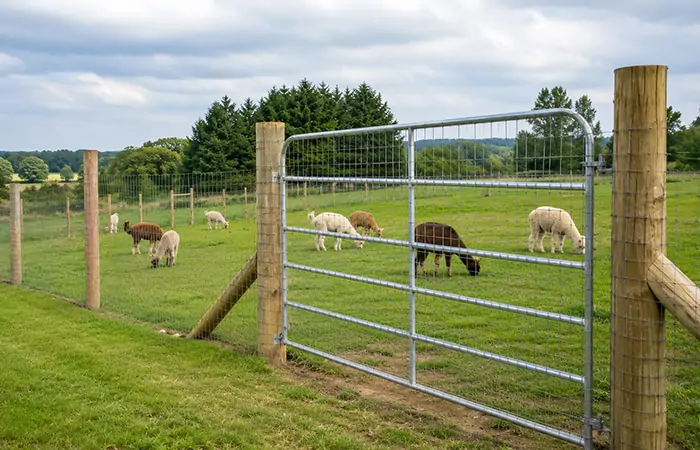
Choosing the best fencing for alpacas is not simply a matter of keeping the animals inside a pasture. A reliable alpaca fence must also reduce entanglement risks, withstand outdoor exposure and help protect the herd from dogs, coyotes and other local predators.
Alpacas are generally calmer around fences than goats or cattle. However, young alpacas may push their heads or legs through oversized openings, while predators can exploit gaps beneath a fence or weak areas around gates.
For this reason, pasture owners should evaluate the entire fencing system—including fence height, mesh opening, wire gauge, knot design, posts, gates, bracing and corrosion protection—rather than purchasing wire mesh based only on price.
This buyer’s guide explains the best fencing for alpaca pastures and helps farm owners, fencing contractors and agricultural project buyers specify the right materials.
What Is the Best Fence for Alpacas? Quick Answer
For most permanent alpaca pastures, the best overall option is a 5-foot-high, small-opening woven wire fence, commonly called a no-climb fence.
A 2 × 4-inch mesh is a widely used safety-oriented specification because its smaller openings reduce the likelihood of an alpaca putting its head or legs through the fence. High-tensile fixed-knot or square-knot field fencing may also be suitable when the mesh arrangement is selected for alpacas and young crias.
Electric wires can provide additional predator deterrence, but they are usually more effective when used with a physical wire mesh fence rather than as the only perimeter barrier.
The final specification should always reflect:
- Local predator pressure
- The age and size of the alpacas
- Perimeter or internal fence use
- Terrain and drainage
- Local fencing regulations
- Required service life and maintenance level
Why Alpacas Need the Right Type of Fence
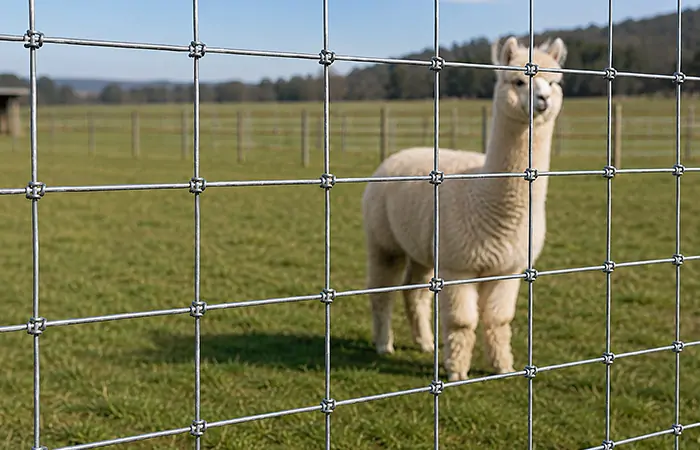
Alpacas do not usually climb, jump against or aggressively challenge fencing. This does not mean that any livestock fence will be safe for them.
Predator protection is a major consideration
In many locations, the main purpose of a strong perimeter fence is not only to contain alpacas but also to keep predators out. Loose domestic dogs, feral dogs and coyotes can threaten a herd, particularly young crias.
The Alpaca Owners Association notes that the most appropriate fence depends significantly on the predator risks in the farm’s area. Predator control may require a combination of physical fencing, electric deterrents, shelter and livestock guardian animals. See the association’s guidance on alpaca fencing and predator control.
Large openings can cause injuries
Oversized mesh openings may allow an alpaca to insert its head or leg through the fence. Problems can also arise from:
- Loose or sagging wire
- Broken welds or knots
- Sharp wire ends
- Unprotected T-post tops
- Excessive gaps beneath the fence
- Gate latches projecting into animal areas
- Barbed wire positioned where alpacas can contact it
A correctly tensioned, small-opening wire fence is therefore usually safer than a loose fence with large graduated openings.
Best Types of Fencing for Alpaca Pastures
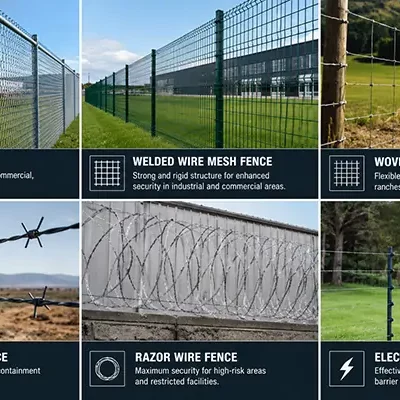
Different fencing materials serve different parts of an alpaca farm. Buyers who are still comparing the main options can first review this guide to the different types of wire fencing.
| Fence type | Alpaca safety | Predator protection | Durabilité | Best application |
|---|---|---|---|---|
| No-climb woven wire | Excellent | Excellent | Excellent | Permanent perimeter fencing |
| Fixed-knot field fence | Good to excellent | Bon | Excellent | Large commercial pastures |
| Square-knot fence | Bon | Bon | Excellent | Livestock and alpaca pastures |
| Hinge-joint fence | Good with suitable openings | Modéré | Bon | Internal pasture divisions |
| Welded wire fence | Good when heavy-duty | Bon | Moderate to good | Small pens and handling areas |
| Electric fence | Moderate alone | Good as reinforcement | Maintenance-dependent | Secondary predator deterrent |
| Wooden rail fence | Bonne visibilité | Faible | Bon | Internal divisions |
| Fil de fer barbelé | Pauvre | Pauvre | Bon | Not recommended around alpacas |
No-climb woven wire fence: best overall
A no-climb woven wire fence combines small rectangular openings with flexible woven joints. The mesh is normally supplied in rolls and stretched between securely braced posts.
For many alpaca farms, a typical specification is:
- Approximately 5 feet high
- 2 × 4-inch openings
- Heavy galvanized steel wire
- Secure woven or knotted intersections
- Strong end, corner and gate posts
The small mesh helps prevent legs and heads from entering the openings. It also creates a more complete barrier against dogs than wooden rails or widely spaced livestock wires.
Buyers should not assume that every woven livestock fence has 2 × 4-inch openings. Standard clôture du champ often has graduated openings that become larger toward the top. Confirm the opening arrangement before ordering, especially when crias will use the pasture.
Fixed-knot fence: best for large pastures
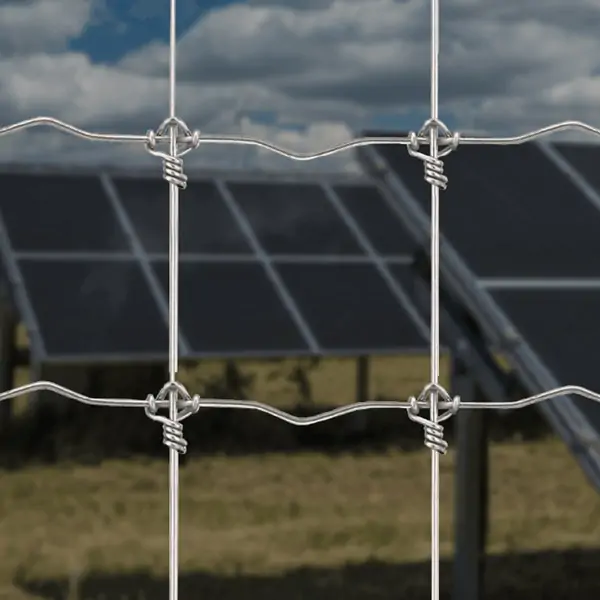
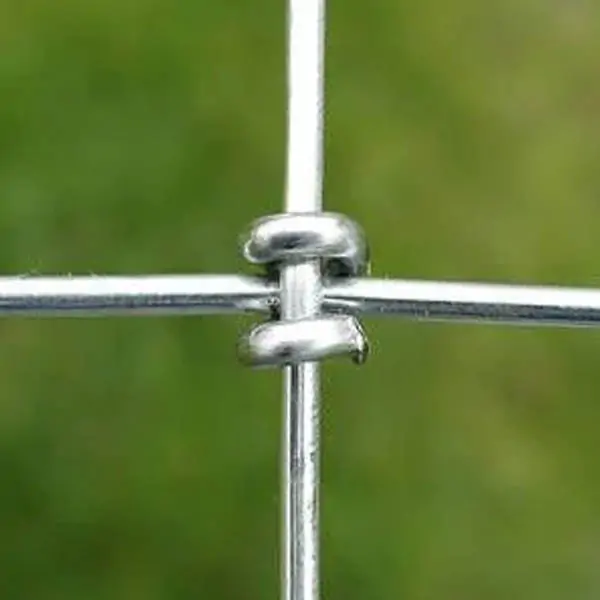
A high-tensile fixed-knot fence is designed to resist deformation and animal impact. At each intersection, a separate knot securely connects the vertical and horizontal wires.
Its main advantages include:
- Haute résistance à la traction
- Reduced sagging over long fence lines
- Strong resistance to animal pressure
- Fewer line posts in some properly engineered systems
- Suitability for uneven agricultural terrain
- Long service life with heavy galvanized coating
Fixed-knot fencing is particularly useful for large farms where durability and efficient long-distance installation are priorities.
However, the term “fixed-knot fence” describes the knot structure, not a single mesh size. For alpacas, buyers should request an appropriate fence height and small lower openings. If the standard model has wide vertical spacing, a customized mesh arrangement or separate no-climb fence may be safer for young animals.
Square-knot fence: a strong livestock option
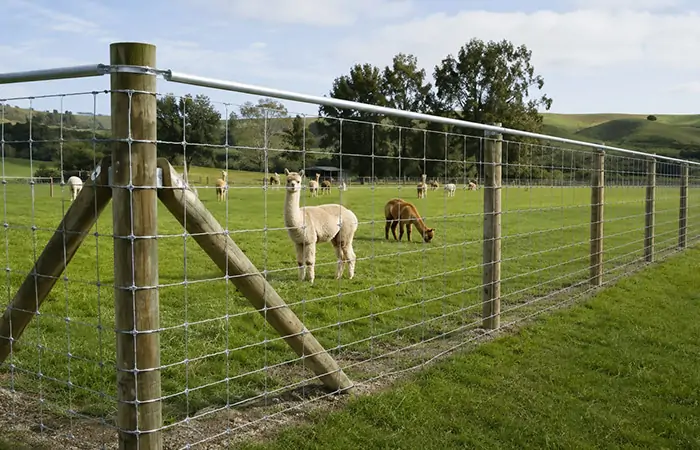
Square-knot fencing uses a knot that holds the line and stay wires in a stable grid. It can be used for cattle, horses, goats, deer, llamas and other farm animals.
For alpaca applications, its suitability depends on:
- Mesh opening dimensions
- Hauteur de la clôture
- Bottom wire clearance
- Wire tensile strength
- Knot security
- Predator risks
Square-knot fence is a practical option when a farm needs a strong woven wire system across plains, hills or other varied terrain. As with fixed-knot products, the buyer should provide the animal type and required opening dimensions when requesting a quotation.
Hinge-joint fence: useful for internal divisions
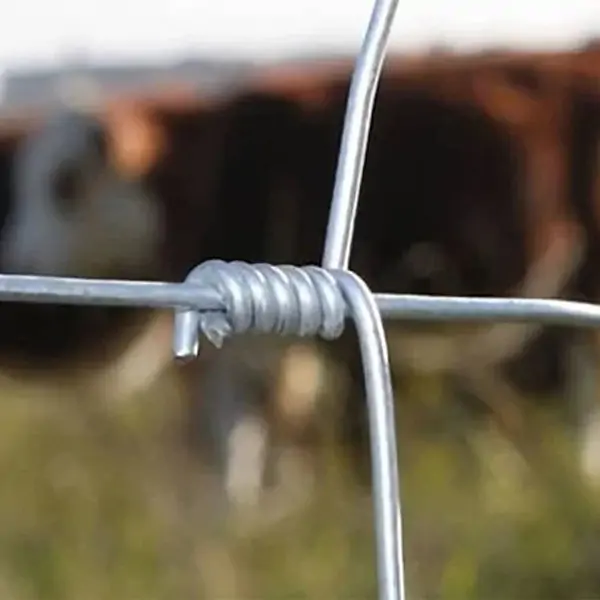
A hinge-joint fence uses wrapped wire intersections that can flex under pressure and return toward their original position.
It is commonly used for cattle, sheep and goat pastures. For alpacas, it may work well as an internal cross-fence when:
- The fence is properly tensioned
- The bottom openings are small enough
- Predator pressure is low
- Sharp ends are removed
- Young alpacas cannot pass their heads through the mesh
Hinge-joint fencing with large graduated openings may not be the first choice for a high-risk perimeter. Compare the actual mesh schedule rather than selecting the fence by product name alone.
Welded wire fence: best for small pens
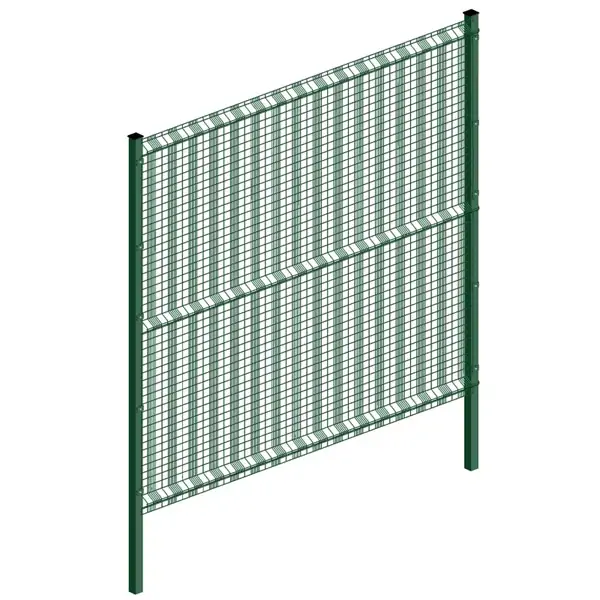
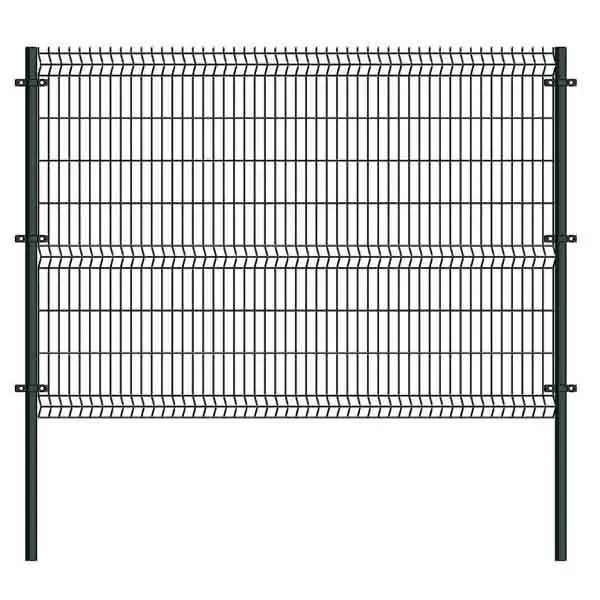
A welded wire fence has horizontal and vertical wires welded at every intersection, producing a rigid grid. Heavy-duty welded mesh can be useful for:
- Quarantine pens
- Handling areas
- Feeding enclosures
- Shelter yards
- Small paddocks
- Loading areas
Its rigidity creates an orderly barrier, but product quality varies. Lightweight welded wire may develop broken intersections after repeated bending or impact. Before ordering, verify the wire diameter, weld strength, mesh opening, surface treatment and panel or roll dimensions.
Our guide to the advantages and disadvantages of welded wire mesh fencing provides a more detailed comparison.
Electric fence: best as additional protection
Electric fencing can discourage predators or animals from approaching a physical fence. Depending on the farm design, an energized wire may be installed:
- Near the outside bottom of the fence
- At predator nose height
- Above the physical mesh
- On offset brackets
- Around temporary rotational grazing areas
Its effectiveness depends on a reliable energizer, correct grounding, vegetation control and regular voltage testing. A power failure, damaged insulator or heavy plant growth can reduce performance.
For permanent perimeter protection, many farms use electric wires as reinforcement rather than relying on them as the only barrier.
Wooden rail fence: visible but incomplete
Wooden rail fencing is easy for animals and people to see, making it useful around handling areas or internal paddocks. However, the gaps between rails do little to stop dogs, coyotes or young animals.
Attaching woven or welded wire mesh to the animal side of the rails can create a more complete system. All fasteners and cut ends should face away from the alpacas.
Why barbed wire is not recommended
Barbed wire can catch fleece and injure an alpaca’s skin, face or eyes. It also leaves large openings that do not form an effective predator barrier.
UC Agriculture and Natural Resources recommends woven wire, no-climb wire, wooden rail or high-tensile fencing for camelids instead of barbed wire. Its llama and alpaca management guidance also emphasizes the importance of a permanent perimeter fence.
How High Does an Alpaca Fence Need to Be?
The required alpaca fence height depends on whether the fence is an internal division or the farm’s main perimeter.
Interior pasture fences
A 4-foot fence may be adequate for some internal pasture divisions where:
- Predator pressure is low
- The alpacas are calm and familiar with the paddock
- Male and female groups are not competing across the fence
- The ground is level
- The fence is clearly visible and correctly tensioned
UC ANR states that interior camelid fences should be at least 4 feet high, while 5 or 6 feet is preferable.
Permanent perimeter fences
A 5-foot fence is a safer general recommendation for permanent exterior boundaries. It provides a more substantial barrier and is better suited to combined livestock containment and predator control.
The gate should be approximately the same height as the surrounding fence. A low gate can become the weakest point in an otherwise secure system.
When to consider a 6-foot fence
A taller fence may be justified when the farm has:
- Significant stray dog or coyote activity
- Mountain lion or wolf pressure
- Steep or uneven terrain
- High-value breeding animals
- Isolation or quarantine pens
- Ground elevations that reduce effective fence height
- Local regulations requiring a taller barrier
Fence height should therefore be treated as a risk-management decision, not a universal number.
Recommended Alpaca Fence Specifications
Mesh opening size
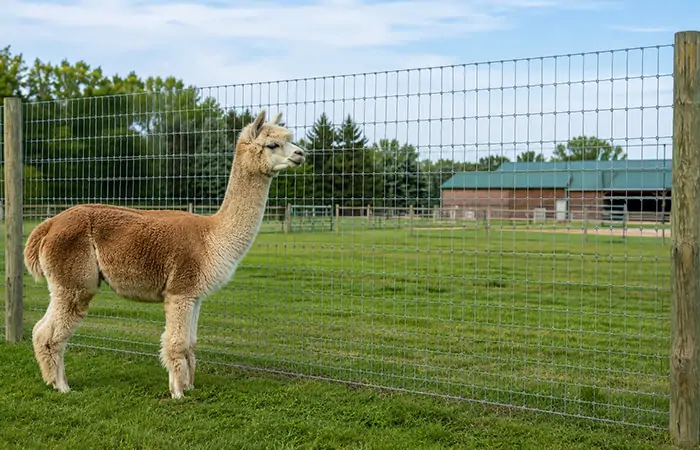
A 2 × 4-inch opening is a common no-climb specification for alpacas. Small openings help reduce the chance that an animal can place a hoof, leg or head through the mesh.
When comparing field fence products, check both the horizontal and vertical spacing. A specification such as “60-inch field fence” describes only its height; it does not confirm the opening size.
Wire gauge and diameter
A lower gauge number generally represents a thicker wire, although gauge standards can vary by market and material. A 12.5-gauge wire is often associated with heavy-duty livestock fencing.
Wire gauge should not be evaluated alone. Buyers should also request:
- Actual wire diameter in millimeters
- Tensile strength
- Top and bottom wire diameter
- Knot or weld construction
- Zinc coating weight
- Poids du rouleau
- Manufacturing tolerance
These values provide a more reliable product comparison than gauge terminology alone.
Galvanized coating
Galvanized wire is widely used for outdoor alpaca fencing because the zinc layer protects the underlying steel from corrosion.
The required coating level depends on climate and expected service life. Farms in coastal, humid or high-rainfall areas should consider a heavier galvanized coating or another enhanced corrosion-resistant finish.
When comparing quotations, confirm whether the coating is:
- Galvanized before weaving
- Galvanized after weaving
- Heavy galvanized
- Zinc-aluminum alloy coated
- PVC coated over galvanized wire
Do not compare two fence quotations as equivalent if their coating weights and wire diameters are different.
Posts and bracing
Even premium wire mesh will sag if the post system is weak. Corner, end and gate posts carry the greatest tension and require stronger foundations and bracing than ordinary line posts.
Typical components include:
- Wood, steel or concrete line posts
- Reinforced corner posts
- End posts
- Gate posts
- Horizontal braces
- Diagonal brace wires
- Post caps
- Clips, staples or ties
Post spacing varies with the fence type, terrain, wire tension and post material. Review this farm fence post spacing guide before finalizing quantities.
Post-hole depth should also reflect soil, frost, drainage and fence height. This guide explains how deep to dig fence post holes for different conditions.
Gates and hardware
Every gate should be treated as part of the containment system. Confirm that:
- The gate height matches the fence
- The gap beneath the gate is controlled
- Hinges cannot be lifted accidentally
- Latches are secure but easy for staff to operate
- Sharp hardware does not project toward animals
- Vehicle and animal traffic can be separated
- Gate posts are properly reinforced
A double-gate or holding area near frequently used entrances can reduce escape risks during deliveries and farm operations.
How to Choose the Best Fencing for an Alpaca Pasture
1. Identify the local predators
List the predators and loose animals found in the area. A fence intended only to contain alpacas may be insufficient where coyotes, dogs or larger predators are common.
Consider whether the project needs a taller fence, external electric wires, smaller bottom openings, buried mesh or enhanced gate security.
2. Separate perimeter and internal fencing
The entire farm does not necessarily need one specification.
Use the strongest system for the exterior boundary. Less intensive fencing may be used for rotational grazing divisions, provided it remains safe for the animals.
Separate specifications can be prepared for:
- Exterior perimeter
- Internal paddocks
- Maternity areas
- Weaning pens
- Quarantine pens
- Handling yards
- Shelter entrances
3. Consider cria safety
Young alpacas are smaller and may pass through openings that are safe for adults. Farms expecting crias should prioritize small mesh openings, controlled bottom gaps and secure gates.
4. Survey the terrain
Slopes, drainage channels, depressions and rocky ground can create spaces beneath the fence. The installed fence should follow the ground closely without being forced into irregular shapes that reduce tension.
Special posts, shorter spans or additional anchoring may be necessary at elevation changes.
5. Calculate the complete system cost
The roll price is only one part of the budget. A complete estimate should include:
- Fence rolls or panels
- Line, corner and gate posts
- Bracing
- Gates
- Fixations
- Tensioning equipment
- Electric fence components
- Freight
- Installation labor
- Inspection and maintenance
A higher-quality fence may produce a lower lifetime cost if it reduces repairs, sagging, corrosion and animal injuries.
Alpaca Pasture Layout and Shelter Planning
Dividing the pasture into several paddocks supports rotational grazing, pasture recovery, weaning and separation of different animal groups.
Safe alleys can connect the pasture to shelters, feeding areas, treatment pens and loading zones. Avoid narrow dead ends or sharp corners where animals could become crowded.
Feeders and water containers should not be installed directly against the fence. Repeated animal pressure around these high-traffic points can loosen the mesh and compact the ground.
Best shelter design for alpacas in California
In many mild California climates, a well-ventilated three-sided shed can provide basic protection. The shelter should offer shade during hot weather, airflow in summer and protection from wind and rain during cooler periods.
The shelter entrance should connect to a secure fenced yard without creating a narrow bottleneck. Inland areas with high summer temperatures may need additional shade and ventilation, while coastal areas require greater attention to moisture and corrosion.
Because shelter design has a different search intent from fencing selection, “best shelter design for alpacas in California” should eventually be developed as a separate article and linked from this section.
Common Alpaca Fencing Mistakes
Avoid these frequent specification and installation errors:
- Using mesh openings that are too large: Adult alpacas may appear safe while crias remain at risk.
- Installing a low perimeter fence: A low fence provides less protection from outside animals.
- Choosing barbed wire: Barbs can catch fleece and cause injuries.
- Leaving gaps beneath the mesh: Predators can exploit gaps caused by slopes, erosion or drainage channels.
- Using weak corner posts: Woven wire tension can pull insufficiently braced posts inward.
- Failing to tension the mesh evenly: Loose fencing is easier for animals to push through and more likely to become tangled.
- Ignoring gates: A poorly fitted gate can defeat an otherwise secure fence.
- Comparing products by price alone: Differences in wire diameter, coating weight, roll length and knot design can significantly affect performance.
- Leaving exposed T-post tops: Protective caps should be used where animals may contact steel posts.
- Skipping regular inspections: Storms, fallen branches, corrosion and animal pressure can create hidden weak points.
Alpaca Fence Installation Checklist
Before introducing alpacas, confirm that the installer has:
- Verified the property boundary
- Located underground utilities
- Measured the full fence line
- Installed reinforced corner, end and gate posts
- Maintained appropriate post spacing
- Followed ground contours
- Stretched the mesh evenly
- Secured the bottom edge
- Removed or covered sharp wire ends
- Installed T-post caps
- Checked gate clearance and latches
- Tested electric components where used
- Inspected the complete perimeter
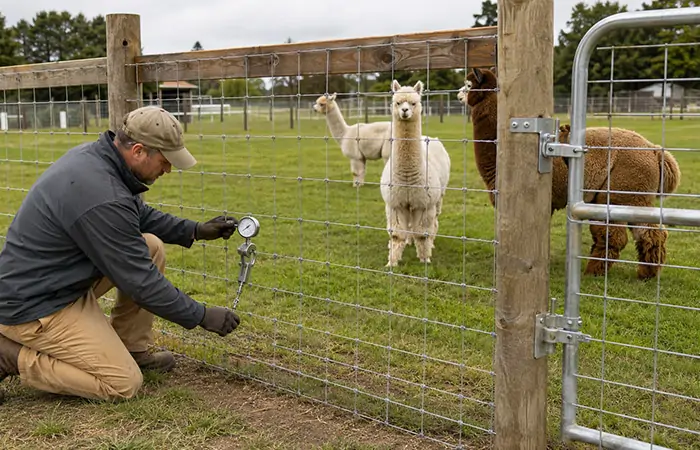
For long woven wire runs, selecting the right field fence stretcher helps apply more consistent tension.
Alpaca Fence Buyer’s Checklist
When requesting a B2B quotation, provide the following information:
- Fence application
- Perimeter or internal use
- Animal type and age
- Required height
- Ouverture en filet
- Wire gauge or diameter
- Knot type
- Tensile strength
- Zinc coating requirement
- Roll height and length
- Total fence length
- Post and gate requirements
- Destination country and port
- Required standards or certificates
- Packaging requirements
- Expected delivery schedule
Providing these details allows the manufacturer to compare appropriate specifications and calculate roll quantities more accurately.
Questions fréquemment posées
What is the best fencing for alpacas?
A 5-foot-high no-climb woven wire fence with small openings is the best general option for many permanent alpaca pastures. The fence should be properly tensioned, corrosion-resistant and supported by reinforced corner and gate posts.
How high does an alpaca fence need to be?
An internal alpaca fence should generally be at least 4 feet high. A 5-foot fence is a safer choice for a permanent perimeter, while 6 feet may be appropriate in areas with greater predator risks.
What mesh size is safest for alpacas?
A 2 × 4-inch no-climb mesh is a commonly recommended small-opening specification. The final choice should consider cria size, fence position and local predators.
Can alpacas be kept behind electric fencing?
Electric fencing can be used for certain internal divisions or as an additional predator deterrent. For a permanent perimeter, combining electric wires with a physical mesh barrier generally provides more dependable protection.
Is welded or woven wire better for alpacas?
Woven wire is usually preferred for long permanent pasture boundaries because it can flex and be tensioned across long runs. Heavy-duty welded wire is useful for small pens and handling areas, but weld strength and wire diameter must be checked.
Can cattle fencing be used for alpacas?
Some cattle field fences can be used, but others have openings that are too large for crias or adult alpaca legs. Check the complete mesh schedule rather than relying on the product name.
Is fixed-knot fencing suitable for alpacas?
Yes, provided the selected model has an appropriate height and opening arrangement. Fixed-knot fencing offers high strength and is particularly suitable for large pastures.
Should alpaca fencing keep predators out?
Yes. Alpacas do not usually challenge fences aggressively, so one of the most important functions of a perimeter fence is preventing dogs, coyotes and other local predators from reaching the herd.
Conclusion
For most permanent alpaca pastures, a 5-foot-high small-opening woven wire fence provides the best balance of containment, animal safety and predator protection.
However, the product name alone does not determine whether a fence is suitable. Buyers should compare the actual mesh opening, wire diameter, knot construction, tensile strength, galvanized coating and complete post-and-gate system.
Large projects may use different specifications for perimeter fencing, internal paddocks and handling pens. Matching each fence to its specific function can improve safety while controlling the total project cost.
Looking for a customized alpaca pasture fence? Contact YESON Wire Mesh with your required height, mesh opening, total fence length and destination port. Our team can help you compare available field fence specifications and prepare a project quotation.
 FR
FR  EN
EN  DE
DE  ES
ES  AR
AR  PT
PT