
Table des matières
ToggleIntroduction
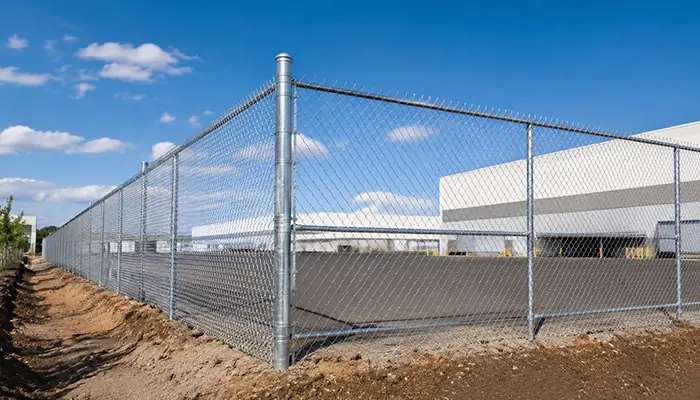
Chain link fence is one of the most widely used fencing systems in the world. Known for its durability, affordability, visibility, and low maintenance requirements, chain link fencing is commonly used for residential, commercial, industrial, agricultural, and security applications.
Whether you are securing a backyard, protecting a warehouse, enclosing a sports field, or establishing a high-security perimeter, chain link fences offer a practical and cost-effective solution.
In this complete guide, you’ll learn what chain link fences are made of, the different types available, standard chain link fence heights and sizes, fence post specifications, components, applications, and how to choose the right chain link fencing system for your project.
Qu'est-ce qu'une clôture à mailles losangées ?
A chain link fence is a woven wire fence made from interconnected steel wires that form a diamond-shaped mesh pattern. The wires are mechanically woven together to create a strong, flexible, and durable fencing fabric.
Chain link fencing is also commonly known as:
- Chain-link fence
- Chain fence
- Cyclone fence
- Wire mesh fence
- Diamond mesh fence
The unique diamond pattern provides excellent visibility while maintaining a secure barrier.
Because of its versatility and relatively low installation cost, chain link fencing remains one of the most popular fencing options worldwide.
What Is Chain Link Fence Made Of?
The performance and lifespan of a chain link fence largely depend on the materials used.
Clôture à mailles losangées en acier galvanisé
Galvanized steel is the most common material used in chain link fence manufacturing.
The steel wire is coated with zinc through either:
- Hot-dip galvanizing
- Electro-galvanizing
The zinc coating protects the steel from rust and corrosion, significantly extending service life.
Avantages
- Excellente résistance à la corrosion
- Rentabilité
- Longue durée de vie
- Suitable for most environments
PVC-Coated Chain Link Fence
PVC-coated chain link fencing consists of galvanized steel wire covered with a protective vinyl or PVC layer.
Common colors include:
- Vert
- Noir
- Brun
- Gray
Avantages
- Enhanced weather resistance
- Improved aesthetics
- Longer service life
- Reduced maintenance
PVC-coated chain link fences are widely used in residential properties, parks, schools, and sports facilities.
Clôture à mailles losangées en acier inoxydable
Stainless steel chain link fencing offers exceptional corrosion resistance.
Common grades include:
- Acier inoxydable 304
- Acier inoxydable 316
Avantages
- Superior corrosion protection
- Excellent strength
- Longue durée de vie
- Ideal for coastal and chemical environments
Typical applications include:
- Marine facilities
- Usines chimiques
- Food processing facilities
- Pharmaceutical plants
Aluminum Chain Link Fence
Aluminum chain link fencing provides a lightweight alternative to steel fencing.
Avantages
- Léger
- Résistant à la corrosion
- Aspect attrayant
- Installation facile
Types of Chain Link Fence
Different projects require different chain link fence configurations.
Residential Chain Link Fence
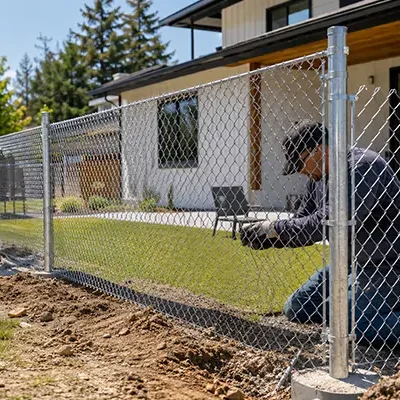
Residential chain link fences are commonly used for:
- Property boundaries
- Backyards
- Gardens
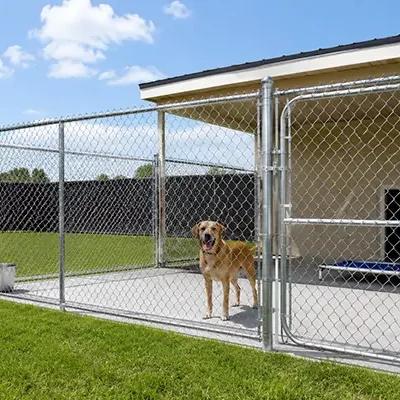
- Pet enclosures
Typical characteristics:
- Height: 3 ft to 6 ft
- Wire Gauge: 11 to 11.5 gauge
- PVC-coated or galvanized finish
Commercial Grade Chain Link Fence
Commercial fencing is designed for businesses and public facilities.
Les applications les plus courantes sont les suivantes
- Schools
- Office buildings
- Retail centers
- Parking lots
Typical characteristics:
- Height: 6 ft to 8 ft
- Wire Gauge: 9 gauge
- Heavy-duty posts
Industrial Chain Link Fencing
Industrial chain link fencing provides higher levels of security and durability.
Les applications comprennent
- Factories
- Entrepôts
- Distribution centers
- Utility facilities
Typical characteristics:
- Heavy wire gauges
- Larger post diameters
- Security accessories
High-Security Chain Link Fence
High-security systems often incorporate:
- Fil de fer barbelé
- Fil de rasoir
- Anti-climb toppings
- Security gates
Les applications comprennent
- Aéroports
- Installations militaires
- Correctional facilities
- Critical infrastructure
Chain Link Fence Panels
Prefabricated chain link fence panels are manufactured in sections and installed quickly on-site.
Benefits include:
- Une installation plus rapide
- Un transport plus facile
- Reduced labor costs
- Modular design
Chain Link Fence Components
Understanding fence components helps ensure proper design and installation.
Tissu à mailles losangées
The woven mesh fabric forms the main body of the fence.
Available mesh openings include:
- 1 inch
- 1-1/4 inch
- 2 inch
- 2-1/4 inch
Poteaux de ligne
Line posts support the fence between terminal posts.
Functions include:
- Maintaining alignment
- Supporting fence fabric
- Providing structural stability
Terminal Posts
Terminal posts are installed at:
- Corners
- Fence ends
- Gate openings
These posts are larger and stronger than line posts.
Top Rail
The top rail runs horizontally along the top of the fence.
Benefits include:
- Additional strength
- Improved appearance
- Meilleure répartition de la tension
Bottom Rail
Bottom rails increase rigidity and security while helping prevent lifting of the fence fabric.
Tension Bars and Tension Bands
These components secure the chain link fabric to terminal posts.
They help maintain proper tension and fence alignment.
Fence Ties
Fence ties attach the mesh fabric to:
- Postes
- Rails
- Braces
Gates
Chain link fence gates are available in:
- Single swing gates
- Double swing gates
- Sliding gates
- Cantilever gates
Standard Chain Link Fence Heights
One of the most common questions is: How tall is a chain link fence?
The answer depends on the intended application.
| Hauteur de la clôture | Common Application |
|---|---|
| 3 pieds | Gardens, decorative fencing |
| 4 pieds | Residential properties |
| 5 ft | Property boundaries |
| 6 pieds | Backyard security |
| 7 ft | Commercial facilities |
| 8 pieds | Industrial properties |
| 10 pieds | High-security sites |
| 12 ft | Maximum security perimeters |
The most common residential chain link fence height is 4 to 6 feet.
Commercial and industrial projects often utilize 6 to 8-foot chain link fences.
Chain Link Fence Sizes and Dimensions
Mesh Size Options
The mesh opening directly affects security and appearance.
| Ouverture en maille | Utilisation typique |
| 1″ | High-security applications |
| 1-1/4″ | Residential fencing |
| 2″ | Commercial fencing |
| 2-1/4″ | Industrial applications |
Wire Gauge Options
Wire gauge determines fence strength.
| Calibre des fils | Typical Application |
| 6 Gauge | Heavy-duty security fencing |
| 9 Gauge | Commercial fencing |
| 11 Gauge | Residential fencing |
| 11.5 Gauge | Economy fencing |
Lower gauge numbers indicate thicker wire.
Chain Link Fence Post Size Chart
Proper post sizing is critical for fence performance.
Line Post Sizes
| Hauteur de la clôture | Recommended Diameter |
| 3–6 ft | 1-7/8″ |
| 7–8 ft | 2-3/8″ |
| 10–12 ft | 4″ |
Terminal Post Sizes
| Hauteur de la clôture | Recommended Diameter |
| 3–4 ft | 2-3/8″ |
| 5–6 ft | 2-7/8″ |
| 7–8 ft | 4″ |
| 10–12 ft | 6″ |
Always follow local codes and engineering requirements when selecting post sizes.
Chain Link Fence Post Spacing Chart
Post spacing affects strength, appearance, and installation costs.
| Application | Espacement recommandé |
| Résidentiel | 8–10 ft |
| Commercial | 8–10 ft |
| Industriel | 10 pieds |
| Haute sécurité | 8 pieds |
Proper spacing ensures structural stability and long-term performance.
Advantages of Chain Link Fence
Rentable
Chain link fencing is among the most economical fencing solutions available.
Durable
Galvanized and PVC-coated options can last decades with minimal maintenance.
Installation facile
Simple construction reduces labor costs and installation time.
Faible entretien
Unlike wood fencing, chain link fences do not require regular painting or staining.
Excellent Visibility
The open mesh design provides unobstructed visibility while maintaining security.
Polyvalent
Suitable for residential, commercial, industrial, agricultural, and security applications.
Common Applications of Chain Link Fencing
Chain link fences are used across numerous industries.
Propriétés résidentielles
- Property boundaries
- Pet enclosures
- Backyard fencing
Commercial Facilities
- Parking lots
- Office buildings
- Retail centers
Installations industrielles
- Entrepôts
- Usines de fabrication
- Logistics centers
Educational Facilities
- Schools
- Universities
- Playgrounds
Installations sportives
- Tennis courts
- Baseball fields
- Soccer fields
Agricultural Applications
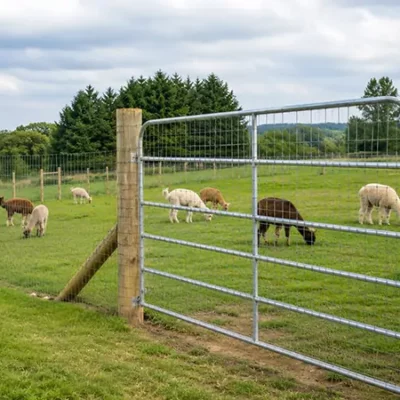
- Enclos pour le bétail
- Farm boundaries
- Poultry facilities
Government and Security Facilities
- Aéroports
- bases militaires
- Utility stations
How to Choose the Right Chain Link Fence
Determine Security Requirements
Higher security applications typically require:
- Taller fences
- Smaller mesh openings
- Heavier wire gauges
Consider Environmental Conditions
Coastal or chemical environments may require:
- Fil recouvert de PVC
- Stainless steel fencing
Establish a Budget
Balance:
- Material costs
- Installation costs
- Long-term maintenance
Evaluate Lifespan Expectations
Galvanized chain link fences typically provide excellent value, while PVC-coated and stainless steel options offer longer service life.
Vérifiez les réglementations locales
Always verify:
- Height restrictions
- Property boundary requirements
- Building codes
- Security regulations
FAQ
What is a chain link fence made of?
Most chain link fences are manufactured from galvanized steel wire, PVC-coated steel wire, stainless steel wire, or aluminum wire.
What is the standard height of a chain link fence?
The most common residential heights are 4 ft, 5 ft, and 6 ft.
How long does a chain link fence last?
A properly installed galvanized chain link fence can last 20–30 years or more depending on environmental conditions.
What is the strongest chain link fence?
Heavy-duty galvanized or stainless steel chain link fencing with smaller mesh openings and thicker wire gauges provides the highest strength.
What size posts are used for chain link fences?
Post diameters typically range from 1-7/8 inches for residential fencing to 6 inches for high-security installations.
Is PVC-coated chain link fencing better than galvanized fencing?
PVC-coated fencing generally offers improved aesthetics and additional corrosion protection, while galvanized fencing provides excellent value and durability.
Conclusion
Chain link fencing remains one of the most reliable, economical, and versatile fencing solutions available today. From residential backyards to industrial facilities and high-security perimeters, chain link fences provide an ideal balance of strength, durability, visibility, and affordability.
When selecting a chain link fence, consider the material, wire gauge, mesh size, fence height, post dimensions, and environmental conditions to ensure optimal performance. Whether you require a residential boundary fence, commercial enclosure, or industrial security perimeter, choosing the right chain link fencing system will provide long-term protection and value for years to come.
As a professional chain link fence manufacturer and supplier, we offer galvanized, PVC-coated, and custom chain link fencing solutions for distributors, contractors, wholesalers, and project buyers worldwide. Contact our team today to discuss your project requirements and receive a competitive quotation.
 FR
FR  EN
EN  DE
DE  ES
ES  AR
AR  PT
PT