
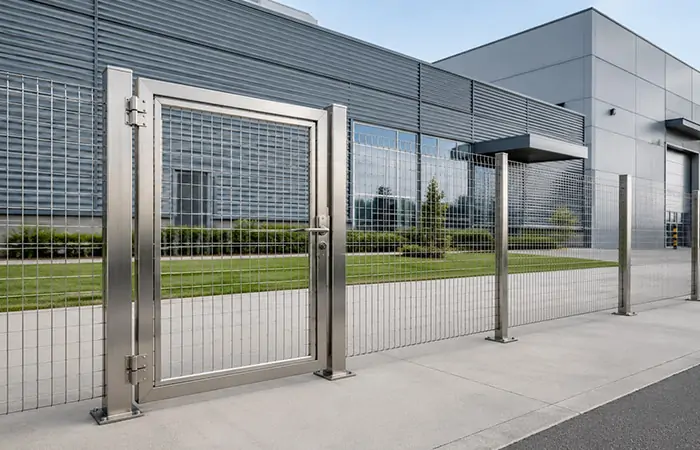
Les clôtures en treillis métallique soudé en acier inoxydable sont largement utilisées dans les installations industrielles, les usines agroalimentaires, les enclos pour animaux, les projets côtiers, les protections de machines et les applications architecturales. Leur structure rigide, leurs mailles uniformes et leur matériau résistant à la corrosion en font une alternative pratique aux clôtures en acier galvanisé dans les environnements exigeants.
Cependant, le choix d'une clôture en acier inoxydable ne se limite pas au choix de la taille des panneaux. Les acheteurs doivent également tenir compte de la nuance d'acier inoxydable, du diamètre du fil, de l'ouverture des mailles, de la structure des panneaux, du traitement des bords, des poteaux, des fixations et de l'environnement d'installation.
Ce guide explique comment sont fabriqués les treillis métalliques soudés en acier inoxydable, en quoi la nuance 304 diffère de la nuance 316, quelles sont les spécifications importantes et quelles informations les acheteurs doivent fournir lorsqu'ils demandent un devis.
Pour connaître les tailles disponibles et les options de personnalisation, consultez le site de YESON panneaux en treillis métallique soudé en acier inoxydable.
Qu'est-ce qu'une clôture en treillis métallique soudé en acier inoxydable ?
Les clôtures en treillis métallique soudé en acier inoxydable sont constituées de fils d’acier inoxydable longitudinaux et transversaux disposés à angle droit et soudés par résistance à chaque intersection. Ce procédé permet d’obtenir des mailles carrées ou rectangulaires qui restent relativement stables dans des conditions normales d’utilisation.
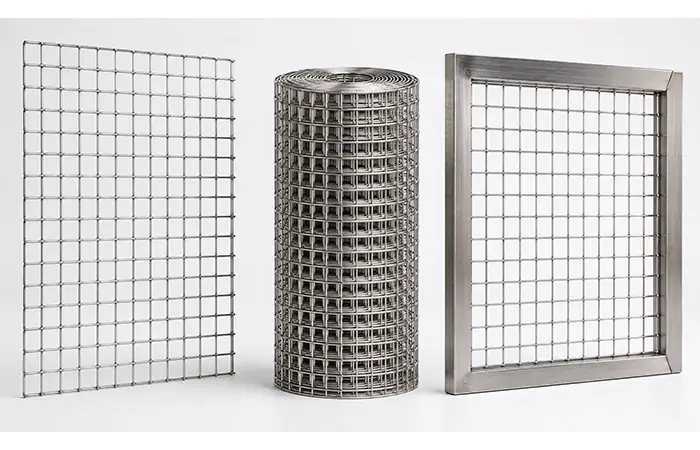
Le treillis fini peut être fourni sous les formes suivantes :
- Panneaux plats en treillis métallique soudé
- Rouleaux de treillis soudés souples
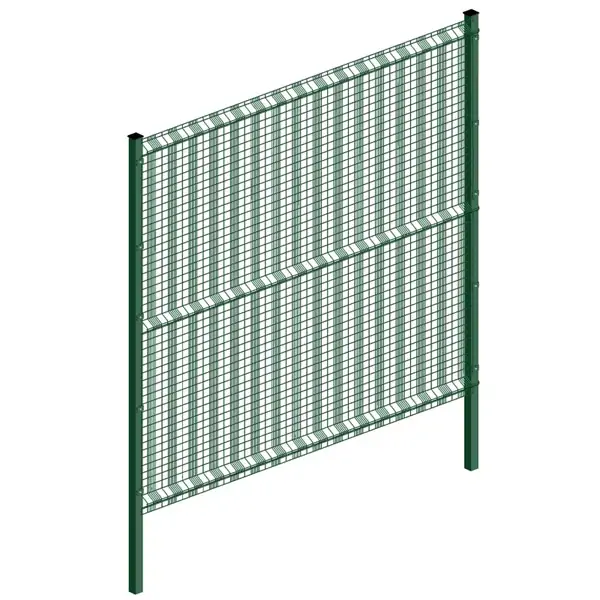
- Panneaux de clôture en acier inoxydable avec cadre
- Panneaux de protection des machines
- Panneaux pour enclos d'animaux
- Portails et cloisons sur mesure
Contrairement au treillis métallique tissé, le treillis soudé ne repose pas sur l'entrelacement des fils pour conserver sa structure. Chaque intersection est soudée, ce qui donne un treillis métallique plus rigide, adapté à la réalisation de clôtures, de cloisons et à la protection des équipements.
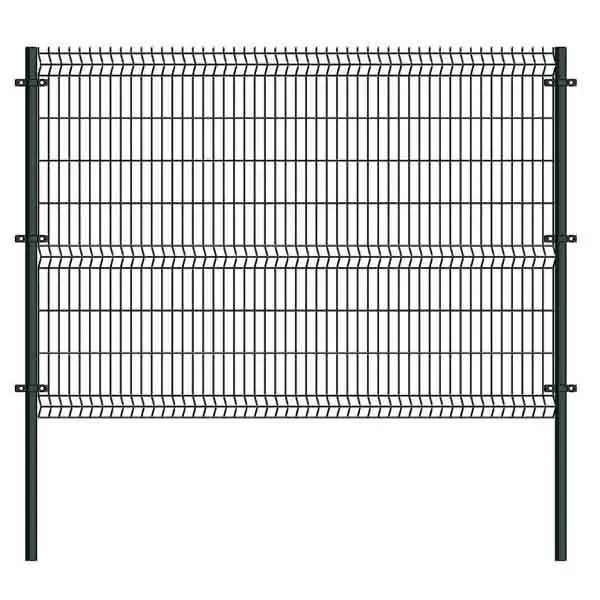
Un système de clôture complet comprend généralement des panneaux grillagés, des poteaux de soutien, des pinces, des équerres, des éléments de fixation, des portails et des fondations. La résistance de la clôture une fois installée dépend donc de l'ensemble du système, et pas uniquement du grillage métallique.
Comment fabrique-t-on un treillis métallique soudé en acier inoxydable ?
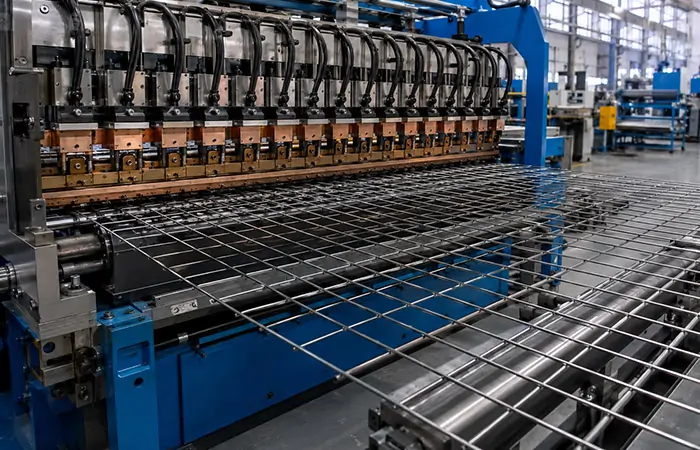
La production commence généralement avec du fil d'acier inoxydable fourni en bobines. Le fil est redressé et coupé, ou acheminé en continu vers une machine à souder automatisée.
Les principales étapes de fabrication sont les suivantes :
- Préparation du fil : Le fil d'acier inoxydable est choisi en fonction de la nuance et du diamètre requis.
- Redressage et alimentation : Les fils longitudinaux et transversaux sont disposés selon l'espacement spécifié.
- Soudage par résistance : Une résistance électrique et une pression régulées relient les fils à chaque intersection.
- Découpe : Le treillis soudé est découpé en panneaux ou conditionné en rouleaux.
- Aplatissement : Les panneaux rigides peuvent être mis à niveau afin de réduire les déformations.
- Finition des bords : Les extrémités des fils peuvent être coupées à ras, laissées en saillie ou encastrées dans un cadre.
- Inspection : La taille des mailles, le diamètre des fils, les dimensions des panneaux, l'uniformité des soudures et l'état de la surface sont contrôlés.
- Conditionnement : Les panneaux sont regroupés ou palettisés afin de limiter leur déformation et leur contamination pendant le transport.
Les projets qui nécessitent un matériau continu plutôt que des panneaux rigides peuvent utiliser un rouleau de treillis métallique soudé en acier inoxydable.
Grille soudée, grille tissée et grillage à poules : comparatif
Ces produits sont parfois regroupés sous le terme “ treillis métallique ”, mais leur structure et leurs caractéristiques techniques diffèrent.
| Produit | La construction | Rigidité | Utilisations courantes |
|---|---|---|---|
| Treillis métallique soudé | Fils soudés à chaque intersection | Haut | Clôtures, protections, cages et cloisons |
| Treillis métallique tissé | Des fils entrelacés, les uns au-dessus des autres et les autres en dessous | Souple à moyen | Filtration, criblage et tamisage |
| Grillage | Fil fin torsadé dans des ouvertures hexagonales | Faible | Enclos pour volailles et barrières lumineuses |
| Treillis métallique | Fils tissés formant un motif en losange | Flexible | Clôtures périphériques et installations sportives |
Le treillis métallique soudé constitue généralement le meilleur choix lorsqu'il est nécessaire d'obtenir des mailles uniformes, une bonne rigidité des panneaux et un processus de fabrication prévisible. Le treillis tissé est plus adapté à la filtration fine, tandis que le grillage à poules est généralement destiné à des applications de confinement légères plutôt qu'à la réalisation de clôtures très résistantes.
Pour une présentation plus détaillée des formes et des applications des matériaux, voir À quoi sert le treillis en acier inoxydable ?.
Pourquoi choisir l'acier inoxydable pour les clôtures en treillis soudé ?
L'acier inoxydable contient au moins 10,5% de chrome. Ce chrome forme une fine couche passive à la surface qui contribue à protéger le métal sous-jacent contre la corrosion. Il convient toutefois de qualifier l'acier inoxydable de « résistant à la corrosion » et non de « totalement inaltérable ».
Ses performances dépendent de la nuance de l'alliage, de la qualité de fabrication, de la contamination de surface, de l'environnement local et des pratiques de nettoyage.
Résistance à la corrosion
La résistance à la corrosion est l'une des principales raisons pour lesquelles les acheteurs optent pour des clôtures en treillis métallique soudé en acier inoxydable. Elle s'avère particulièrement utile dans les cas où l'acier au carbone ordinaire nécessiterait d'être peint, galvanisé ou remplacé fréquemment.
Parmi les environnements types, on peut citer :
- Bâtiments industriels humides
- Établissements de restauration
- Stations de traitement des eaux
- Infrastructures côtières
- Laboratoires
- Installations pharmaceutiques
- Zones de lavage
- Enclos pour animaux et cliniques vétérinaires
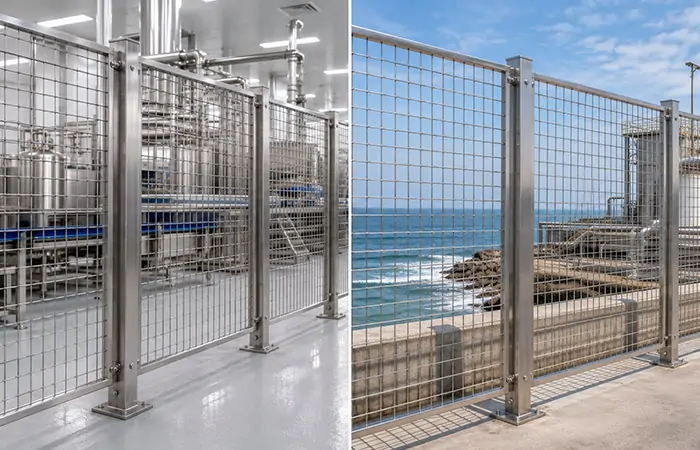
Il reste important de choisir la nuance d'acier inoxydable adaptée. La nuance 304 peut donner de bons résultats dans une usine agroalimentaire en intérieur, mais elle n'est peut-être pas le meilleur choix pour une clôture exposée aux embruns salés au bord de la mer.
Mailles rigides et stables
Les fils étant soudés à chaque intersection, les mailles résistent mieux aux déformations que celles de nombreux produits tissés. Les treillis soudés conviennent donc parfaitement aux cloisons de sécurité, aux enceintes de stockage, aux cages et aux protections de machines.
Des mailles plus petites et des fils plus épais augmentent généralement la rigidité, mais ils augmentent également le poids et le coût du matériau. Le concepteur de la clôture doit trouver le juste équilibre entre les exigences en matière de visibilité, de ventilation, de résistance, de poids et de sécurité.
Hygiène et facilité de nettoyage
La surface en acier inoxydable, relativement lisse, est plus facile à nettoyer qu'une surface peinte dont la peinture s'écaille ou est endommagée. Cela peut s'avérer utile dans les environnements où l'hygiène est primordiale.
Toutefois, l'hygiénisme dépend de la conception globale. Des arêtes vives, des joints inaccessibles, des cadres mal conçus et des raccords susceptibles de retenir la saleté peuvent encore poser des problèmes. Les acheteurs doivent réfléchir à la manière dont les panneaux seront nettoyés et se demander s'ils seront exposés à un nettoyage à haute pression, à la vapeur, à des produits chimiques ou à des désinfectants.
Longue durée de vie
L'acier inoxydable présente généralement un prix d'achat initial plus élevé que le treillis métallique galvanisé. Dans un environnement corrosif, sa durée de vie plus longue et le fait qu'il nécessite moins de réparations au niveau du revêtement peuvent améliorer sa valeur sur toute sa durée de vie.
La comparaison pertinente ne se limite donc pas au simple prix par panneau. Les acheteurs doivent tenir compte des éléments suivants :
- Fréquence de remplacement prévue
- Frais de nettoyage et d'entretien
- Réparation du revêtement
- Frais de pose
- Arrêt de production
- Coûts de mise au rebut et de remplacement
Treillis métallique soudé en acier inoxydable 304 et 316
Les nuances 304 et 316 sont les matériaux les plus couramment demandés pour les clôtures en treillis d'acier inoxydable. Il s'agit dans les deux cas d'aciers inoxydables austénitiques couramment utilisés, mais la nuance 316 contient du molybdène, ce qui améliore la résistance à la corrosion par piqûres et à la corrosion interstitielle dans de nombreux environnements contenant des chlorures.
| Facteur | acier inoxydable 304 | acier inoxydable 316 |
| Résistance générale à la corrosion | Bon | Plus haut |
| Résistance aux chlorures | Modéré | Mieux |
| Environnement commun | Intérieur, milieu urbain et industrie en général | Côtier, marin et riche en chlorure |
| Coût relatif des matériaux | Inférieur | Plus haut |
| Utilisation courante des clôtures | Clôtures en acier inoxydable à usage général | Des conditions d'exposition plus intenses |
Quand faut-il opter pour l'acier inoxydable 304 ?
L'acier de nuance 304 est généralement choisi pour :
- Cloisons d'entrepôt pour l'intérieur
- Clôtures industrielles générales
- Protections de machines
- Remplissage architectural
- Zones de transformation alimentaire non exposées à des concentrations élevées de chlorure
- Enclos pour animaux dans des environnements contrôlés
- Lieux urbains en plein air présentant une exposition modérée
Il offre un bon compromis entre résistance à la corrosion, facilité de mise en œuvre et coût du matériau.
Dans quels cas l'acier inoxydable 316 justifie-t-il son surcoût ?
L'acier de nuance 316 est généralement utilisé pour :
- Clôtures côtières
- Installations maritimes
- Environs de la piscine
- L'aquaculture en eau salée
- Usines de traitement chimique
- Lieux exposés aux sels de déneigement
- Zones de lavage industriel contenant des chlorures
L'expression “ qualité marine ” ne signifie pas que l'acier 316 ne peut en aucun cas se tacher ou se corroder. Les dépôts de sel, un mauvais drainage, la contamination de surface et une exposition extrême peuvent tout de même nuire à ses performances. Le choix du matériau doit être fondé sur les conditions réelles du site.
Pour une comparaison plus détaillée des matériaux, consultez Grille métallique en acier inoxydable 304 vs 316.
Peut-on distinguer les aciers 304 et 316 à leur aspect ?
En général, non. Ces deux matériaux présentent un aspect métallique similaire. Les acheteurs ne doivent pas se fier à la couleur ni à un examen visuel pour vérifier la qualité du produit.
Pour les commandes B2B, demandez les documents suivants :
- Certificat de conformité des matériaux de broyage
- Rapport sur la composition chimique
- Cahier des charges d'achat
- Identification des niveaux scolaires
- Tests effectués par un organisme tiers lorsque cela est nécessaire
La documentation doit correspondre au lot de matière utilisé pour la production et ne pas se limiter à un certificat d'échantillon générique.
Caractéristiques techniques du treillis métallique soudé en acier inoxydable
Un cahier des charges utile ne doit pas se limiter à la mention “ panneau en treillis d'acier inoxydable ”. Il doit au minimum préciser la nuance, le diamètre des fils, la taille des mailles, les dimensions du panneau, la quantité et le traitement des bords.
Taille de l'ouverture des mailles
La taille des mailles a une incidence sur la sécurité, la visibilité, la ventilation, le confinement des animaux et la possibilité de passer la main à travers la clôture.
| Ouverture nominale | Application typique |
| 1/4 de pouce | Grilles fines, barrières anti-nuisibles et enclos pour petits animaux |
| 1/2 pouce | Enclos pour petits animaux et grilles de protection |
| 1 pouce | Cages, cloisons et protections diverses |
| 1 × 2 pouces | Clôtures et cloisons industrielles |
| 2 × 2 pouces | Clôtures en général et grandes cages |
| 2 × 4 pouces | Applications périmétriques et agricoles |
| 3 pouces et plus | Grandes enceintes et barrières économiques |
Précisez si le terme “ ouverture ” désigne la distance libre entre les fils ou l'écartement centre à centre. Confondre ces deux mesures peut entraîner une erreur dimensionnelle importante.
Diamètre et calibre du fil
Le diamètre du fil influe sur la rigidité du panneau, sa résistance aux chocs, son poids et son prix. Un panneau de clôture en fil métallique soudé destiné à un usage intensif nécessite généralement un fil plus épais qu’un enclos léger pour animaux.
Les systèmes de calibrage des fils ne sont pas toujours interprétés de manière uniforme d'un marché à l'autre. Pour les achats internationaux, précisez le diamètre en millimètres, même si un numéro de calibre est également indiqué.
Par exemple:
Diamètre du fil : 3,0 mm (diamètre réel)
Ouverture des mailles : 50 × 50 mm d'ouverture libre
C'est plus clair que de demander une “ maille de calibre 12 ” sans préciser le système de calibrage ni la tolérance de mesure.
Dimensions du panneau
Les dimensions courantes des panneaux en treillis soudé varient selon les marchés et les applications. La fabrication sur mesure peut inclure :
- Largeur du panneau
- Hauteur du panneau
- Ouverture en filet
- Diamètre du fil
- Construction à plat ou encadrée
- Bords renforcés
- Découpes
- Trous de fixation
- Portails
- Emballage spécial
Les dimensions des panneaux doivent correspondre à l'espacement des poteaux. Commander le treillis avant d'avoir validé la structure porteuse peut entraîner des problèmes lors de la pose.
Panneaux plats, rouleaux et panneaux encadrés
Écrans plats offrent une meilleure rigidité et sont plus faciles à installer dans les systèmes de clôtures modulaires, les protections d'équipements et les cages.
Rouleaux de maille sont utiles lorsqu’une couverture continue, un transport plus aisé ou une découpe sur place sont nécessaires. Les fils fins et les petits diamètres sont plus adaptés au laminage que les treillis rigides très lourds.
Panneaux encadrés associer un treillis soudé à un cadre périphérique constitué de cornières, de tubes ou de barres plates. Ce cadre apporte une rigidité supplémentaire et offre des points de fixation bien définis.
Types de bords
Parmi les configurations courantes des bords, on peut citer :
- Bord à coupe à ras : Les fils sont coupés près du fil transversal extérieur.
- Bord en surplomb : Les extrémités des fils dépassent du dernier fil transversal.
- Bord replié : Le treillis est cintré afin d'améliorer sa rigidité ou de réduire le nombre d'extrémités apparentes.
- Bord encadré : Le treillis est soudé ou fixé à l'intérieur d'un cadre qui l'entoure.
On privilégie généralement les bords affleurants ou encadrés lorsque des personnes ou des animaux sont susceptibles d'entrer en contact avec le panneau. Des fils en surplomb peuvent être utilisés comme dispositif de sécurité, mais leur emplacement et leur conformité à la réglementation doivent être vérifiés au cas par cas pour chaque projet.
Applications courantes
Clôtures de sécurité industrielles
Les panneaux en treillis d'acier inoxydable permettent de séparer les opérateurs des machines, des cellules robotisées, des convoyeurs et des zones de production à accès restreint. Leur structure ajourée préserve la visibilité et la circulation de l'air.
Une protection de machine doit être conçue en fonction du risque spécifique, de la distance d'accès et des exigences de sécurité applicables. L'ouverture des mailles, la hauteur de la barrière et la distance par rapport au risque doivent être prises en compte conjointement.
Installations agroalimentaires et pharmaceutiques
Les installations des secteurs agroalimentaire, des boissons et pharmaceutique peuvent utiliser des mailles en acier inoxydable pour :
- Partitions de stockage
- Protections pour équipements
- Cages pour ingrédients
- Armoires résistantes au lavage à grande eau
- Séparation des zones de production
- Barrières de ventilation
L'acier inoxydable est souvent choisi car il résiste à l'humidité et ne nécessite pas l'application d'une couche de peinture. Il convient toutefois d'évaluer la nuance et la finition en fonction des produits chimiques et des procédés de nettoyage utilisés dans l'établissement.
Clôtures côtières et maritimes
Les chantiers en bord de mer exposent les clôtures métalliques à un air chargé de sel. L'acier de nuance 316 offre une meilleure résistance que le 304, mais un nettoyage régulier à l'eau douce peut néanmoins s'avérer nécessaire.
Les concepteurs devraient également évaluer :
- Distance par rapport au rivage
- Direction dominante du vent
- Contact direct avec l'eau de mer
- Température et humidité
- Drainage
- Fréquence de nettoyage
- Compatibilité entre les montants et les éléments de fixation
L'utilisation d'un panneau de maille 316 avec des fixations de qualité inférieure peut créer des points faibles dans le système.
Enclos pour animaux
Le treillis soudé en acier inoxydable est utilisé pour les chenils, les volières, les installations vétérinaires, les enclos à volaille et les cages d'élevage.
La sélection doit tenir compte des éléments suivants :
- Taille de l'animal
- Ouverture obligatoire
- Force de morsure ou de choc
- Diamètre du fil
- Protection contre les arêtes vives
- Produits chimiques de nettoyage
- Assemblages entre le plancher et l'ossature
Une petite ouverture ne signifie pas pour autant qu’un panneau convient à tous les animaux. La résistance du fil métallique, la qualité des soudures et le cadre de support sont tout aussi importants.
Installations de traitement de l'eau et usines chimiques
Ces installations peuvent exposer les clôtures à une humidité constante, à des produits chimiques de traitement ou à des contaminants atmosphériques. Le choix de la classe de résistance doit tenir compte du produit chimique, de sa concentration, de la température et de la durée d'exposition.
Lorsque l'environnement est particulièrement agressif, demandez conseil à un ingénieur en matériaux plutôt que de partir du principe que n'importe quelle nuance d'acier inoxydable fera l'affaire.
Projets architecturaux
Les mailles en acier inoxydable peuvent être intégrées dans :
- Panneaux de remplissage pour garde-corps
- Cloisons de jardin
- Barrières d'escalier
- Portails en treillis métallique
- Clôtures en bois et en fil de fer
- Clôtures à traverses avec treillis métallique
- Panneaux décoratifs
Sa structure quadrillée régulière et son aspect métallique s'harmonisent avec les conceptions architecturales modernes. Dans les espaces publics, le système une fois installé doit respecter les exigences applicables en matière de protection, d’ouverture et de charge.
Pour comparer les clôtures soudées en acier inoxydable à d’autres types de clôtures, consultez le guide consacré à différents types de clôtures en fil de fer.
Grille métallique soudée en acier inoxydable ou en acier galvanisé
Les treillis en acier galvanisé et en acier inoxydable constituent tous deux des solutions efficaces pour la réalisation de clôtures. Le choix approprié dépend du degré d'exposition, de la durée de vie attendue et du budget alloué au projet.
| Facteur | Maille en acier inoxydable | Treillis soudé galvanisé |
| Coût initial | Généralement plus élevé | Généralement inférieur |
| Protection contre la corrosion | Fourni par l'alliage | Assurée principalement par un revêtement en zinc |
| Bords coupés | Pas de couche de revêtement distincte | La protection dépend du revêtement et de l'exposition |
| Apparence | Finition inox naturel | Finition galvanisée brillante ou mate |
| Utilisation du littoral | Le 316 pourrait convenir | Nécessite un choix minutieux du revêtement |
| Maintenance | Généralement faible | Cela dépend de l'état du revêtement et de l'environnement |
| Vérification des matériaux | Relevé de notes | Spécifications relatives au fil de base et au revêtement |
Dans quels cas le treillis galvanisé est-il le meilleur choix ?
Le treillis métallique soudé galvanisé est souvent plus économique pour :
- Clôtures agricoles en général
- Régions intérieures arides
- Clôtures temporaires
- Applications dans le secteur du bâtiment
- Projets soumis à des budgets initiaux stricts
- Endroits où les panneaux peuvent être remplacés facilement
Les acheteurs qui envisagent cette alternative peuvent consulter l'offre de YESON panneaux en treillis métallique soudé galvanisé.
Dans quels cas l'acier inoxydable offre-t-il un meilleur rapport qualité-prix sur le long terme ?
L'acier inoxydable peut s'avérer plus rentable lorsque des dommages au revêtement, l'exposition au sel, des lavages constants ou des remplacements fréquents rendraient l'entretien d'une clôture galvanisée trop coûteux.
On peut citer, à titre d'exemple, les installations situées en bord de mer, les sites agroalimentaires, les zones de traitement des produits chimiques et les lieux où le remplacement d'une clôture entraînerait une interruption de la production.
Peut-on installer un treillis en acier inoxydable sur des ossatures en acier galvanisé ou en acier au carbone ?
C'est physiquement possible, mais les assemblages entre métaux différents nécessitent une attention particulière. L'humidité et le contact électrique entre différents métaux peuvent, dans certaines conditions, favoriser la corrosion galvanique.
Le concepteur du projet peut prescrire des fixations compatibles, des rondelles d’isolation, des barrières de protection ou un cadre en acier inoxydable adapté. Il convient également d’éviter les joints susceptibles de retenir l’eau.
Comment choisir la bonne clôture en treillis d'acier inoxydable
1. Définir la fonction
Commencez par déterminer si le filet sera utilisé comme :
- Clôture périphérique
- Protection des machines
- Confinement des animaux
- Compartimentage des entrepôts
- Contrôle de sécurité
- Remplissage architectural
- Protection des équipements
Selon les applications, les dimensions des ouvertures, les hauteurs et les diamètres des fils varient.
2. Évaluer l'environnement
Précisez si l'installation est située à l'intérieur ou à l'extérieur et indiquez les facteurs d'exposition suivants :
- Sel
- Humidité
- Produits chimiques
- Produits d'entretien
- Températures élevées
- Déchets d'origine animale
- Poussières industrielles
- Eau stagnante
Ces informations permettent de déterminer s'il convient d'envisager l'utilisation du 304, du 316 ou d'un autre matériau.
3. Choisissez l'ouverture de la maille
L'ouverture doit contenir l'animal ou l'objet concerné et empêcher l'accès à tout danger. Elle doit également garantir la circulation d'air et la visibilité requises.
4. Sélectionnez le diamètre du fil
Un fil plus épais augmente la rigidité et le poids du matériau. Évitez de choisir le diamètre du fil en vous basant uniquement sur son prix ; le panneau doit être adapté aux chocs prévus et à la portée entre les appuis.
5. Définir le système de panneaux et de poteaux
Confirmer :
- Largeur et hauteur du panneau
- Espacement entre les messages
- Section « Articles »
- Poteaux d'angle
- Poteaux de portail
- Plaques de base ou poteaux encastrés
- Nombre de colliers
- Exigences relatives aux fondations
6. Définir les bords et les fixations
Déterminez si les bords doivent être affleurants, encadrés ou prolongés. Les fixations doivent être compatibles avec le matériau du panneau et adaptées au niveau de sécurité requis.
7. Vérification des pièces justificatives
Selon le projet, la documentation peut inclure :
- Certificats de matériaux
- Rapport de contrôle dimensionnel
- Contrôle des soudures
- Validation d'échantillon
- Photographies d'emballage
- Photos de tournage
- Contrôle par un organisme tiers
- Documents relatifs au pays d'origine
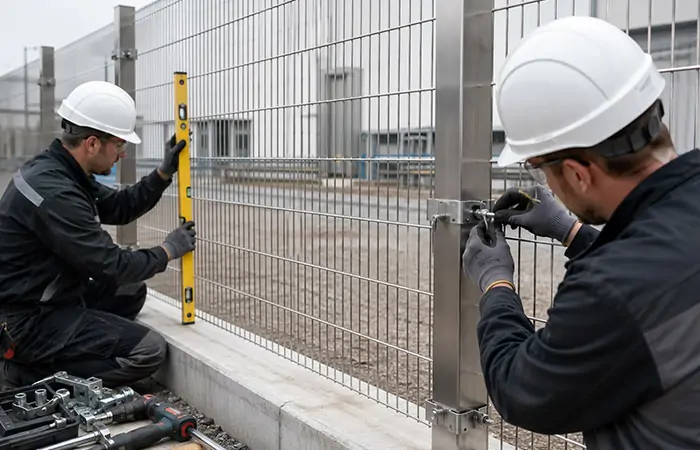
Pose de panneaux de clôture en treillis métallique soudé
Les méthodes d'installation varient en fonction de la hauteur de la clôture, des conditions du sol, de la charge due au vent et des exigences en matière de sécurité. Voici une séquence générale.
Préparer la mise en page
Marquez le tracé de la clôture, les angles, les portails et les dénivelés. Vérifiez la présence de réseaux souterrains avant de procéder aux travaux d'excavation.
Installer les poteaux
Les poteaux peuvent être encastrés dans le béton, fixés au béton à l'aide de plaques de base ou raccordés à une structure métallique existante. Veillez à ce que les poteaux restent verticaux et alignés.
La résistance du béton, les dimensions des semelles et la durée de prise doivent être déterminées en fonction des conditions propres au projet.
Positionner les panneaux
Mettez chaque panneau en place et veillez à maintenir une distance constante par rapport au sol. Utilisez des supports provisoires pour vérifier le niveau, l'alignement et l'espacement.
Fixer les panneaux
Fixez les panneaux à l'aide des colliers, supports ou boulons en acier inoxydable spécifiés. Serrez les fixations de manière uniforme pour éviter toute déformation du treillis.
Installation des portails et des renforts
Les poteaux de portail peuvent nécessiter un renforcement supplémentaire, car ils supportent des charges mobiles. Vérifiez les charnières, les loquets, la garde au sol et le sens d'ouverture.
Inspecter la clôture une fois terminée
Vérifier :
- Alignement des panneaux
- Éléments de fixation desserrés
- Arêtes vives
- Soudures manquantes
- Câbles endommagés
- Garde au sol
- Fonctionnement du portail
- Stabilité après la pose
- Zones susceptibles de retenir l'eau
Les clôtures de haute sécurité, de grande hauteur ou exposées au vent doivent faire l'objet d'un contrôle par un professionnel qualifié spécialisé dans les clôtures ou les structures.
Entretien et nettoyage
Les clôtures en acier inoxydable nécessitent relativement peu d'entretien, mais il ne faut pas pour autant les négliger.
Inspection de routine
Vérifiez régulièrement la clôture afin de détecter :
- Colliers et fixations desserrés
- Fils tordus
- Soudures rompues
- Dommages dus à un choc
- Dépôts en surface
- Contamination par le fer
- Mauvais drainage
- Mouvements autour des fondations des poteaux
Les sites où les véhicules ou les machines circulent fréquemment peuvent nécessiter des inspections plus fréquentes.
Nettoyage des mailles en acier inoxydable
Pour le nettoyage général :
- Rincez les salissures non incrustées à l'eau claire.
- Utilisez un détergent doux si nécessaire.
- Utilisez une brosse ou un chiffon doux et non abrasif.
- Rincez abondamment.
- Veillez à ce que l'eau s'écoule plutôt que de s'accumuler dans les joints.
Évitez les brosses et les outils en acier au carbone susceptibles de déposer des particules de fer sur la surface en acier inoxydable. Vérifiez que les produits chimiques de nettoyage sont compatibles avec le type d’acier inoxydable utilisé.
Pourquoi l'acier inoxydable peut-il présenter des taches brunes ?
Une coloration superficielle peut être due à :
- Particules d'acier au carbone déposées
- Accumulation de sel
- Produits chimiques de nettoyage inadaptés
- Mauvais drainage
- Contamination due au soudage
- Nettoyage insuffisant
- Nuance de matériau incorrecte
Une tache brune n'est pas toujours le signe d'une corrosion structurelle profonde, mais il convient d'en rechercher la cause.
Facteurs influençant le prix des clôtures en treillis métallique soudé en acier inoxydable
Il n'existe pas de prix au mètre carré universel fiable, car les exigences en matière de matériaux et de fabrication varient considérablement.
Les principaux facteurs de coût sont les suivants :
Nuance d'acier inoxydable
Le grade 316 coûte généralement plus cher que le 304 en raison de sa composition en alliage et de son prix sur le marché. Les certificats de conformité des matériaux et les exigences spécifiques au grade peuvent également influer sur le devis.
Diamètre du fil
Un fil plus épais augmente la quantité d'acier inoxydable présente dans chaque panneau. La matière première représentant une part importante du coût, une légère augmentation du diamètre peut avoir une incidence significative sur le prix.
Ouverture en maille
Les ouvertures plus petites nécessitent davantage de fils longitudinaux et transversaux. Cela entraîne une augmentation de la quantité de matériau utilisée, du temps de soudage et du poids du panneau.
Dimensions et quantité des panneaux
Les grands panneaux peuvent permettre de réduire le nombre de montants, mais leur fabrication, leur emballage et leur manutention peuvent s'avérer plus difficiles. Des quantités commandées plus importantes peuvent améliorer l'efficacité de la production.
Montures et accessoires
Les poteaux, les montants, les serre-joints, les plaques de base, les portillons et les fixations en acier inoxydable doivent être pris en compte lors de la comparaison des prix des systèmes de clôture complets.
Conditionnement
L'emballage destiné à l'exportation peut comprendre des fagots, des palettes en acier, des caisses en bois, un film protecteur et des matériaux résistants à l'humidité. L'emballage doit empêcher toute déformation et toute contamination des panneaux pendant le transport.
Fret
Les frais de transport dépendent du poids et du volume de l'envoi, de sa destination, de l'utilisation des conteneurs et des exigences locales en matière de livraison.
Voici une formule pratique pour calculer le coût d'un projet :
Coût total du projet = panneaux grillagés + poteaux + portails + fixations + fabrication + emballage + transport + installation
Comment évaluer un fournisseur de treillis métalliques soudés
Un devis peu élevé ne signifie pas nécessairement que le coût du projet sera le plus bas. Avant de passer commande, évaluez à la fois la qualité des matériaux et le processus de contrôle qualité du fabricant.
Vérifier la nuance du matériau
Demandez au fournisseur d'indiquer clairement la nuance dans le devis et les documents de fabrication. Demandez un certificat de conformité du matériau lorsque la vérification de la nuance est importante.
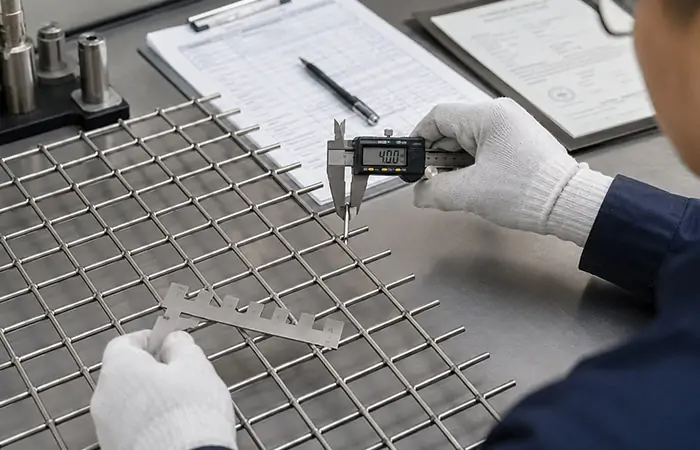
Vérifier la qualité des soudures
Vérifiez les éléments suivants sur un échantillon ou un panneau de pré-production :
- Soudures manquantes
- Carrefours peu sûrs ou endommagés
- Traces de brûlure importantes
- Ouvertures irrégulières
- Déformation du panneau
- Fils sectionnés
- Bords tranchants ou mal coupés
Vérifier les tolérances dimensionnelles
Le devis doit indiquer les dimensions nominales et, le cas échéant, les tolérances admises pour le diamètre du fil, l'ouverture des mailles et les dimensions des panneaux.
Examiner les possibilités de personnalisation
Vérifiez si le fournisseur est en mesure de fournir :
- Ouvertures sur mesure
- Diamètres de fil sur mesure
- Panneaux découpés sur mesure
- Cadres
- Portails
- Traitement des bords
- Emballage spécial
- Marque de distributeur
- Documentation relative aux inspections
Pour en savoir plus sur l'expérience de YESON en matière de fabrication et de personnalisation, rendez-vous sur le À propos de YESON page.
Demander un échantillon
Un échantillon permet à l'acheteur d'évaluer le matériau, la taille des mailles, le diamètre du fil, l'uniformité des soudures et la finition avant le lancement de la production en série. L'approbation de l'échantillon est particulièrement utile pour les panneaux sur mesure.
Informations à inclure dans votre appel d'offres
Fournir des informations complètes permet de réduire les délais de soumission des devis et aide les différents fournisseurs à établir leurs devis sur une base uniforme.
Veuillez utiliser le modèle d'appel d'offres suivant :
Produit : Panneau de clôture en treillis métallique soudé en acier inoxydable
Nuance du matériau : 304 / 316 / autre
Maillage : ___ × ___ mm
Mesure initiale : Ouverture libre / entraxe
Diamètre du fil : ___ mm
Dimensions du panneau : ___ × ___ mm
Quantité : ___ panneaux
Type de bord : À ras / en saillie / plié / encadré
Postes à pourvoir : Oui / Non
Éléments de fixation nécessaires : Oui / Non
Portails requis : Oui / Non
Utilisation : ___
Environnement d'installation : ___
Pays ou port de destination : ___
Exigences en matière d'emballage : ___
Certificats ou contrôles requis : ___
Envoyez ces informations via le Page de devis YESON pour obtenir une proposition adaptée à votre projet.
Questions fréquemment posées
Le treillis métallique soudé en acier inoxydable convient-il à la réalisation de clôtures extérieures ?
Oui. Il est couramment utilisé à l'extérieur en raison de sa résistance à la corrosion. Il convient de choisir la nuance appropriée en fonction du taux d'humidité, de la présence de sel, des produits chimiques et de la durée de vie requise.
Quel est le meilleur choix pour une clôture extérieure : l'acier 304 ou 316 ?
La nuance 304 convient à de nombreux environnements extérieurs généraux. La nuance 316 est généralement privilégiée pour les zones côtières, marines et riches en chlorure. Il n'est pas systématiquement nécessaire d'opter pour la nuance la plus chère dans tous les projets.
Le treillis soudé en acier inoxydable rouille-t-il ?
L'acier inoxydable résiste à la corrosion, mais il n'en est pas pour autant totalement à l'abri. Les dépôts de sel, la contamination par le fer, l'utilisation de produits chimiques inadaptés et le choix d'une nuance inappropriée peuvent entraîner l'apparition de taches ou une corrosion localisée.
Quelle est la maille la plus adaptée pour une clôture de sécurité ?
Il n'existe pas de taille idéale. Des mailles trop petites peuvent compliquer l'escalade et l'accès aux outils, tandis qu'un fil plus épais améliore la rigidité. La sécurité dépend également de la hauteur de la clôture, des poteaux, des fixations, des portails et des fondations.
Le treillis soudé est-il plus résistant que le treillis tissé ?
Les treillis soudés offrent généralement une meilleure stabilité des mailles et une plus grande rigidité des panneaux. Les treillis tissés peuvent quant à eux offrir davantage de souplesse et s'avérer préférables pour la filtration ou les installations nécessitant une certaine mobilité.
À quoi sert un treillis métallique soudé de 1/2 pouce ?
Un maillage de 1/2 pouce est couramment utilisé pour les enclos de petits animaux, les barrières anti-nuisibles, les grillages de protection et les protections fines pour machines. Le diamètre de fil requis dépend de l'application.
Peut-on découper un treillis soudé en acier inoxydable aux dimensions souhaitées ?
Oui. Il peut être découpé à l'aide d'outils adaptés, mais les bords ainsi obtenus peuvent être tranchants. Les bords coupés doivent être ébavurés, repliés ou enfermés dans un cadre lorsqu'ils risquent d'entrer en contact avec des personnes ou des animaux.
Peut-on installer des lattes brise-vue sur une clôture en treillis métallique soudé ?
Certains modèles de clôtures soudées peuvent être équipés de panneaux brise-vue ou de lattes, mais il faut tenir compte de la charge supplémentaire due au vent. Les poteaux, les panneaux et les fondations peuvent nécessiter un renforcement.
Quelle est la durée de vie d'une clôture en acier inoxydable ?
La durée de vie dépend de la nuance de l'alliage, des conditions d'exposition, du mode de fabrication, de l'entretien et de la conception structurelle. Il est impossible d'estimer une durée de vie fiable sans connaître l'environnement d'installation.
Quelles informations sont nécessaires pour obtenir un devis précis ?
Veuillez indiquer la classe, l'ouverture, le diamètre du fil, les dimensions du panneau, la quantité, le type de bordure, les accessoires, l'application, la destination et les exigences en matière de documentation.
Conclusion
Les clôtures en treillis métallique soudé en acier inoxydable constituent une solution rigide, épurée et résistante à la corrosion pour les projets industriels, commerciaux, d'enclos pour animaux et architecturaux.
La nuance 304 convient à de nombreuses applications générales, tandis que la nuance 316 offre une meilleure résistance dans les environnements côtiers et riches en chlorure. L’ouverture des mailles, le diamètre des fils, les cadres, les poteaux et les éléments de fixation doivent être précisés dans le cadre d’un système complet.
Lorsque vous comparez des devis, ne vous basez pas uniquement sur le prix par panneau. Vérifiez la nuance exacte de l’acier inoxydable, le diamètre du fil, les dimensions des mailles, la qualité des soudures, les tolérances, l’emballage et les accessoires fournis.
Vous avez besoin de panneaux en treillis soudé en acier inoxydable sur mesure pour votre prochain projet ? Indiquez à YESON la nuance souhaitée, la taille des mailles, le diamètre du fil, les dimensions des panneaux, la quantité et la destination pour recevoir un devis personnalisé.
 FR
FR  EN
EN  DE
DE  ES
ES  AR
AR  PT
PT