
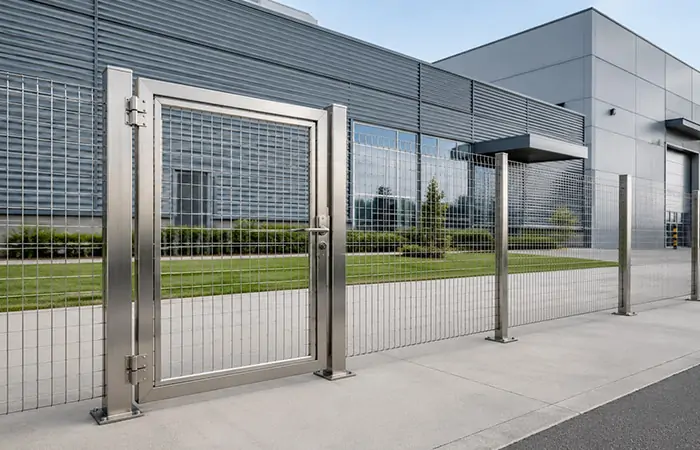
Stainless steel welded wire mesh fencing is widely used in industrial facilities, food-processing plants, animal enclosures, coastal projects, machine guards and architectural applications. Its rigid construction, uniform mesh openings and corrosion-resistant material make it a practical alternative to galvanized steel fencing in demanding environments.
However, specifying a stainless steel fence involves more than selecting a panel size. Buyers must also consider the stainless steel grade, wire diameter, mesh opening, panel construction, edge treatment, posts, fasteners and installation environment.
This guide explains how stainless steel welded wire mesh is manufactured, how 304 differs from 316, which specifications matter and what information buyers should include when requesting a quotation.
For available sizes and customization options, view YESON’s painéis de malha de arame soldado de aço inoxidável.
What Is Stainless Steel Welded Wire Mesh Fencing?
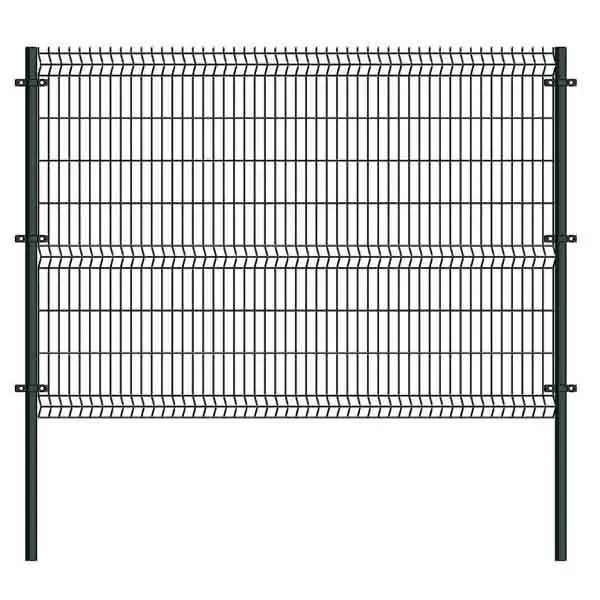
Stainless steel welded wire mesh fencing consists of longitudinal and transverse stainless steel wires positioned at right angles and resistance-welded at every intersection. The process produces square or rectangular openings that remain relatively stable under normal use.
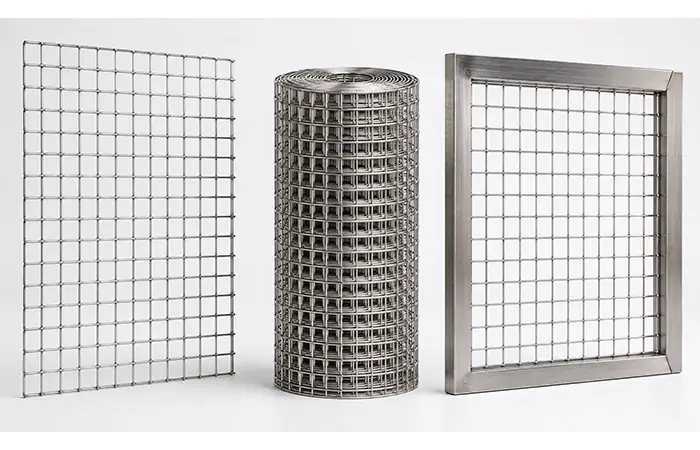
The finished mesh may be supplied as:
- Flat welded wire mesh panels
- Flexible welded mesh rolls
- Framed stainless steel fence panels
- Machine-guard panels
- Animal-enclosure panels
- Custom gates and partitions
Unlike woven wire mesh, welded mesh does not depend on interlocking wires to maintain its structure. Each intersection is welded, creating a more rigid metal mesh suitable for fencing, partitions and equipment protection.
A complete fence system normally includes the mesh panels, supporting posts, clamps, brackets, fasteners, gates and foundations. The strength of the finished fence therefore depends on the entire system—not only the wire mesh.
How Is Stainless Steel Welded Wire Mesh Manufactured?
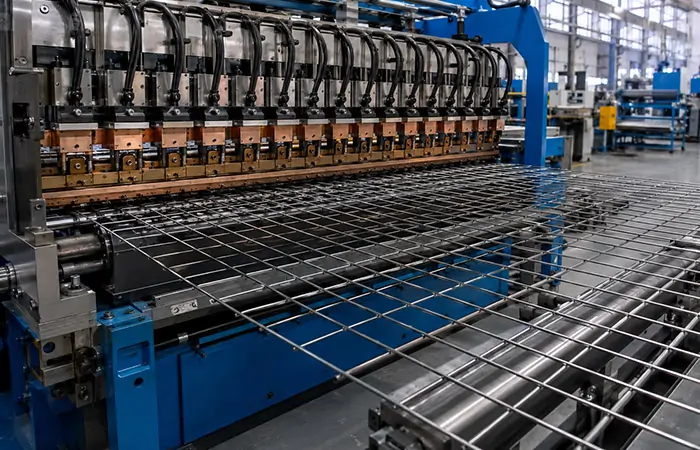
Production generally begins with stainless steel wire supplied in coils. The wire is straightened and cut or fed continuously into an automated welding machine.
The main manufacturing stages include:
- Wire preparation: Stainless steel wire is selected according to the required grade and diameter.
- Straightening and feeding: Longitudinal and transverse wires are positioned at the specified spacing.
- Resistance welding: Controlled electrical resistance and pressure join the wires at each intersection.
- Cutting: The welded mesh is cut into panels or prepared as a roll.
- Flattening: Rigid panels may be levelled to reduce distortion.
- Edge finishing: Wire ends may be flush-cut, left with an overhang or enclosed within a frame.
- Inspection: Mesh size, wire diameter, panel dimensions, weld consistency and surface condition are checked.
- Packaging: Panels are bundled or palletized to reduce bending and contamination during transportation.
Projects that require continuous material rather than rigid panels can use a stainless steel welded wire mesh roll.
Welded Mesh vs. Woven Mesh vs. Chicken Wire
These products are sometimes grouped under the term “wire mesh,” but they have different structures and performance characteristics.
| Produto | Construção | Rigidez | Common uses |
|---|---|---|---|
| Tela de arame soldada | Wires welded at each intersection | Alto | Fencing, guards, cages and partitions |
| Rede metálica tecida | Wires interwoven over and under each other | Flexible to medium | Filtration, screening and sieving |
| Chicken wire | Thin wire twisted into hexagonal openings | Baixo | Poultry enclosures and light barriers |
| Chain link mesh | Wires woven into a diamond pattern | Flexível | Perimeter fencing and sports facilities |
Welded metal mesh is usually the better option when uniform openings, panel rigidity and predictable fabrication are required. Woven mesh is more suitable for fine filtration, while chicken wire is generally intended for lightweight containment rather than high-strength fencing.
For a broader explanation of material forms and applications, see what stainless steel mesh is used for.
Why Choose Stainless Steel for Welded Mesh Fencing?
Stainless steel contains at least 10.5% chromium. This chromium forms a thin passive layer on the surface that helps protect the underlying metal from corrosion. Stainless steel should nevertheless be described as corrosion-resistant—not completely corrosion-proof.
Its performance depends on the alloy grade, fabrication quality, surface contamination, local environment and cleaning practices.
Resistência à corrosão
Corrosion resistance is one of the main reasons buyers select stainless steel welded wire mesh fencing. It is particularly valuable where ordinary carbon steel would require painting, galvanizing or frequent replacement.
Typical environments include:
- Humid industrial buildings
- Food and beverage facilities
- Water-treatment plants
- Coastal infrastructure
- Laboratórios
- Pharmaceutical facilities
- Wash-down areas
- Animal and veterinary enclosures
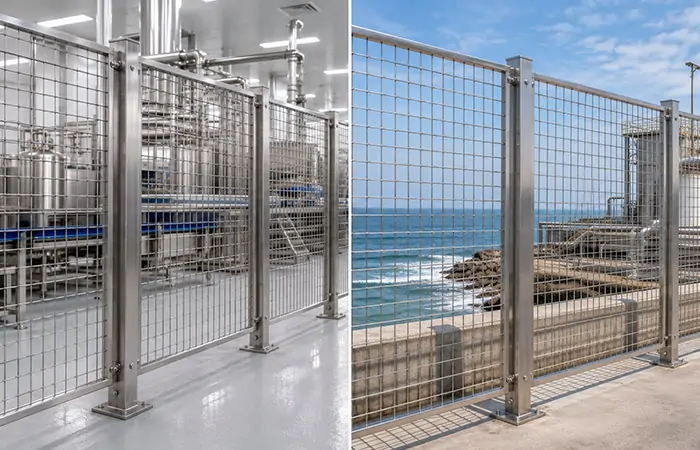
Selecting the correct stainless steel grade remains important. Grade 304 may perform well in an indoor food-processing facility but may not be the best choice for a fence exposed to airborne salt beside the ocean.
Rigid and Stable Mesh Openings
Because the wires are welded at each intersection, the openings resist movement better than those in many woven products. This makes welded mesh suitable for safety partitions, storage enclosures, cages and machine guarding.
Smaller openings and thicker wires generally increase rigidity, but they also increase material weight and cost. The fence designer must balance visibility, ventilation, strength, weight and security requirements.
Hygiene and Cleanability
The relatively smooth stainless steel surface is easier to clean than a painted surface with peeling or damaged coating. This can be useful in hygiene-sensitive environments.
However, sanitary suitability depends on the complete design. Sharp edges, inaccessible joints, poorly designed frames and dirt-trapping connections may still cause problems. Buyers should consider how the panels will be cleaned and whether they will be exposed to pressure washing, steam, chemicals or disinfectants.
Longa vida útil
Stainless steel normally has a higher initial purchase price than galvanized steel mesh. In a corrosive environment, the longer service life and reduced need for coating repair can improve lifetime value.
The correct comparison is therefore not simply the price per panel. Buyers should consider:
- Expected replacement frequency
- Cleaning and maintenance costs
- Coating repair
- Installation labour
- Production downtime
- Disposal and replacement costs
304 vs. 316 Stainless Steel Welded Wire Mesh
Grades 304 and 316 are the most frequently requested materials for stainless steel mesh fencing. Both are commonly used austenitic stainless steels, but 316 contains molybdenum, which improves resistance to pitting and crevice corrosion in many chloride-containing environments.
| Factor | 304 stainless steel | 316 stainless steel |
| Resistência geral à corrosão | Bom | Mais alto |
| Resistência aos cloretos | Moderado | Better |
| Common environment | Indoor, urban and general industrial | Coastal, marine and chloride-rich |
| Relative material cost | Mais baixo | Mais alto |
| Typical fencing use | General-purpose stainless fencing | More aggressive exposure conditions |
When Should You Choose 304 Stainless Steel?
Grade 304 is commonly selected for:
- Indoor warehouse partitions
- General industrial fencing
- Machine guards
- Architectural infill
- Food-processing areas without aggressive chloride exposure
- Animal enclosures in controlled environments
- Urban outdoor locations with moderate exposure
It offers a useful balance between corrosion resistance, fabrication performance and material cost.
When Is 316 Stainless Steel Worth the Additional Cost?
Grade 316 is normally considered for:
- Coastal fencing
- Marine facilities
- Swimming-pool surroundings
- Aquicultura de água salgada
- Chemical-processing plants
- Locations exposed to de-icing salts
- Industrial wash-down areas containing chlorides
The term “marine grade” does not mean that 316 can never stain or corrode. Salt deposits, poor drainage, surface contamination and extreme exposure may still affect performance. Material selection should be based on actual site conditions.
For a more detailed material comparison, read 304 vs. 316 stainless steel wire mesh.
Can 304 and 316 Be Identified by Appearance?
Usually not. Both materials have a similar metallic appearance. Buyers should not rely on colour or visual inspection to verify the grade.
For B2B orders, request documentation such as:
- Mill material certificate
- Chemical composition report
- Purchase specification
- Grade identification
- Third-party testing when required
The documentation should correspond to the material batch used for production rather than being a generic sample certificate.
Stainless Steel Welded Wire Mesh Specifications
A useful specification must define more than “stainless steel mesh panel.” At minimum, it should state the grade, wire diameter, opening size, panel dimensions, quantity and edge treatment.
Tamanho da abertura da malha
The mesh opening affects security, visibility, ventilation, animal containment and the ability to reach through the fence.
| Nominal opening | Typical application |
| 1/4 inch | Fine guards, pest barriers and small-animal containment |
| 1/2 inch | Small-animal enclosures and protective screens |
| 1 inch | Cages, partitions and general guards |
| 1 × 2 inches | Enclosures and industrial partitions |
| 2 × 2 inches | General fencing and large cages |
| 2 × 4 inches | Perimeter and agricultural applications |
| 3 inches and above | Large enclosures and economical barriers |
Ask whether “opening” means the clear distance between wires or the centre-to-centre spacing. Confusing these two measurements can lead to a significant dimensional error.
Wire Diameter and Gauge
Wire diameter influences panel stiffness, impact resistance, weight and price. A heavy-duty welded wire fence panel normally requires a thicker wire than a lightweight animal enclosure.
Wire gauge systems are not always interpreted consistently across markets. For international purchasing, specify the diameter in millimetres, even if a gauge number is also included.
Por exemplo:
Wire diameter: 3.0 mm actual diameter
Mesh opening: 50 × 50 mm clear opening
This is clearer than requesting “12-gauge mesh” without identifying the gauge system or measurement tolerance.
Panel Dimensions
Common welded mesh panel dimensions vary by market and application. Custom manufacturing may include:
- Largura do painel
- Altura do painel
- Abertura de malha
- Diâmetro do fio
- Flat or framed construction
- Reinforced edges
- Cut-outs
- Mounting holes
- Gates
- Special packaging
Panel dimensions should coordinate with the post spacing. Ordering the mesh before confirming the supporting structure may create installation problems.
Flat Panels, Rolls and Framed Panels
Flat panels provide better rigidity and are easier to install in modular fence systems, equipment guards and cages.
Mesh rolls are useful when continuous coverage, easier transport or on-site cutting is required. Fine wire and smaller diameters are more suitable for rolling than very heavy rigid mesh.
Framed panels combine welded mesh with a surrounding angle, tube or flat-bar frame. The frame provides additional stiffness and creates defined fixing points.
Edge Types
Common edge configurations include:
- Flush-cut edge: Wires are cut close to the outer cross wire.
- Overhanging edge: Wire ends extend beyond the final cross wire.
- Folded edge: The mesh is bent to improve stiffness or reduce exposed ends.
- Framed edge: The mesh is welded or fixed inside a surrounding frame.
Flush or framed edges are generally preferred where people or animals could contact the panel. Overhanging wires may be used as a security feature, but their position and legality should be reviewed for the specific project.
Aplicações comuns
Industrial Safety Fencing
Stainless steel mesh panels can separate workers from machinery, robotic cells, conveyors and restricted production areas. Their open construction maintains visibility and airflow.
A machine guard should be designed around the specific hazard, access distance and applicable safety requirements. Mesh opening, fence height and distance from the hazard must be considered together.
Food and Pharmaceutical Facilities
Food, beverage and pharmaceutical facilities may use stainless steel mesh for:
- Storage partitions
- Equipment guards
- Ingredient cages
- Wash-down enclosures
- Production-area separation
- Ventilation barriers
Stainless steel is often selected because it resists moisture and does not depend on an applied paint layer. The grade and finish should still be evaluated against the chemicals and cleaning processes used at the facility.
Coastal and Marine Fencing
Coastal projects expose metal fencing to salt-laden air. Grade 316 can offer better resistance than 304, but regular fresh-water cleaning may still be necessary.
Designers should also evaluate:
- Distance from the shoreline
- Prevailing wind direction
- Direct saltwater contact
- Temperature and humidity
- Drenagem
- Cleaning frequency
- Compatibility of posts and fasteners
Using a 316 mesh panel with lower-grade fasteners can create weak points in the system.
Recintos para animais
Stainless steel welded mesh is used for kennels, aviaries, veterinary facilities, poultry enclosures and breeding cages.
Selection should consider:
- Animal size
- Required opening
- Bite or impact force
- Diâmetro do fio
- Sharp-edge protection
- Cleaning chemicals
- Floor and frame connections
A small opening does not automatically make a panel suitable for every animal. Wire strength, weld quality and the supporting frame are equally important.
Water Treatment and Chemical Plants
These facilities may expose fencing to continuous moisture, treatment chemicals or airborne contaminants. Grade selection should be based on the chemical, concentration, temperature and duration of exposure.
When the environment is especially aggressive, obtain advice from a materials engineer instead of assuming that any stainless steel grade will be sufficient.
Architectural Projects
Stainless steel mesh can be incorporated into:
- Railing infill
- Garden partitions
- Stair barriers
- Metal mesh gates
- Wood-and-wire fences
- Rail fences with wire mesh
- Decorative screens
Its regular grid and metallic appearance suit modern architectural designs. For public areas, the finished system should comply with applicable guard, opening and load requirements.
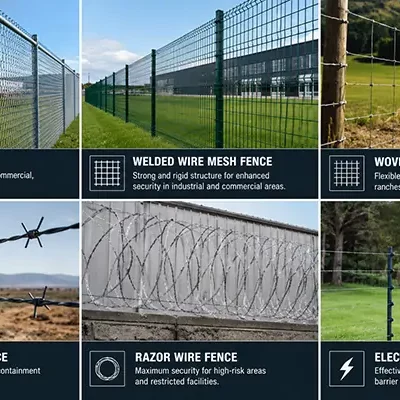
To compare stainless welded fencing with other fence constructions, see the guide to different types of wire fences.
Stainless Steel vs. Galvanized Welded Wire Mesh
Galvanized and stainless steel mesh can both provide effective fencing. The correct choice depends on exposure, service-life expectations and project budget.
| Factor | Malha de aço inoxidável | Galvanized welded mesh |
| Initial cost | Usually higher | Usually lower |
| Proteção contra a corrosão | Provided by the alloy | Provided primarily by zinc coating |
| Cut edges | No separate coating layer | Protection depends on coating and exposure |
| Aparência | Natural stainless finish | Bright or matte galvanized finish |
| Coastal use | 316 may be suitable | Requires careful coating selection |
| Manutenção | Generally low | Depends on coating damage and environment |
| Material verification | Grade certificate | Base wire and coating specification |
When Is Galvanized Mesh the Better Choice?
Galvanized welded wire mesh is often more economical for:
- General agricultural fencing
- Dry inland locations
- Temporary enclosures
- Construction applications
- Projects with strict initial budgets
- Locations where panels can be replaced easily
Buyers considering this alternative can review YESON’s galvanized welded wire mesh panels.
When Does Stainless Steel Offer Better Lifetime Value?
Stainless steel may provide better value where coating damage, salt exposure, constant washing or frequent replacement would make galvanized fencing expensive to maintain.
Examples include coastal plants, food facilities, chemical-processing areas and locations where replacing a fence would interrupt production.
Can Stainless Mesh Be Installed on Galvanized or Carbon-Steel Frames?
It is physically possible, but connections between dissimilar metals require attention. Moisture and electrical contact between different metals can contribute to galvanic corrosion under certain conditions.
The project designer may specify compatible fasteners, isolation washers, protective barriers or a matching stainless steel frame. Water-trapping joints should also be avoided.
How to Select the Right Stainless Steel Mesh Fence
1. Define the Function
Start by identifying whether the mesh will be used as:
- Vedação do perímetro
- Proteção de máquinas
- Animal containment
- Warehouse partitioning
- Security screening
- Architectural infill
- Equipment protection
Different applications require different opening sizes, heights and wire diameters.
2. Evaluate the Environment
Record whether the installation is indoors or outdoors and identify exposure to:
- Sal
- Humidity
- Chemicals
- Cleaning agents
- High temperatures
- Animal waste
- Industrial dust
- Standing water
This information helps determine whether 304, 316 or another material should be considered.
3. Choose the Mesh Opening
The opening must contain the intended animal or object and prevent access to hazards. It should also provide the required airflow and visibility.
4. Select the Wire Diameter
A thicker wire increases stiffness and material weight. Avoid selecting wire diameter from price alone; the panel must be suitable for the expected impact and span between supports.
5. Define the Panel and Post System
Confirm:
- Panel width and height
- Post spacing
- Post section
- Corner posts
- Gate posts
- Base plates or embedded posts
- Clamp quantity
- Foundation requirements
6. Specify Edges and Fasteners
Identify whether edges must be flush, framed or extended. Fasteners should be compatible with the panel material and appropriate for the security level.
7. Confirm Documentation
Depending on the project, documentation may include:
- Material certificates
- Dimensional inspection report
- Weld inspection
- Sample approval
- Packing photographs
- Production photographs
- Third-party inspection
- Country-of-origin documentation
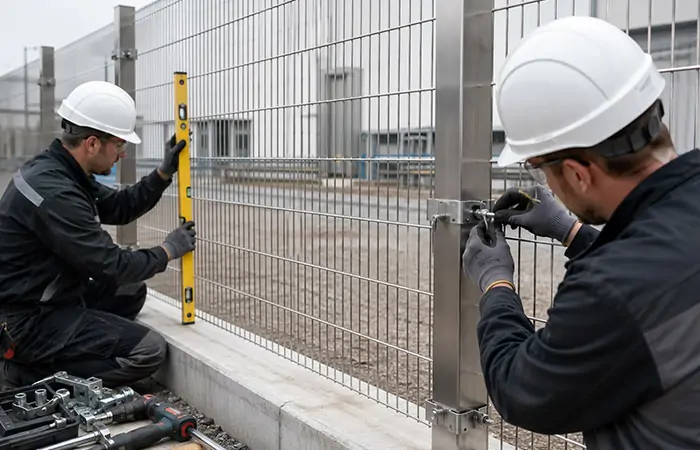
Installation of Welded Wire Mesh Fence Panels
Installation methods vary according to fence height, ground conditions, wind loading and security requirements. The following is a general sequence.
Prepare the Layout
Mark the fence line, corners, gates and changes in elevation. Confirm underground services before excavation.
Install the Posts
Posts may be embedded in concrete, fixed to concrete with base plates or connected to an existing steel structure. Keep the posts vertical and aligned.
Concrete strength, footing dimensions and curing time should be determined according to the project conditions.
Position the Panels
Lift each panel into position and maintain a consistent clearance above the ground. Use temporary supports while checking level, alignment and spacing.
Attach the Panels
Secure the panels using specified stainless steel clamps, brackets or bolts. Tighten the fixings evenly to avoid distorting the mesh.
Install Gates and Reinforcement
Gate posts may require additional reinforcement because they carry moving loads. Check the hinges, latches, ground clearance and opening direction.
Inspect the Completed Fence
Check:
- Panel alignment
- Loose fasteners
- Sharp edges
- Missing welds
- Damaged wires
- Ground clearance
- Gate operation
- Post stability
- Areas that may trap water
High-security, tall or wind-exposed fencing should be reviewed by a qualified fence or structural professional.
Maintenance and Cleaning
Stainless steel fencing requires relatively little maintenance, but it should not be ignored.
Routine Inspection
Inspect the fence periodically for:
- Loose clamps and fasteners
- Bent wires
- Broken welds
- Impact damage
- Surface deposits
- Iron contamination
- Poor drainage
- Movement around post foundations
Facilities with frequent vehicle or machinery movement may require more frequent inspections.
Cleaning Stainless Steel Mesh
For general cleaning:
- Rinse away loose dirt with fresh water.
- Apply a mild detergent when necessary.
- Use a soft, non-abrasive brush or cloth.
- Rinse thoroughly.
- Allow water to drain rather than collect in joints.
Avoid carbon-steel brushes and tools that can transfer iron particles onto the stainless surface. Cleaning chemicals should be checked for compatibility with the stainless grade.
Why Can Stainless Steel Develop Brown Stains?
Surface staining may result from:
- Deposited carbon-steel particles
- Salt accumulation
- Inappropriate cleaning chemicals
- Poor drainage
- Welding contamination
- Insufficient cleaning
- Incorrect material grade
A brown stain does not always indicate deep structural corrosion, but its cause should be investigated.
Stainless Steel Welded Wire Mesh Fence Price Factors
There is no reliable universal price per square metre because the material and fabrication requirements vary significantly.
The main cost factors are:
Grau de aço inoxidável
Grade 316 generally costs more than 304 because of its alloy composition and market price. Material certificates and special grade requirements can also affect the quotation.
Diâmetro do fio
Thicker wire increases the amount of stainless steel in every panel. Because raw material is a major part of the cost, a small increase in diameter can materially affect pricing.
Abertura de malha
Smaller openings require more longitudinal and transverse wires. This increases material use, welding time and panel weight.
Panel Size and Quantity
Large panels may reduce the number of posts but can be more difficult to manufacture, pack and handle. Higher order quantities may improve production efficiency.
Frames and Accessories
Posts, frames, clamps, base plates, gates and stainless steel fasteners must be included when comparing complete fence-system prices.
Embalagem
Export packaging may include bundles, steel pallets, wooden cases, protective film and moisture-resistant materials. Packaging should prevent panel deformation and contamination during transportation.
Freight
Freight depends on shipment weight, volume, destination, container utilization and local delivery requirements.
A practical project-cost formula is:
Total project cost = mesh panels + posts + gates + fasteners + fabrication + packaging + freight + installation
How to Evaluate a Welded Wire Mesh Supplier
A low quotation does not necessarily represent the lowest project cost. Before placing an order, evaluate both the material and the manufacturer’s quality-control process.
Verify the Material Grade
Ask the supplier to state the grade clearly in the quotation and production documents. Request a material certificate when grade verification is important.
Check the Weld Quality
Inspect a sample or pre-production panel for:
- Missing welds
- Weak or broken intersections
- Excessive burn marks
- Uneven openings
- Panel distortion
- Split wires
- Sharp or poorly cut edges
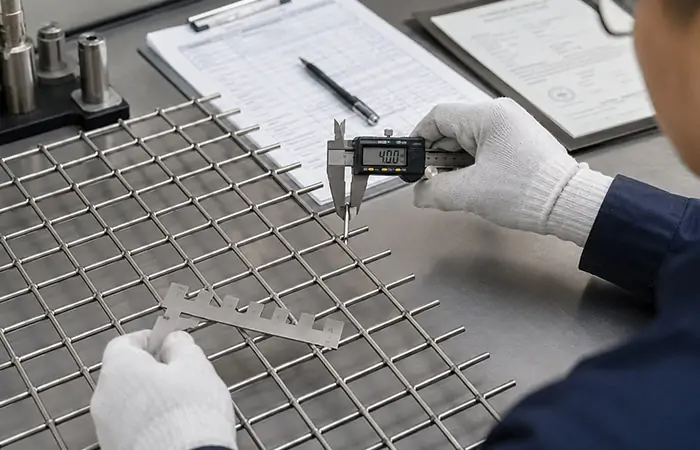
Confirm Dimensional Tolerances
The quotation should state the nominal dimensions and, where necessary, permitted tolerances for wire diameter, mesh opening and panel size.
Review Customization Capability
Confirm whether the supplier can provide:
- Custom openings
- Custom wire diameters
- Cut-to-size panels
- Frames
- Gates
- Edge treatment
- Special packaging
- Private labelling
- Inspection documentation
You can learn more about YESON’s manufacturing and customization background on the Sobre a YESON page.
Request a Sample
A sample allows the buyer to evaluate the material, opening size, wire diameter, weld consistency and finish before mass production. Sample approval is especially useful for customized panels.
Information to Include in Your RFQ
Providing complete information reduces quotation delays and helps different suppliers quote on the same basis.
Use the following RFQ template:
Product: Stainless steel welded wire mesh fence panel
Material grade: 304 / 316 / other
Mesh opening: ___ × ___ mm
Opening measurement: Clear opening / centre-to-centre
Diâmetro do fio: ___ mm
Panel size: ___ × ___ mm
Quantity: ___ panels
Edge type: Flush-cut / overhang / folded / framed
Posts required: Yes / No
Fasteners required: Yes / No
Gates required: Yes / No
Application: ___
Installation environment: ___
Destination country or port: ___
Packaging requirement: ___
Required certificates or inspection: ___
Send this information through the YESON quotation page to obtain a project-specific proposal.
Perguntas mais frequentes
Is stainless steel welded wire mesh suitable for outdoor fencing?
Yes. It is commonly used outdoors because of its corrosion resistance. The correct grade should be selected according to humidity, salt, chemicals and required service life.
Is 304 or 316 better for outdoor fencing?
Grade 304 suits many general outdoor environments. Grade 316 is usually preferred for coastal, marine and chloride-rich locations. The more expensive grade is not automatically necessary for every project.
Does stainless steel welded mesh rust?
Stainless steel is corrosion-resistant, but it is not completely immune to corrosion. Salt deposits, iron contamination, inappropriate chemicals and incorrect grade selection can lead to staining or localized corrosion.
What mesh size is best for a security fence?
There is no single best size. Smaller openings can make climbing and tool access more difficult, while thicker wire improves rigidity. Security performance also depends on fence height, posts, fixings, gates and foundations.
Is welded mesh stronger than woven mesh?
Welded mesh normally provides greater opening stability and panel rigidity. Woven mesh may offer more flexibility and can be preferable for filtration or installations requiring movement.
What is 1/2-inch welded wire mesh used for?
A 1/2-inch mesh is commonly used for small-animal enclosures, pest barriers, protective screens and fine machine guards. The required wire diameter depends on the application.
Can stainless steel welded mesh be cut to size?
Yes. It can be cut with suitable tools, but the resulting edges may be sharp. Cut edges should be deburred, folded or enclosed in a frame when they could contact people or animals.
Can privacy slats be installed in welded wire fencing?
Some welded fence designs can accept privacy screens or slats, but the additional wind load must be considered. The posts, panels and foundations may require reinforcement.
How long does stainless steel fencing last?
Service life depends on the alloy grade, exposure, fabrication, maintenance and structural design. A reliable lifespan cannot be stated without knowing the installation environment.
What information is required for an accurate price?
Provide the grade, opening, wire diameter, panel dimensions, quantity, edge type, accessories, application, destination and documentation requirements.
Conclusão
Stainless steel welded wire mesh fencing provides a rigid, clean and corrosion-resistant solution for industrial, commercial, animal-containment and architectural projects.
Grade 304 is suitable for many general applications, while 316 offers better resistance in coastal and chloride-rich environments. Mesh opening, wire diameter, frames, posts and fasteners must be specified as part of a complete system.
When comparing quotations, do not evaluate price per panel alone. Confirm the actual stainless steel grade, wire diameter, opening measurement, weld quality, tolerances, packaging and included accessories.
Need customized stainless steel welded mesh panels for your next project? Send YESON your required grade, mesh opening, wire diameter, panel size, quantity and destination to receive a tailored quotation.
 PT
PT  EN
EN  DE
DE  FR
FR  ES
ES  AR
AR