
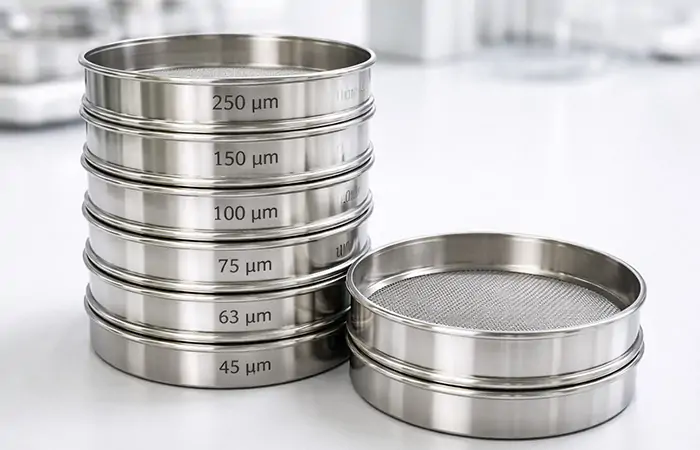
In laboratory testing, mining, food processing, pharmaceuticals, chemicals, and metal powder production, particle size control is not optional—it is fundamental to quality. Yet one of the most common sources of error in sieve analysis is simple confusion about sieve sizes, mesh numbers, and unit conversions.
This guide explains, with practical tables and conversions, how U.S. standard sieve sizes relate to metric (mm and micron) openings, how mesh actually works, and how to select the correct sieve for your application.
Why Understanding Sieve Sizes Is Critical in Industrial Screening
A sieve is not just a piece of wire mesh in a frame. It is a precision measuring instrument used to determine particle size distribution. If you select the wrong sieve size:
- Test results become invalid
- Products fail compliance standards
- Material grading becomes inaccurate
- Quality control data becomes unreliable
This is why laboratories worldwide follow standardized sieve specifications defined by ASTM International under ASTM E11.
What Is a Sieve Size?
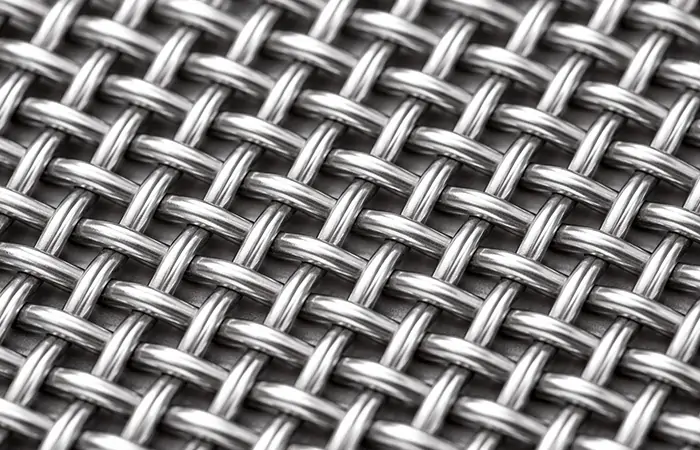
Sieve size refers to the actual clear opening between the wires of a mesh.
It is pas the mesh number.
It is the physical aperture that determines what particles pass through.
Sieve sizes are expressed in:
- Inches (in)
- Millimeters (mm)
- Microns (µm)
Sieve Mesh vs. Sieve Size vs. Microns (The Most Confusing Part)
This is where most mistakes happen.
| Term | What It Means | Important Note |
|---|---|---|
| Engrener | Nombre d'ouvertures par pouce | Higher mesh = smaller opening |
| Sieve Size | Actual opening between wires | What really matters |
| Micron | Metric measurement of opening | 1 mm = 1000 µm |
Why mesh is confusing:
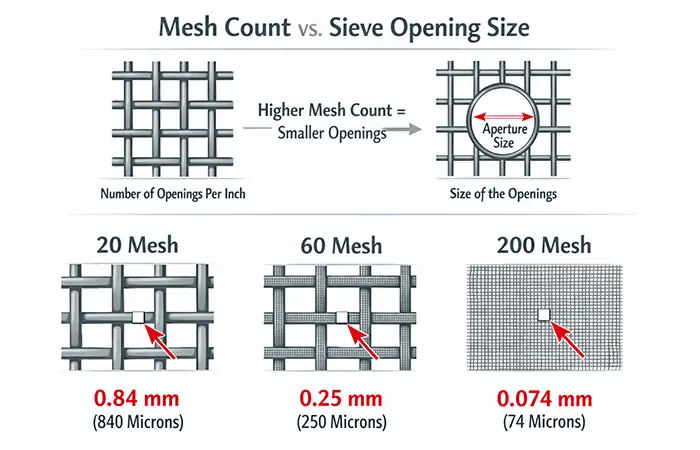
A 200 mesh sieve has smaller holes than a 60 mesh sieve. The number increases as the opening decreases.
U.S. Standard Sieve Sizes (ASTM E11)
Under ASTM E11, U.S. test sieves are standardized from very coarse to extremely fine:
- #4 (very coarse aggregate)
- #10, #40, #60 (common industrial screening)
- #100, #200 (powder and lab analysis)
- #325, #400 (fine powder, metal, pharmaceutical)
These numbers correspond to precise opening sizes, not arbitrary mesh counts.
Complete U.S. Sieve Size Chart (Mesh / Inches / mm / Microns)
This table is the core reference used in laboratories and industrial screening.
| Sieve No. | Engrener | Opening (inch) | Ouverture (mm) | Opening (µm) |
|---|---|---|---|---|
| #4 | 4 | 0.187 | 4.75 | 4750 |
| #10 | 10 | 0.0787 | 2.00 | 2000 |
| #20 | 20 | 0.0331 | 0.85 | 850 |
| #40 | 40 | 0.0165 | 0.425 | 425 |
| #60 | 60 | 0.0098 | 0.250 | 250 |
| #80 | 80 | 0.0070 | 0.180 | 180 |
| #100 | 100 | 0.0059 | 0.150 | 150 |
| #120 | 120 | 0.0049 | 0.125 | 125 |
| #140 | 140 | 0.0041 | 0.106 | 106 |
| #170 | 170 | 0.0035 | 0.090 | 90 |
| #200 | 200 | 0.0029 | 0.075 | 75 |
| #230 | 230 | 0.0024 | 0.063 | 63 |
| #270 | 270 | 0.0021 | 0.053 | 53 |
| #325 | 325 | 0.0017 | 0.045 | 45 |
| #400 | 400 | 0.0015 | 0.038 | 38 |
Metric Sieve Sizes and Millimeter Standards
Many industries outside the U.S. specify sieve sizes directly in millimeters:
| Ouverture (mm) | Opening (µm) | Approx. U.S. Sieve |
|---|---|---|
| 5.00 | 5000 | Larger than #4 |
| 2.00 | 2000 | #10 |
| 1.00 | 1000 | Between #18 and #20 |
| 0.50 | 500 | Between #35 and #40 |
| 0.25 | 250 | #60 |
| 0.150 | 150 | #100 |
| 0.075 | 75 | #200 |
| 0.045 | 45 | #325 |
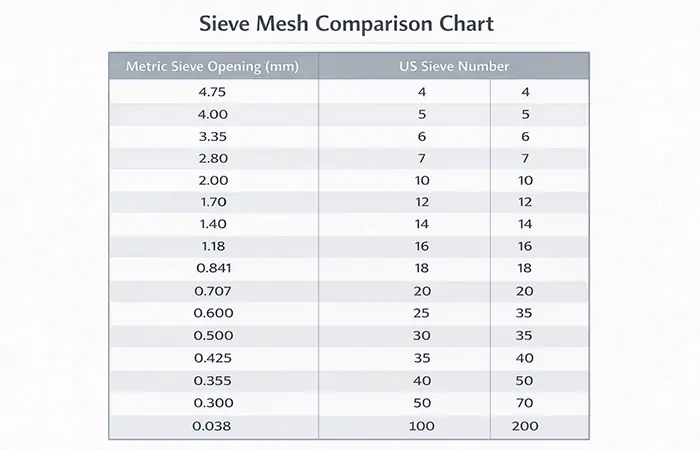
Sieve Size Conversion: Mesh ↔ mm ↔ Micron ↔ Inches
Key Conversions
- 1 inch = 25.4 mm
- 1 mm = 1000 microns
- Opening (mm) = 25.4 ÷ mesh (approximation, not exact due to wire diameter)
Common Searches Answered
| Query | Answer |
|---|---|
| What size is #4 sieve? | 4.75 mm (4750 µm) |
| What size is #10 sieve? | 2.00 mm (2000 µm) |
| What size is #40 sieve? | 0.425 mm (425 µm) |
| What size is #60 sieve? | 0.250 mm (250 µm) |
| What size is #100 sieve? | 0.150 mm (150 µm) |
| What size is #200 sieve? | 0.075 mm (75 µm) |
| 75 microns in inches | 0.00295 in |
| 37.5 mm to inches | 1.476 in |
| 1 mm sieve equals what mesh? | ~18–20 mesh |
Most Commonly Used Sieve Sizes by Industry
Laboratory Particle Analysis
- #40, #60, #100, #200
Mining and Aggregate
- #4, #10, #20, #40
Food Powder (flour, sugar, spices)
- #60, #80, #100
Chemical & Pharmaceutical Powders
- #100, #200, #325
Metal Powder & Additive Manufacturing
- #200, #325, #400

How to Choose the Correct Sieve Size
Select sieve size based on:
- Target particle size you need to measure
- Industry testing standard
- Required precision level
Rule of thumb:
Choose a sieve with an opening slightly larger than the smallest particle you want to retain.
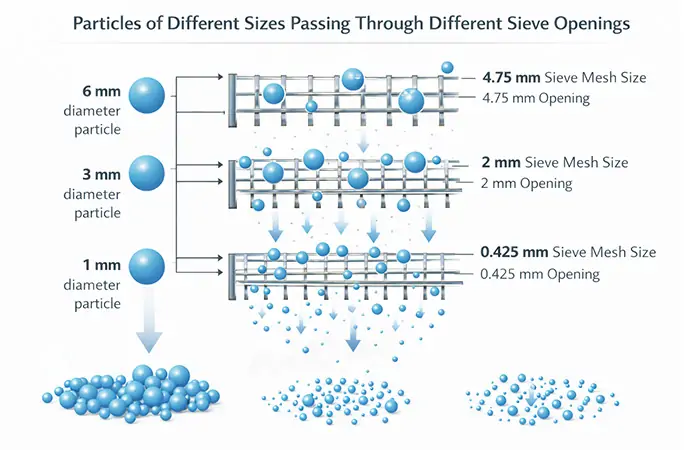
Sieve Analysis and Why Standard Sieve Sizes Matter
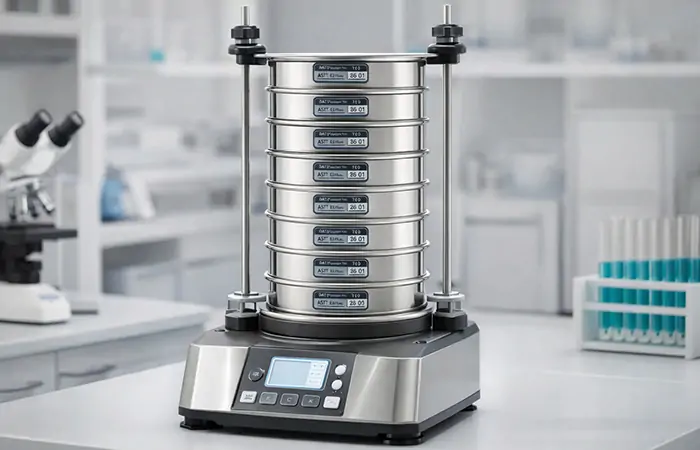
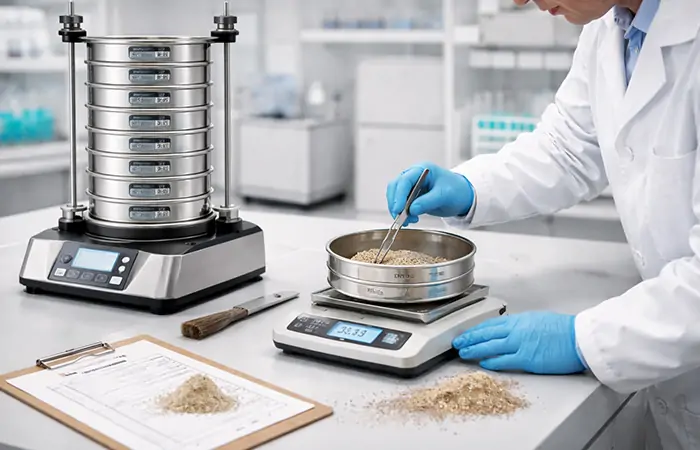
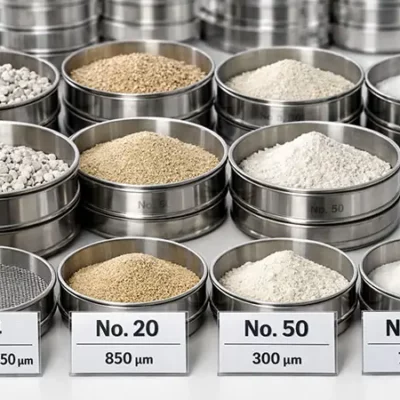
Sieve analysis uses a stack of standardized sieves arranged from coarse to fine. After shaking:
- Material retained on each sieve is weighed
- Particle distribution is calculated
- Results are valid only if standard sieve sizes are used
Any deviation in mesh accuracy invalidates the test.
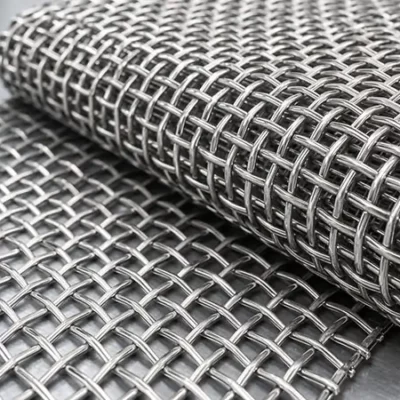
Why Stainless Steel Wire Mesh Is Used in Test Sieves
Test sieves require:
- Dimensional stability
- Résistance à la corrosion
- Accurate, consistent openings
- Longue durée de vie
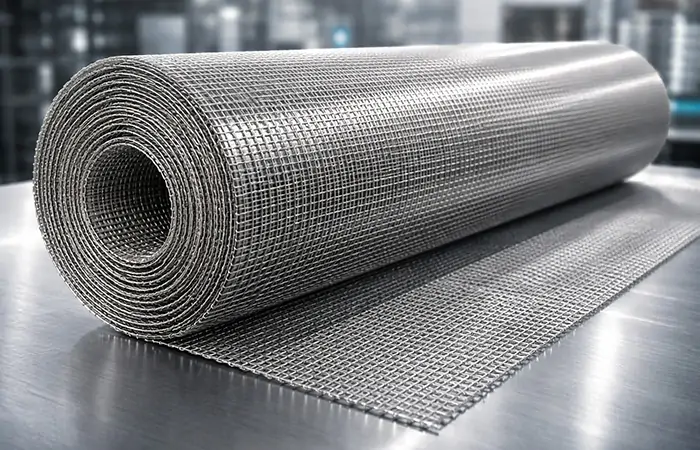
This is why woven stainless steel wire mesh is universally used for laboratory sieves. It maintains aperture accuracy under repeated use and cleaning, and complies with ASTM dimensional tolerances.
Frequently Asked Questions About Sieve Sizes
What mesh is 75 microns?
≈ 200 mesh
What mesh is 150 microns?
≈ 100 mesh
Is mesh the same as sieve size?
No. Mesh is count per inch; sieve size is the actual opening.
Why does higher mesh mean smaller holes?
Because more wires per inch leave less space between them.
Can I convert mesh directly to mm?
Only approximately. Exact opening depends on wire diameter and standard specification.
Conclusion: Understanding Sieve Sizes Prevents Costly Testing Errors
Sieve sizes are not arbitrary numbers. They are precision standards that define the accuracy of particle analysis across industries. By understanding the relationship between:
- Engrener
- Inches
- Millimeters
- Microns
- ASTM standards
You can select the correct sieve, perform valid testing, and ensure reliable quality control.
For laboratories, mining operations, food processors, chemical manufacturers, and metal powder producers, mastering sieve size standards is not just technical knowledge—it is operational necessity.

 FR
FR  EN
EN  DE
DE  ES
ES  AR
AR  PT
PT