
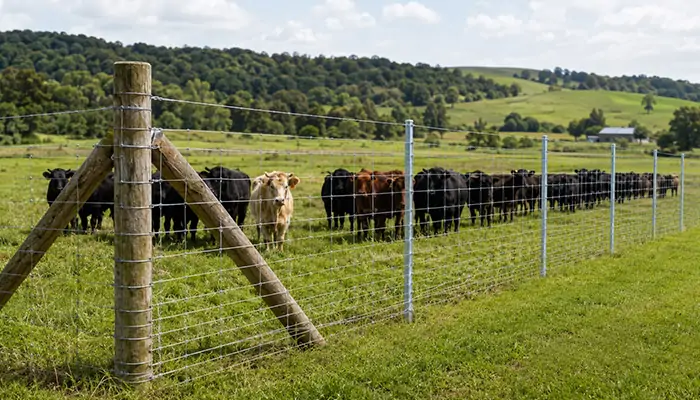
Choosing a wire fence is not simply a matter of selecting a height and ordering enough rolls. The way the horizontal and vertical wires are connected has a major influence on flexibility, impact resistance, mesh stability, installation requirements and total project cost.
The three main types of woven-wire fence are hinge-joint fence, S-knot fence and fixed-knot fence. Hinge-joint fencing is flexible and economical. S-knot fencing provides a smooth, stable mesh surface. Fixed-knot fencing delivers high structural stability for demanding livestock and wildlife applications.
This guide explains how each knot works, where each fence performs best, how woven wire compares with welded wire, and which specifications professional buyers should confirm before requesting a quotation.
What Is a Woven Wire Fence?
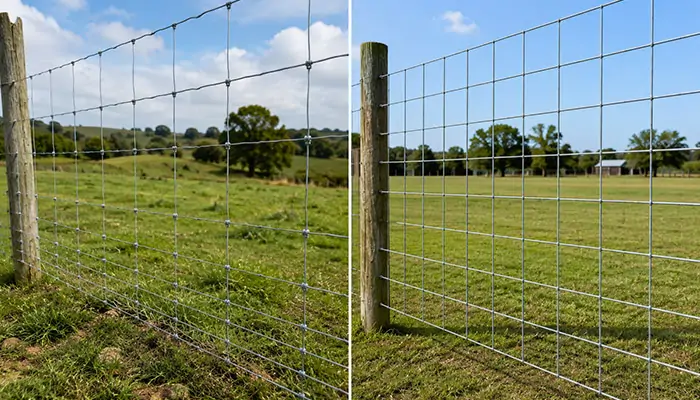
A woven wire fence is made from horizontal line wires and vertical stay wires that are mechanically joined at each intersection. Unlike welded mesh, the wires are not permanently fused together. A knot or wrap holds the grid in place while allowing the fence to respond to pressure in a controlled way.
Woven wire fencing is commonly supplied in rolls and installed on wooden, steel T-post or Y-post systems. Depending on the design, the openings may remain uniform from top to bottom or become smaller near the ground. Graduated openings help contain young animals while reducing unnecessary wire in the upper part of the fence.
The terms field wire fence, woven field fence, wire farm fence, livestock fence و cattle fence roll are often used for products in this general category. However, they do not always describe an identical specification. Buyers should still confirm the knot type, fence height, roll length, wire diameter, opening size, tensile strength and coating.
For an overview of available structures and animal-specific options, see YESON’s woven wire field fence solutions.
Quick Comparison of the Three Types of Woven Wire Fence
| Fence type | Connection structure | المرونة | Mesh stability | Typical applications |
|---|---|---|---|---|
| Hinge joint | Stay wires wrap around each horizontal line wire | عالية | متوسط | General cattle, sheep, goat and pasture fencing |
| S-knot | A separate S-shaped knot connects continuous line and stay wires | متوسط | Medium to high | Horses, sheep, goats, dogs and mixed livestock |
| Fixed knot | A separate knot locks continuous line and stay wires together | متوسط | عالية | Cattle, deer, wildlife exclusion and long commercial fence lines |
These descriptions are a starting point, not a substitute for a complete specification. A heavy conventional fence can outperform a poorly specified high-tensile product, while a correctly engineered fence can reduce maintenance even if its initial material price is higher.
Type 1: Hinge-Joint Woven Wire Fence
How a Hinge-Joint Fence Is Constructed
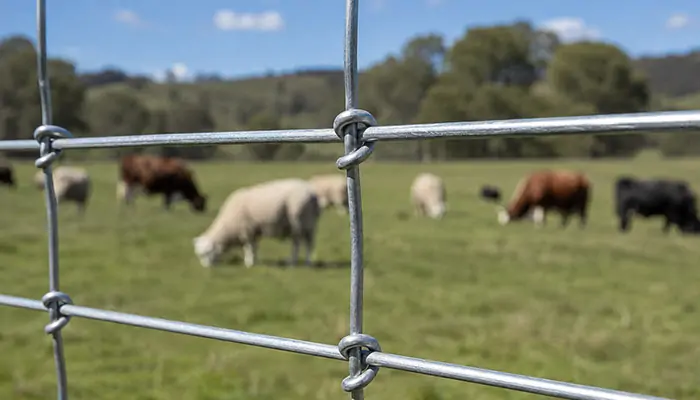
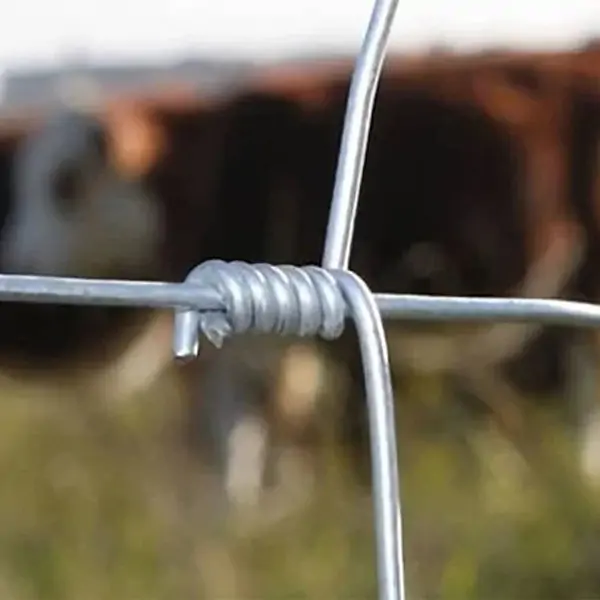
In a hinge-joint fence, vertical stay wires are wrapped around each horizontal line wire to create a hinged connection. Under animal pressure, the joint can move and the mesh can flex instead of acting like a completely rigid panel. When the load is removed, a correctly tensioned fence can recover much of its original shape.
This flexibility makes hinge-joint woven wire suitable for rolling ground, broad pasture boundaries and everyday livestock containment. It is one of the most familiar types of farm fencing and is widely used where buyers need a practical balance between price, durability and adaptability.
Main Advantages of Hinge-Joint Fencing
- Flexible construction adapts well to many agricultural sites.
- The mesh can absorb moderate animal impact without relying on welded intersections.
- Graduated openings can help contain sheep, goats, calves, poultry or other small animals near ground level.
- It is generally an economical option for long farm and ranch boundaries.
- Multiple heights, wire diameters and roll lengths can be produced for different projects.
Possible Limitations
The same movement that gives a hinge-joint fence its flexibility can make it less dimensionally stable than a fixed-knot system under repeated heavy pressure. If the line is poorly tensioned, the braces are weak or the posts are too widely spaced for the selected product, the mesh may sag or lose alignment.
Hinge-joint fencing is therefore not automatically the cheapest system over its full service life. Installation design, labor, post quantity and future maintenance must also be considered.
Best Applications
Hinge-joint fencing is commonly selected for cattle pastures, sheep and goat enclosures, farm boundaries, grassland, forest edges and other large rural areas. When the site needs an adaptable, cost-conscious field wire fence, a high-tensile hinge-joint fence is a useful option to evaluate.
Type 2: S-Knot Woven Wire Fence
What Is an S-Knot Fence?
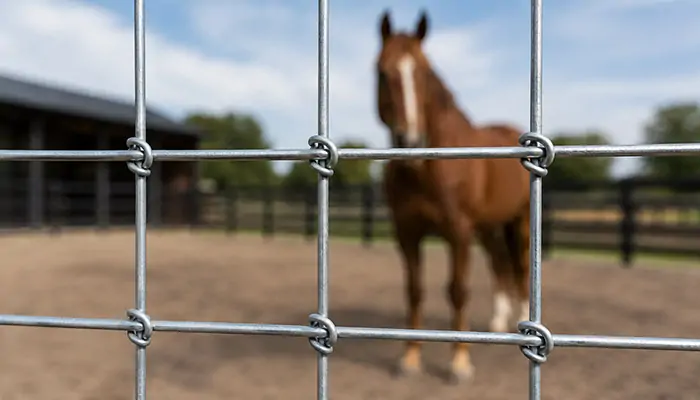
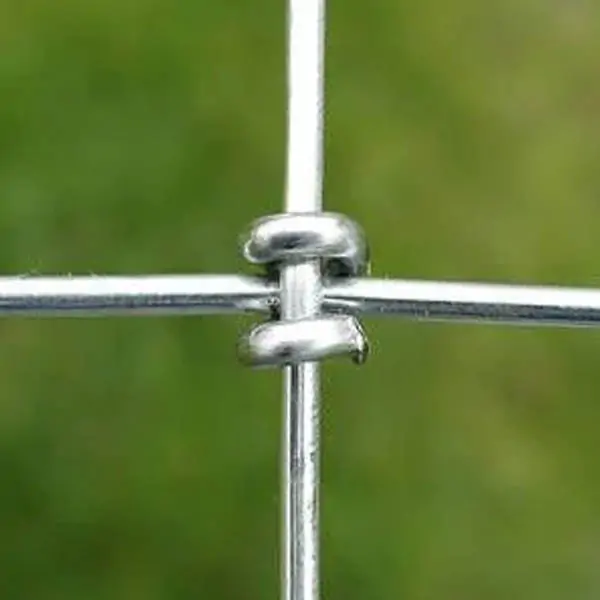
An S-knot fence, also called a square-knot or Square Deal knot fence, uses a separate piece of wire shaped around the horizontal and vertical wires at each intersection. The knot secures continuous stay wires without exposing the same type of projecting wrap found on some traditional field-fence constructions.
Because the connection is compact and the vertical wires remain continuous, the grid holds its shape well. The smooth animal-contact surface is particularly valuable where rubbing, hides, manes, legs or hooves are a concern.
Main Advantages of S-Knot Fencing
- Continuous vertical stay wires improve opening stability.
- The compact knot creates a relatively smooth surface for animal contact.
- Small, consistent openings can be used for horses, sheep, goats, dogs and young livestock.
- The design balances flexibility with better vertical integrity than many basic hinge-joint products.
- It can be produced in different heights, opening patterns and wire specifications.
Possible Limitations
S-knot fencing can cost more than a basic hinge-joint fence because of its knot structure and intended performance. It also should not be assumed to equal every fixed-knot fence in severe impact applications. Actual performance depends on the wire grade, diameter, tensile strength, mesh layout, coating and installation method.
Buyers should also check terminology carefully. Some suppliers use “square knot” to describe the S-shaped connecting wire, while others use broader marketing names. A knot close-up, specification sheet and sample are more reliable than the product name alone.
Best Applications
S-knot woven fencing is a strong candidate for horse paddocks, sheep and goat farms, dog enclosures, mixed-livestock operations and non-climb applications. For animal projects requiring stable openings and a smoother surface, review the available S-knot and square-knot fence specifications.
Type 3: Fixed-Knot Woven Wire Fence
How Fixed-Knot Fencing Works
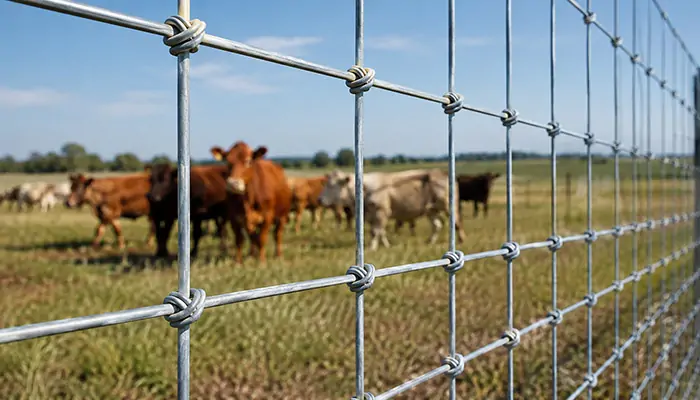
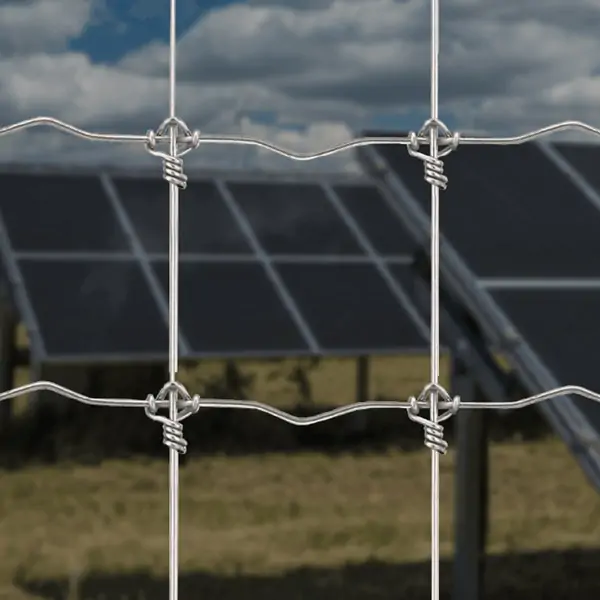
A fixed-knot fence uses a separate knot wire to lock each horizontal line wire to a continuous vertical stay wire. The connection restricts the stay wire from sliding along the horizontal wire. This helps the openings remain aligned when cattle push against the mesh or when a wildlife-exclusion fence experiences wind, vegetation and uneven loading.
Fixed-knot fencing is frequently manufactured with high-tensile steel wire. This combination creates a strong fence system with good resistance to impact, sagging and permanent deformation when it is installed with suitable braces and controlled tension.
Main Advantages of Fixed-Knot Fencing
- Locked intersections resist movement and mesh distortion.
- High-tensile options handle demanding livestock and wildlife applications.
- Continuous vertical wires improve overall grid stability.
- Strong mesh may allow efficient line-post layouts when the manufacturer, terrain and engineering design permit it.
- A well-designed system can reduce repairs and long-term maintenance on large projects.
Possible Limitations
Fixed-knot fencing usually has a higher initial material cost than light-duty hinge-joint fencing. It also requires correct tensioning equipment and strong terminal, corner and change-of-direction assemblies. Excessive tension or inadequate bracing can cause installation failure even when the mesh itself is high quality.
For international purchases, buyers should not compare roll prices without normalizing the specifications. A wider or longer roll, heavier edge wire, closer vertical spacing, higher zinc coating or stronger steel will affect both price and shipping weight.
Best Applications
Fixed-knot woven wire is commonly used for cattle, deer, game reserves, ranch perimeters, orchards, vineyards, crop protection and other high-pressure or long-distance projects. YESON’s fixed-knot woven wire fence is available in multiple heights, vertical-wire spacings, roll lengths and coating options for commercial requirements.
Fixed Knot vs. S-Knot vs. Hinge Joint: Which Is Better?
There is no single best woven wire fence for every farm. The better option is the one that matches the animal, terrain, expected pressure, installation system and project budget.
| Project requirement | Recommended starting point | Why |
| Economical general farm boundary | Hinge joint | Flexible and practical for long pasture lines |
| Horse or small-livestock enclosure | S-knot | Stable openings and a smoother contact surface |
| Cattle in high-pressure areas | Fixed knot | Locked intersections resist mesh deformation |
| Deer or wildlife exclusion | Fixed knot | Strong grid and high-fence options suit demanding barriers |
| Rolling or uneven terrain | Hinge joint or a suitable high-tensile system | Flexibility helps the fence follow ground contours |
| Long commercial fence line | High-tensile fixed knot | Strong, stable system can support efficient layouts |
| Mixed livestock with young animals | S-knot or graduated hinge joint | Smaller lower openings improve containment |
For a fair comparison, request quotations using the same height, roll length, wire diameter, stay spacing, opening pattern, coating and packaging requirements. Comparing only “price per roll” can produce the wrong purchasing decision.
How to Choose Woven Wire Fencing for Different Animals
الماشية
Cattle fencing must resist leaning, rubbing and concentrated impact. A hinge-joint cattle fence may be sufficient for a normal pasture with good feed distribution and moderate stocking pressure. Fixed-knot fencing is often a better starting point for crowded areas, perimeter lines, handling zones or sites where repair access is difficult.
Fence height, wire strength and lower-opening size should reflect the cattle type and age. Buyers planning a large livestock project can compare different cattle fencing roll options before choosing a final mesh pattern.
الخيول
Horse fencing should be highly visible, smooth and designed to reduce the risk of a hoof entering an opening. Small, consistent mesh openings are generally preferred to large field-fence openings. Sharp ends, loose wires and protruding hardware should be eliminated.
An S-knot design can be suitable because of its stable grid and relatively smooth knot. Regardless of knot type, the final system must be selected and installed for the specific horses and site; a top sight line or additional rail may also be considered by the project designer.
Sheep and Goats
Sheep and goat fencing usually needs smaller openings near the ground to contain lambs and kids. Goats also climb, lean and place greater pressure on weak sections, so mesh stability and bracing deserve close attention.
Hinge-joint, S-knot and fixed-knot fences may all be used when their specifications are appropriate. A graduated mesh with close lower wires is often more important than the knot name by itself.
Deer and Wildlife
Wildlife exclusion is strongly influenced by fence height. Deer fences are normally taller than standard livestock boundaries, while the opening pattern should prevent animals from pushing through or becoming trapped.
High-tensile fixed-knot fencing is widely considered for this application because the locked intersections help maintain the tall mesh structure. Terrain dips, drainage channels and gates must be addressed so that animals cannot move under or around the fence.
Dogs and Poultry
Small dogs require openings that prevent the head or body from passing through. For poultry, lightweight hexagonal chicken wire, electric poultry netting or welded mesh may be more appropriate than a conventional cattle field fence, depending on whether the goal is containment, predator resistance or rotational grazing.
The phrase “types of chicken wire” therefore describes a separate selection problem. Chicken wire should not be treated as another knot category within woven field fencing.
High-Tensile vs. Conventional Woven Wire Fence
“High tensile” describes the mechanical properties of the steel wire, not the shape of the knot. A fixed-knot fence is often produced with high-tensile wire, but the terms are not interchangeable. Hinge-joint and other woven structures can also be manufactured in high-tensile specifications.
High-tensile wire is designed to carry greater tension and resist permanent stretching. In a correctly designed system, it can reduce sag and support longer fence runs. However, it is less forgiving of weak corners, unsuitable tools and uncontrolled tensioning. Conventional lower-tensile wire can be easier to handle or repair in some small projects, but it may require closer post spacing or more maintenance.
Professional buyers should request the specified tensile-strength range for the line wires, stay wires and knot wires. Wire diameter alone does not provide enough information to judge performance.
Woven Wire vs. Welded Wire Fence
Woven wire and welded wire can look similar from a distance, but their intersections behave differently.
| Factor | Woven wire fence | Welded wire fence |
| Wire connection | Mechanical knots or wraps | Resistance-welded intersections |
| المرونة | Generally higher | Generally more rigid |
| Uneven terrain | Often easier to adapt | Better suited to controlled, even layouts |
| Impact response | Movement can spread through the mesh | Load is carried through rigid weld points |
| Common supply form | Rolls | Rolls or rigid panels |
| Typical applications | Livestock, field and wildlife fencing | Garden fencing, cages, partitions and industrial barriers |
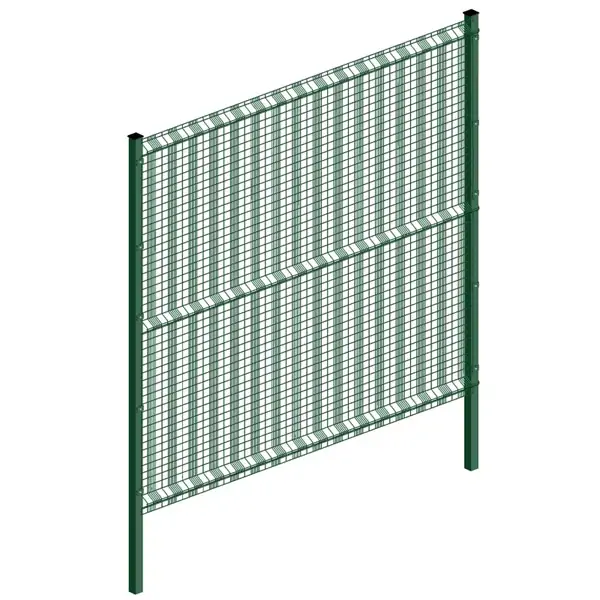
Neither product is universally stronger. Wire grade, diameter, mesh opening, weld quality, knot design, coating and support system all affect performance. Woven wire is usually favored for long livestock boundaries and uneven ground. Welded wire mesh rolls can be a better fit where uniform openings and a more rigid grid are needed.
Woven Wire Fence Post Spacing and Installation Factors
There is no universal post spacing for every woven wire fence. Appropriate spacing depends on:
- wire tensile strength and diameter;
- fence and roll height;
- knot type and mesh pattern;
- soil condition and terrain changes;
- livestock or wildlife pressure;
- corner count and fence-line length;
- post material and section size;
- terminal bracing and tensioning method; and
- local wind, snow or vegetation loads.
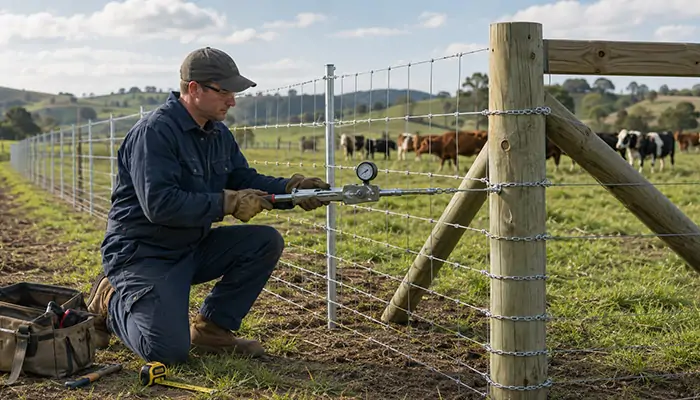
Line posts hold the mesh at the required height and alignment. End, corner and gate posts resist the much larger loads created by tensioned wire, so they require stronger foundations and bracing. Extra support may be necessary at sharp elevation changes, low spots and curves.
Common installation mistakes include weak corner assemblies, tensioning only the top of the roll, leaving excessive ground clearance, failing to follow terrain contours and using a generic spacing rule for every product.
Before installation, consult the product data and a qualified local installer or engineer. YESON’s دليل تباعد أعمدة سياج المزرعة provides additional planning context, while available fence post products can be reviewed as part of a complete system.
What Is a Linear Foot in Fencing?
A linear foot measures length only. It does not include fence height or area.
1 linear foot = 12 inches = 0.3048 meter.
To estimate the required fence length, add the length of every section:
Total linear feet = sum of all fence-section lengths
For example, a rectangular field measuring 200 feet by 300 feet has a perimeter of:
200 + 300 + 200 + 300 = 1,000 linear feet
The purchase quantity should then account for gate openings, overlaps or joins, corners, terrain, roll optimization, installation losses and spare material. If the fence is sold in 330-foot rolls, dividing 1,000 by 330 gives 3.03, so the project would require at least four rolls before considering other site-specific factors.
For a B2B quotation, provide both the total length and the required fence height. A request for “1,000 linear feet” alone does not contain enough information to calculate the correct product, weight or price.
Important Specifications for B2B Woven Wire Fence Buyers
An effective request for quotation should include the following information:
- Application: cattle, horses, sheep, goats, deer, wildlife or crop protection.
- Knot type: hinge joint, S-knot or fixed knot.
- Fence height: in millimeters, meters, inches or feet.
- Roll length: required commercial roll size.
- Horizontal-wire layout: uniform or graduated spacing.
- Vertical stay spacing: distance between vertical wires.
- قطر السلك: top, bottom, intermediate, stay and knot wires where applicable.
- قوة الشد: for each relevant wire component.
- معالجة السطح: electro-galvanized, hot-dip galvanized, zinc-aluminum or coated finish.
- Coating mass: required zinc or alloy coating level.
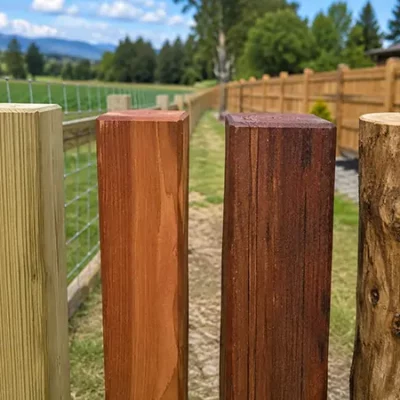
- Post and accessory system: wooden, T-post, Y-post or another project-specific design.
- Total project length: including a drawing when possible.
- Packaging: bulk rolls, palletized rolls, labels and private branding.
- Order quantity: number of rolls or total linear length.
- Destination: delivery country, destination port and required trade term.
- Inspection requirements: material certificates, coating tests, dimensional checks or third-party inspection.
A practical inquiry can read:
Please quote a woven wire fence for cattle pasture. Required height: 1.2 m; roll length: 100 m; vertical spacing: 150 mm; hot-dip galvanized finish; total project length: 10,000 m. Please recommend a suitable knot type and wire diameter, and provide roll weight, packing details, container quantity, production lead time and FOB price.
The clearer the inquiry, the easier it is for a supplier to recommend a technically comparable and cost-efficient solution.
الأسئلة الشائعة
What are the three main types of woven wire fence?
The three main types are hinge-joint fence, S-knot or square-knot fence, and fixed-knot fence. They are distinguished primarily by the way the horizontal and vertical wires are connected.
What is the best woven wire fence for cattle?
Hinge-joint fencing can work well for general cattle pastures. Fixed-knot fencing is often preferred for high-pressure areas, long commercial lines and projects requiring greater mesh stability. The final choice should also consider wire strength, height, opening pattern and installation design.
Is fixed-knot fencing stronger than hinge-joint fencing?
Fixed-knot fencing generally provides more stable intersections and better resistance to wire movement. However, the strength of the finished fence depends on the complete specification and installation, not the knot alone.
What is the best woven wire fence for horses?
A smooth fence with small, consistent openings is normally preferred to reduce the risk of a hoof becoming trapped. S-knot fencing is a common option because its knot is compact and its openings remain stable. The fence should still be evaluated for the specific horses and facility.
How far apart should posts be for a woven wire fence?
There is no single spacing that applies to all woven wire fences. Post spacing depends on wire tensile strength, fence height, terrain, post type, animal pressure, braces and the manufacturer’s installation guidance.
Can woven wire fencing be electrified?
An offset electric wire can be installed alongside some woven wire systems to discourage animals from leaning or rubbing. It requires suitable insulators, an energizer, grounding and a safe layout. Follow the equipment manufacturer’s instructions and applicable local requirements.
What is the difference between woven wire and welded wire?
Woven wire uses knots or wraps at the intersections, giving it greater flexibility. Welded wire uses rigid welded intersections, giving it consistent openings and dimensional stability. Their suitability depends on the application and full material specification.
How many linear feet of fencing do I need?
Measure every fence section and add the lengths together. Then adjust for gates, joins, site changes, roll lengths, installation waste and spare material. Fence height must be specified separately.
Conclusion: Choosing the Right Woven Wire Fence
The three knot systems solve different fencing problems. Hinge-joint fencing offers flexibility and value for general farm boundaries. S-knot fencing combines stable openings with a smoother animal-contact surface. Fixed-knot fencing provides strong, locked intersections for cattle, deer, wildlife and demanding commercial projects.
Do not select a fence from the knot name or roll price alone. Confirm the target animal, terrain, fence height, mesh pattern, wire diameter, tensile strength, coating, post system and total project length. Those details determine whether the installed fence will perform as expected.
Need help matching a woven wire fence to your livestock or agricultural project? Contact YESON with your application, required height, roll length, mesh spacing, total quantity and destination port. Our team can recommend a suitable structure and prepare a customized quotation.
 AR
AR  EN
EN  DE
DE  FR
FR  ES
ES  PT
PT