
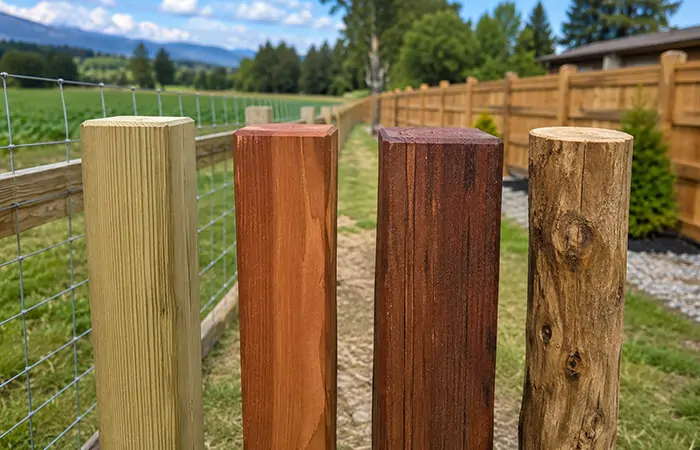
Choosing the best wood for fence posts is one of the most important decisions in any fencing project. Posts support the entire fence, resist wind and wire tension, carry gates, and remain exposed to soil, moisture, fungi, and insects for many years.
However, there is no single type of wood that is best for every fence.
Ground-contact pressure-treated pine is usually the most practical option for general residential and agricultural fencing. Cedar and redwood are attractive choices with natural decay resistance, while black locust is suitable for projects that prioritize natural durability. Douglas fir and some oak species can also be used, but their performance depends heavily on species, grade, treatment, and local conditions.
This guide compares the most common wooden fence posts and explains how to select the right wood species, treatment, size, and installation method for residential, garden, agricultural, and commercial fencing projects.
Quick Answer: What Is the Best Wood for Fence Posts?
For most fencing projects, the best overall choice is ground-contact-rated pressure-treated pine because it is affordable, widely available, and protected against decay and insect damage.
Choose:
- Pressure-treated pine for overall value
- Cedar for appearance and dimensional stability
- Redwood for premium residential and landscape fences
- Black locust for natural ground-contact durability
- White oak for traditional farm fencing
- Treated Douglas fir where higher structural strength is required
For fencing installed in the United States, wood placed in soil should normally be marked for ground contact. The American Wood Protection Association classifies general ground-contact applications, including many fence posts, as UC4A or higher.
| Fence application | Recommended wood | Main advantage |
|---|---|---|
| General residential fence | Ground-contact treated pine | Cost and availability |
| Privacy fence | Cedar or treated pine | Appearance and stability |
| Farm and livestock fence | Treated pine or black locust | Strength and durability |
| Split rail fence | Cedar, locust or treated pine | Natural appearance |
| Wet or humid location | Properly treated pine | Improved decay protection |
| Premium landscape fence | Redwood or cedar | Appearance and finish |
| Heavy gate post | Graded 6×6 or 8×8 treated timber | Greater load capacity |
What Makes a Good Wood Fence Post?
A good fence post must do more than look straight when it is delivered. Its long-term performance depends on several connected factors.
Resistance to Rot and Insects
The ground line—the area where the post enters the soil—is usually the most vulnerable part of a wooden post. It experiences repeated wet-and-dry cycles while remaining exposed to fungi, termites, and other wood-destroying organisms.
Natural durability also varies within the same piece of wood. Heartwood may be more decay resistant than sapwood, while untreated sapwood from almost every species has relatively low resistance under conditions favorable to decay. This is one reason buyers should not evaluate a post only by its species name.
Strength and Load Capacity
Fence posts may need to resist:
- Wind acting on solid privacy panels
- Tension from woven or barbed wire
- Livestock pressure
- Gate weight and repeated gate movement
- Impact during installation
- Changes in soil moisture and stability
A search for “4×4 wood post fence yield strength” cannot be answered with one universal value. Post capacity depends on wood species, structural grade, grain direction, moisture content, knots, actual dimensions, post spacing, embedment depth, and loading direction.
For engineered, high-wind, public-safety, or unusually tall fences, the post size and foundation should be verified by a qualified local professional.
Dimensional Stability
Wood naturally exchanges moisture with the surrounding environment. As a result, fence posts may shrink, twist, check, split, or warp as they dry.
Proper seasoning, grading, storage, and installation reduce these problems. Posts should also be inspected for excessive sweep, major splits, loose knots, and other defects before installation.
Correct Preservative Treatment
“Pressure treated” does not automatically mean that the wood is suitable for burial.
Some treated lumber is manufactured only for above-ground use. Posts installed in soil should carry the appropriate ground-contact classification required by the destination market. In the United States, this will commonly be UC4A or a higher category when exposure is more severe.
Best Types of Wood for Fence Posts
1. Pressure-Treated Pine Fence Posts
Pressure-treated pine is one of the most common choices for wood post fencing. It is readily available in standard sizes, relatively easy to machine, and generally costs less than naturally durable premium woods.
During pressure treatment, preservatives are forced into the wood to improve resistance to fungal decay and insects.
تشمل المزايا ما يلي:
- Competitive material cost
- Wide availability
- Multiple square and round post sizes
- Compatibility with privacy panels, rails, and wire mesh
- Better decay resistance than untreated pine
- Suitable for large, standardized projects
Potential disadvantages include checking, splitting, twisting, shrinkage, and differences in treatment quality.
For an in-ground fence post, specify ground-contact-treated pine, not ordinary above-ground treated lumber. After cutting or drilling, exposed areas should be treated according to the post manufacturer’s instructions. AWPA guidance notes that suitable preservatives should be applied to field cuts and drilled holes because treatment penetration may vary across the wood.
الأفضل لـ: Residential fences, farm fencing, garden enclosures, privacy fences and general commercial projects.
2. Cedar Fence Posts
Cedar is valued for its warm appearance, lower weight, dimensional stability, and natural resistance to decay. It is commonly used for garden fences, privacy fences, decorative fencing, and split rail systems.
However, “cedar” is not a single performance grade. Durability varies by species, heartwood content, growth conditions, and whether the post remains in direct soil contact.
Cedar sapwood is less durable than high-quality heartwood. A post with a large proportion of sapwood may not perform like a premium heartwood cedar post, even if both products carry the same general species label.
تشمل المزايا ما يلي:
- Attractive natural color
- Good dimensional stability
- Easy cutting and installation
- Natural resistance to some decay organisms
- Suitable for visible residential applications
Limitations include higher cost, variable grades, and reduced service life when lower-quality material remains continuously wet.
الأفضل لـ: Garden fences, decorative fences, residential privacy fencing and split rail fences.
3. Redwood Fence Posts
Redwood is a premium fencing material known for its appearance and dimensional stability. Higher-quality heartwood grades offer good natural decay resistance, while sapwood and lower grades may provide less protection.
Redwood posts work well in projects where visual quality is important, including high-end homes, gardens, parks, and landscape boundaries.
تشمل المزايا ما يلي:
- Premium natural appearance
- Good dimensional stability
- Easy machining
- Suitable for staining or natural finishes
- Good decay resistance in suitable heartwood grades
The main limitations are cost and regional availability. Large agricultural projects may find redwood less economical than treated pine or locally available durable species.
الأفضل لـ: Premium residential, garden and landscape fences.
4. Douglas Fir Fence Posts
Douglas fir has good strength and is widely used in structural applications. However, untreated Douglas fir should not automatically be considered suitable for long-term burial.
When used as a fence post, it should be appropriately treated for the intended exposure. Untreated material is better suited to above-ground rails, boards, and components in relatively dry conditions.
تشمل المزايا ما يلي:
- Good strength-to-weight performance
- Straight, consistent appearance
- Availability in larger structural dimensions
- Suitability for heavy fence components when correctly graded
Limitations include lower natural ground-contact durability compared with black locust or high-quality cedar heartwood.
الأفضل لـ: Treated structural posts, large posts, dry-climate fencing and above-ground rails.
5. Oak Fence Posts
Oak can produce strong and durable fence posts, but buyers must identify the actual oak species. White oak generally has better moisture and decay resistance than red oak.
Dense oak posts can withstand substantial agricultural loads, but their hardness also makes cutting, drilling, and fastening more difficult. Pre-drilling may be required to prevent splitting and make installation easier.
تشمل المزايا ما يلي:
- High density and strength
- Traditional appearance
- Suitable for farm and ranch settings
- Good durability in appropriate species and grades
Limitations include weight, inconsistent supply, difficult machining, and significant performance differences between oak species.
الأفضل لـ: Traditional farm fences, ranch fencing and heavy rural applications.
6. Black Locust Fence Posts
Black locust is often regarded as one of the most naturally durable North American woods for fence posts. Its heartwood has strong natural decay resistance and has historically been used for agricultural posts.
تشمل المزايا ما يلي:
- Excellent natural durability
- قوة عالية
- Good performance in ground-contact applications
- Suitable for farm and livestock fencing
- Reduced dependence on preservative treatment when appropriate heartwood is used
Potential disadvantages include regional supply limitations, irregular shapes, splitting, and less consistent dimensions than factory-produced treated posts.
الأفضل لـ: Farms, ranches, vineyards, rural boundaries and naturally durable fencing projects.
7. Peeler Core Fence Posts
A peeler core is the round center remaining after veneer has been peeled from a log. These cores may be processed and treated for use as agricultural fence posts.
They can provide consistent round dimensions and competitive pricing, but buyers should confirm:
- Wood species
- Ground-contact treatment
- Treatment penetration
- Preservative retention
- Post diameter and taper
- Straightness tolerance
- Pointed or flat ends
A low purchase price does not compensate for inadequate treatment or weak material.
الأفضل لـ: Agricultural line posts, wire fencing and cost-sensitive large-volume projects.
Wood Fence Post Comparison
| Wood type | Natural decay resistance | Treatment needed for burial? | Cost level | Recommended application |
|---|---|---|---|---|
| Pressure-treated pine | Low untreated; good when treated | نعم | Low–Medium | General and farm fencing |
| Cedar | Moderate–Good in suitable heartwood | Added protection may be advisable | Medium–High | Gardens and privacy fences |
| Redwood | Good in quality heartwood | Depends on grade and exposure | عالية | Premium landscape fences |
| Douglas fir | Low–Moderate untreated | Usually yes | متوسط | Structural posts and rails |
| White oak | Moderate–Good | Depends on exposure | Medium–High | Traditional farm fencing |
| Black locust | Excellent heartwood durability | Often used untreated | Medium–High | Long-lasting farm posts |
| Peeler core | Species dependent | Usually required | Low–Medium | Agricultural line posts |
These ratings are comparative rather than guaranteed service-life figures. Climate, drainage, post quality, treatment, installation, maintenance, and soil organisms can substantially change actual performance.
Treated vs. Untreated Fence Posts
What Are Treated Wood Fence Posts?
Treated wooden fence posts contain preservatives that help protect the wood against fungal decay and insects. Pressure treatment is generally more reliable than applying a surface coating because the preservative penetrates the wood.
When purchasing treated lumber fence posts, confirm:
- Intended use category
- Treatment standard
- Preservative type
- Treatment retention
- Wood species
- Post grade
- Actual dimensions
- Required end-cut treatment
For international B2B projects, specifications should refer to the destination country’s recognized treatment and environmental requirements.
Can Untreated Wood Be Used for Fence Posts?
Untreated fence posts can be used in limited situations, including:
- سياج مؤقت
- Naturally durable heartwood
- Dry, well-drained environments
- Easily replaceable garden fences
- Components installed entirely above ground
Ordinary untreated pine, sapwood, or Douglas fir should not be expected to provide reliable long-term performance in wet soil.
Which Option Is Better for Commercial Projects?
Properly specified treated posts are usually more practical for large projects because they offer greater consistency in dimensions, treatment, availability, and replacement supply.
Naturally durable posts can be an excellent option when the species, heartwood content, grade, and supply chain are carefully controlled.
What Size Wood Should You Use for Fence Posts?
Post size depends on fence height, wind exposure, panel weight, post spacing, soil, gate loads, and embedment depth.
4×4 Wood Fence Posts
A 4×4 wood fence post is commonly used for:
- Short garden fences
- Light residential fences
- Picket fences
- Small wire mesh enclosures
- Low-wind applications
Remember that nominal and actual lumber dimensions may differ. Confirm the actual finished dimensions before designing brackets or foundations.
6×6 Wood Posts
A 6×6 post provides more strength and stiffness than a 4×4 and is frequently selected for:
- Six-foot privacy fences
- Corner posts
- End posts
- Gate posts
- Heavy fence panels
- Wind-exposed locations
Not every six-foot fence automatically requires a 6×6 post, but the larger section may be justified by wind load, panel weight, and gate movement.
8×8 Timber Posts
An 8×8 post is generally reserved for:
- Heavy entrance gates
- Decorative gateways
- Agricultural structures
- High-load corners
- Large commercial or estate fences
Because these posts are heavy and expensive to transport, procurement decisions should include installation equipment and freight cost.
Fence Post Length and Burial Depth
A “6-foot fence post” is not necessarily long enough for a six-foot-high fence. The total post must include both the above-ground height and the buried portion.
Post depth varies with fence height, soil, wind, frost line, and local regulations. Review Yeson’s guide to how deep to dig fence post holes before finalizing post length.
Best Wood for Different Fence Applications
Best Wood for Privacy Fence Posts
Ground-contact-treated pine provides the best balance of cost and performance for many privacy fences. Cedar and redwood are suitable when appearance is a priority.
Because solid fence panels catch considerable wind, corner, end, and gate posts may need larger dimensions, closer spacing, deeper foundations, or additional bracing.
Best Wood for Farm and Livestock Fencing
Treated pine, black locust, white oak, and treated round posts are common choices for agricultural fencing.
Many farms use a hybrid system:
- Heavy wooden posts at corners, ends, and gates
- Galvanized steel posts along straight fence lines
- Woven or fixed-knot wire as the barrier
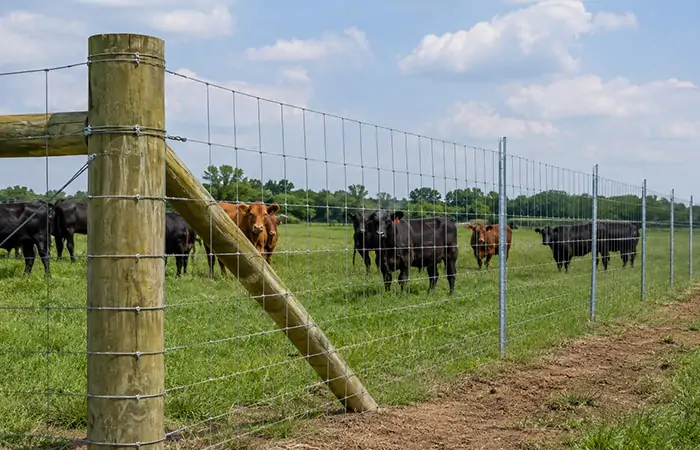
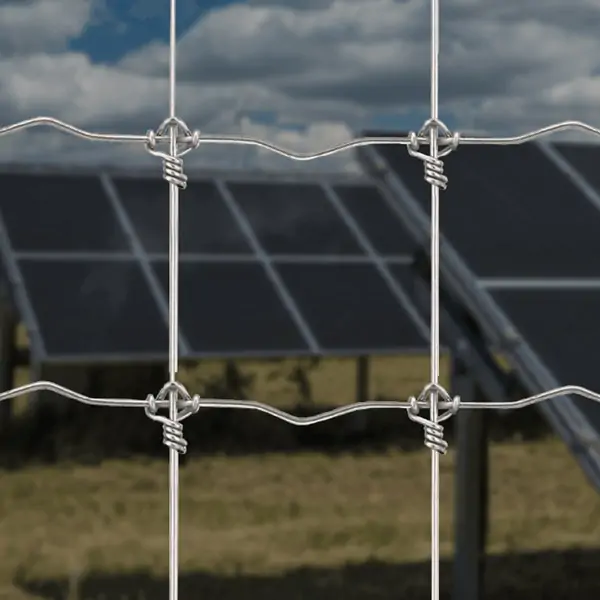
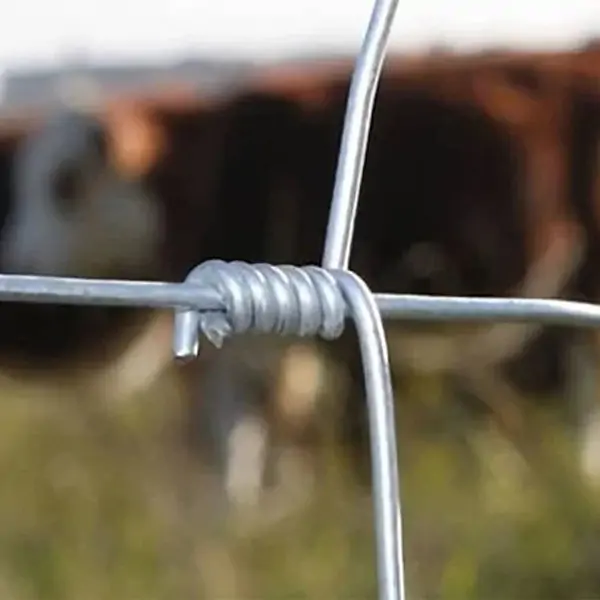
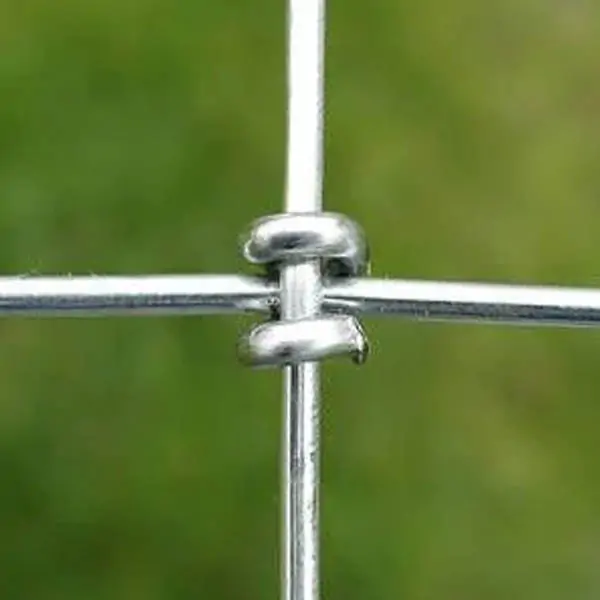
This design uses wood where strong anchoring is needed and steel where consistent spacing and faster installation are important. Explore Yeson’s field fence systems و fixed knot fence for livestock, vineyard, orchard, and boundary applications.
Best Wood for Split Rail Fences
Cedar, black locust, and treated pine are among the most practical options for split rail fences.
Cedar provides an attractive rustic finish, locust offers natural durability, and treated pine is often the most economical choice for standardized projects.
Best Wood for Garden Fence Posts
Cedar and treated pine work well for garden fences. Cedar provides a natural appearance, while treated pine offers better cost efficiency.
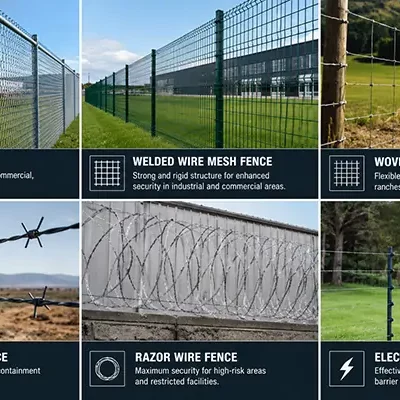
For small garden areas, wooden posts can be combined with welded wire or decorative metal panels. Buyers comparing barrier styles can read our guide to the different types of wire fences.
Best Wood for Wet, Humid, or Hot Climates
In wet, humid, subtropical, and termite-prone areas, species alone is not enough. The project should consider:
- Ground-contact treatment
- Local deterioration risk
- الصرف الصحي
- Termite exposure
- Preservative retention
- Cut-end protection
- Soil contact
- Inspection frequency
In severe environments, a higher treatment category or a galvanized steel post may provide more predictable performance.
Can You Use Landscape Timbers for Fence Posts?
Landscape timbers can sometimes be used for light or temporary fences, but they are not automatically equivalent to structural fence posts.
Before using landscape timber as a fence post, check:
- Whether it is rated for ground contact
- Its actual dimensions
- Wood grade and straightness
- Treatment depth and retention
- Expected fence load
- Gate and corner requirements
- Wind exposure
Landscape timbers should generally not be used for heavy gates, high-tension agricultural wire, or tall privacy panels unless their structural capacity has been verified.
How to Protect Wood Fence Posts From Rot
Use the Correct Ground-Contact Wood
Do not bury lumber labeled only for above-ground use. Confirm the post’s end tag, treatment certificate, or purchase specification.
Protect Cut Ends and Drilled Holes
Cutting or drilling treated posts can expose untreated wood. Apply a compatible field-cut preservative according to the treated-wood supplier’s instructions and local requirements.
Improve Drainage
Standing water around the ground line accelerates deterioration. Shape the surrounding surface so water drains away from the post.
Choose the Foundation Method Carefully
| طريقة | Main advantage | Limitation |
|---|---|---|
| Compacted soil | Low cost and simple | Performance depends on soil |
| Compacted gravel | Supports drainage | Must be installed in layers |
| أسمنت | Strong lateral support | Poor finishing may trap water |
| Expanding foam | Fast and lightweight | Not suitable for every load |
The choice between foam and concrete should be based on fence height, wind, soil, gate load, and the product manufacturer’s limitations—not installation speed alone.
Inspect the Ground Line Regularly
Periodic inspections should look for:
- Soft or discolored wood
- Fungal growth
- Insect damage
- Deep cracks
- Loose or leaning posts
- Standing water
- Failed coatings
- Corroded fasteners
Wood vs. Metal Fence Posts
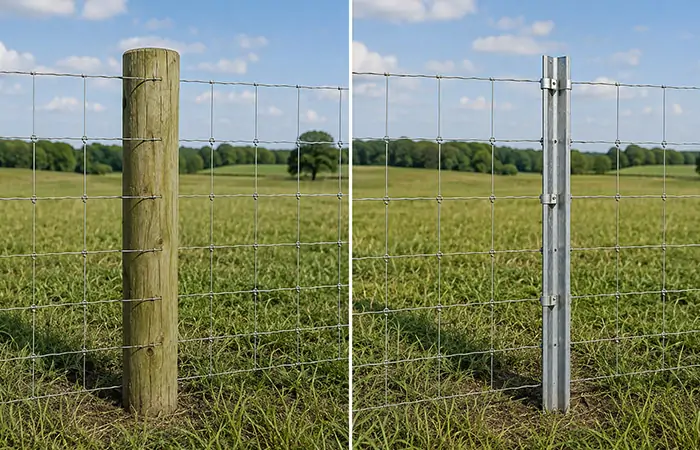
Wood is not always the best post material. Metal posts are often more suitable for industrial fences, high-tension wire systems, humid regions, and projects requiring uniform dimensions.
| Factor | Wood posts | Metal posts |
|---|---|---|
| مظهر | Natural and traditional | Clean and industrial |
| Decay resistance | Depends on species and treatment | Galvanized steel does not rot |
| Termite resistance | Treatment dependent | Not affected by termites |
| Dimensional consistency | Natural variation | Highly consistent |
| Heavy corner anchoring | Very effective with large posts | Requires correct section and bracing |
| تثبيت | Cutting and drilling are easy | Post driver or power tools may be needed |
| صيانة | Ground-line inspection required | Coating damage should be inspected |
| Wire attachment | Staples and brackets | Clips, ties and brackets |
Yeson supplies several types of galvanized steel fence posts, including Y posts, U-channel posts, metal fence posts and studded T posts. These can be used as line posts or as part of a complete metal fencing system.
B2B Fence Post Procurement Checklist
Before ordering wooden fence posts for a commercial or agricultural project, confirm the following information.
Wood and Quality
- Exact wood species
- Heartwood and sapwood content
- Structural grade
- Moisture condition
- Knot and split limits
- Straightness tolerance
- Surface finish
Treatment
- Above-ground or ground-contact classification
- Preservative system
- Treatment retention
- Applicable standard
- Treatment certificate
- Requirements for field cuts and holes
أبعاد
- Nominal and actual dimensions
- طول المنشور
- Round-post diameter and taper
- Pointed or flat end
- Size tolerance
- Packaging quantity
Fence Design
- ارتفاع السياج
- Post spacing
- Wire tension
- وزن اللوحة
- Gate width and weight
- Corner bracing
- Soil conditions
- Wind exposure
- Frost depth
For agricultural projects, use Yeson’s دليل تباعد أعمدة سياج المزرعة as an initial planning reference. Final spacing must still be adjusted for the selected mesh, wire tension, terrain, livestock, and post type.
Total Project Cost
Compare more than the price per post. A proper cost analysis should include:
- Material price
- Freight
- Import duties
- Installation labor
- Equipment requirements
- Expected maintenance
- Replacement interval
- Availability of matching replacement posts
Common Mistakes When Choosing Wood Fence Posts
Avoid these frequent purchasing and installation mistakes:
- Choosing posts only by price
- Using above-ground lumber below ground
- Assuming all cedar, redwood, or oak has equal durability
- Using undersized gate and corner posts
- Ignoring soil drainage and frost depth
- Leaving cut ends untreated
- Using landscape timbers for structural fencing without verification
- Confusing nominal and actual dimensions
- Installing high-tension wire without suitable corner bracing
- Using fasteners that are incompatible with treated lumber
الأسئلة الشائعة
What type of wood fence post lasts the longest?
Quality black locust heartwood is one of the most naturally durable options. Properly treated pine and other industrially treated posts may also provide reliable long-term performance. Actual service life depends on treatment, drainage, climate, installation, and wood quality.
Is pressure-treated pine good for fence posts?
Yes. It is one of the most practical fence post materials, provided that the product is specifically rated for ground contact.
Is cedar better than pressure-treated pine?
Cedar generally offers a more attractive natural finish and good dimensional stability. Pressure-treated pine is usually more affordable and may provide more predictable in-ground protection when correctly treated.
Can untreated wood be used for fence posts?
Naturally durable heartwood may be used untreated in suitable environments. Ordinary untreated pine, Douglas fir, and sapwood are generally poor choices for long-term contact with moist soil.
Can landscape timbers be used as fence posts?
They may be suitable for light garden or temporary fences if their dimensions, treatment, and condition meet the project requirements. They are not automatically suitable for tall privacy fences, heavy gates, or high-tension wire.
Should I use 4×4 or 6×6 fence posts?
A 4×4 is commonly used for light residential and garden fences. A 6×6 may be more suitable for privacy fences, corners, gates, heavy panels, or wind-exposed areas.
What is the best wood for a six-foot privacy fence?
Ground-contact-treated pine, cedar, and redwood are common choices. Post size, spacing, depth, and foundation must also account for wind load.
How can I prevent wooden fence posts from rotting?
Use the correct wood or treatment category, protect all cuts and holes, improve ground-line drainage, avoid trapping water, and inspect the post regularly.
Conclusion: Which Fence Post Should You Choose?
The best fence post wood depends on the application:
- Best overall value: Ground-contact pressure-treated pine
- Best natural appearance: Cedar
- Best premium option: Redwood
- Best natural durability: Black locust
- Best for large structural posts: Properly treated and graded Douglas fir
- Best for heavy gates: Engineered 6×6 or 8×8 treated timber
- Best hybrid farm system: Wooden corner posts with galvanized steel line posts
A reliable fence is a complete system. Post material, wire type, coating, post spacing, foundation, tensioning, and accessories must work together.
Need help selecting a wire fence and post system for an agricultural, residential, or commercial project? Explore Yeson’s fence post products or contact our team for specifications, customization, packaging, and export support.
 AR
AR  EN
EN  DE
DE  FR
FR  ES
ES  PT
PT