
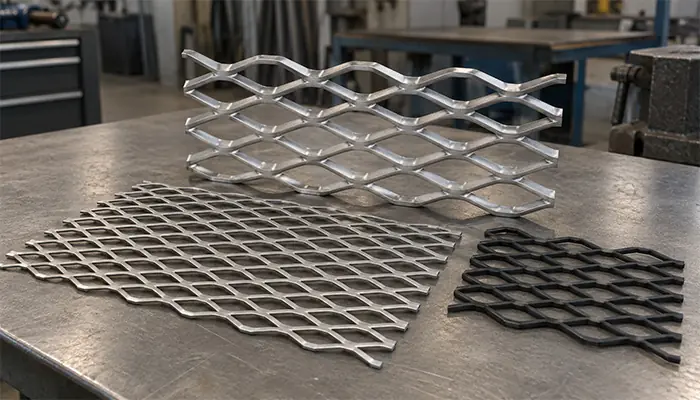
An expanded metal sheet may look straightforward, but its diamond pattern tells you only part of the story. Surface profile, material, strand dimensions and opening size all influence how a panel performs and how it fits into a finished assembly.
The main types of expanded metal include standard or raised mesh, flattened mesh, expanded metal grating, architectural mesh, and fine or micro mesh. Expanded metal lath is another important product family used in building finishes.
For importers, distributors, fabricators and project buyers, understanding these differences makes product comparisons more useful. This guide explains how to identify the right type, read specifications and prepare an enquiry that suppliers can quote accurately.
What Is Expanded Metal and How Is It Made?
ما هو المعدن الموسع؟
Expanded metal is sheet material that has been slit and stretched into an interconnected network of openings. The familiar diamond pattern consists of metal strands joined at the points where adjacent openings meet.
The mesh itself is formed from one continuous piece of material. Finished products may then be cut, bent or attached to frames, depending on the application.
“Expanded metal sheet” normally describes the supplied sheet, while “expanded metal mesh” emphasizes its open structure. Buyers can explore YESON’s expanded metal mesh range to compare available material and product options.
كيف يتم تصنيع المعدن الممدد؟
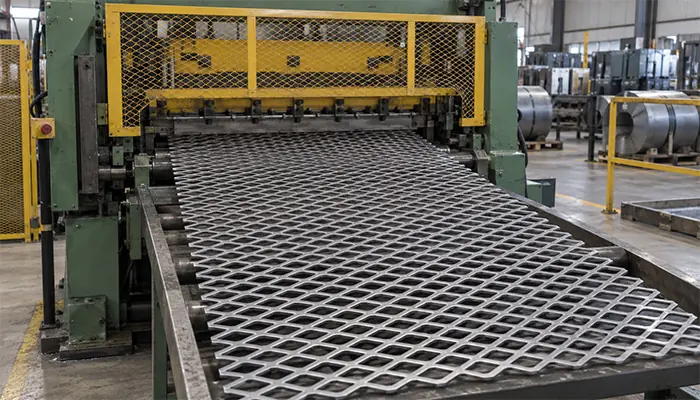
An expanding press cuts and forms the sheet in a coordinated operation, opening the slits into a repeating pattern. The result initially has a raised profile. Additional rolling produces flattened expanded metal when a flatter surface is required.
Cutting, forming and finishing follow the agreed production route. Because these operations can affect finished dimensions, drawings should identify the condition in which the product will be inspected. The basic process and surface forms are described in The Expanded Metal Company’s product guide.
What Is Expanded Steel?
Expanded steel is expanded metal manufactured from steel. The broader term also covers aluminum and other suitable materials. Specifying “expanded steel” alone leaves several purchasing decisions open: the steel grade, mesh pattern, surface profile and finish still need to be defined.
What Are the Different Types of Expanded Metal?
These product families describe different characteristics. Raised and flattened refer to surface form; grating, architectural mesh and fine mesh describe more specialized products. Material and coating are separate choices.
For example, one panel can be flattened, made from carbon steel and supplied with a galvanized finish.
1. Standard or Raised Expanded Metal
Standard expanded metal, also called regular or raised expanded metal, retains the three-dimensional shape created during expansion. Its strands sit at an angle, giving the sheet a textured profile.
Its textured surface and depth make it a useful option for guards, partitions and enclosures. The open pattern also allows ventilation through the panel. Where the sheet sits against another component, the raised structure must be allowed for in mounting clearances and contact points.
Here, “standard” names the product form. Any required technical standard or certification must be stated separately in the order.
2. Flattened Expanded Metal
Flattened expanded metal passes through an additional rolling operation to reduce the raised profile. The resulting surface is more even, making it a practical option for covers, partitions and assemblies requiring a flatter contact face. It also produces a different visual finish from the textured raised mesh.
Flattening also changes the finished geometry. A buyer replacing a raised panel with a flattened version should confirm the final mesh dimensions, thickness and sheet size.
Request tolerances for the delivered condition, particularly when panels must fit channels or prefabricated frames. A product photograph alone cannot establish whether the finished panel will fit an existing assembly.
3. شبكة معدنية موسعة
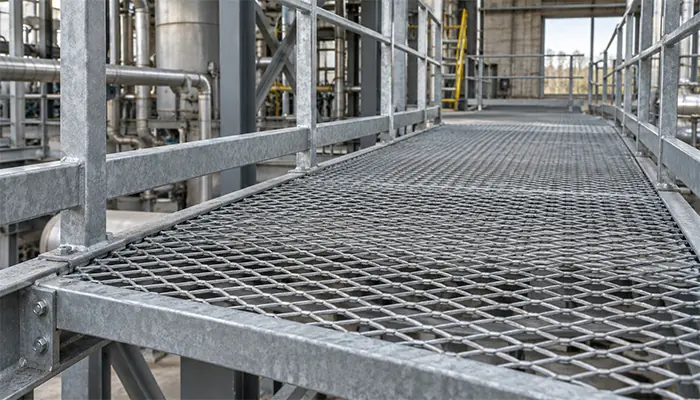
Expanded metal grating is intended for applications where the mesh acts as a supporting surface, such as selected walkways, platforms and access systems.
The purchasing specification must describe the load and the structure supporting it. Relevant details include clear span, load distribution, mesh direction, allowable deflection and fixing arrangement. Ask for data covering the proposed installation.
“Heavy gauge expanded metal” is a broad description. Thickness is only one part of the specification; a heavy-looking sheet is insufficient evidence that it suits a walkway.
4. Architectural Expanded Metal
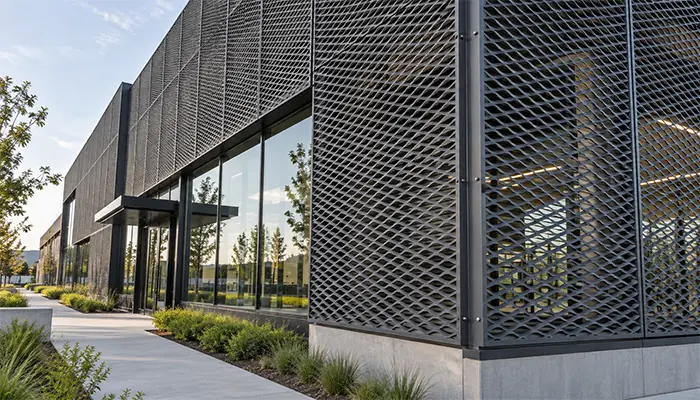
Architectural expanded metal is selected for visual and spatial effects as well as functional requirements. Common applications include facades, screens, ceilings, partitions and railing infill.
Opening pattern, strand angle, panel orientation and finish influence how the surface looks from different positions. For facade procurement, review the mesh with its intended supports and panel joints.
YESON’s large-opening expanded metal mesh provides a product option to discuss when comparing mesh patterns. Request a sample in the proposed orientation before approving a large architectural order.
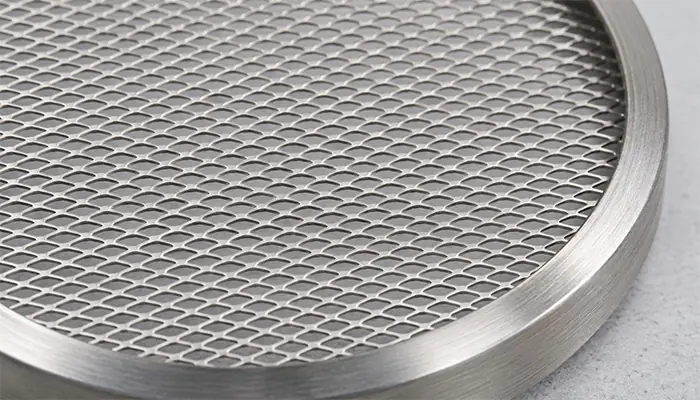
5. Fine and Micro Expanded Metal
Fine and micro expanded metal use much smaller patterns for applications such as filtration, support layers and precision components. The Expanded Metal Company identifies filtration, shielding and battery components among the uses of micro expanded metal.
For procurement, a label such as “micro mesh” is only the starting point. Provide the required openings, material, thickness and dimensional tolerances.
Where filtration is involved, establish whether the expanded mesh performs the separation or supports another filtering medium. The required specification will differ.
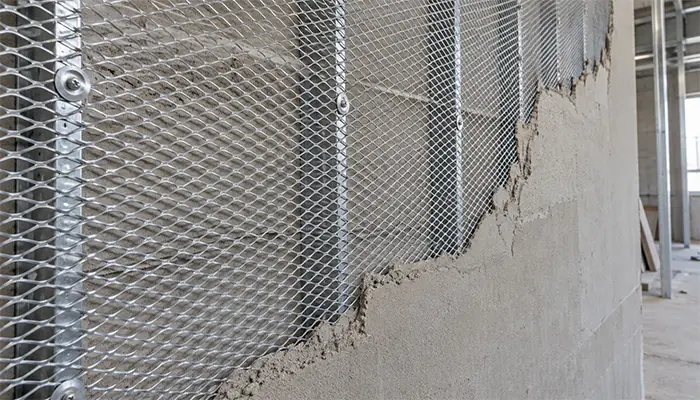
6. Expanded Metal Lath
Expanded metal lath provides a metal base within plaster, stucco and related finish systems. Diamond mesh lath and self-furring forms address different installation needs. ClarkDietrich’s diamond mesh lath documentation describes its use as a substrate for plaster and stucco.
Order lath according to the specified wall or ceiling assembly. Relevant details include material, coating, lath form, backing where required, and installation requirements.
Its construction role is distinct from a load-bearing walkway panel, so products should be compared within the appropriate application.
Raised vs. Flat Expanded Metal: What Is the Difference?
The most visible difference is the surface profile. The practical decision concerns how that profile interacts with the rest of the assembly.
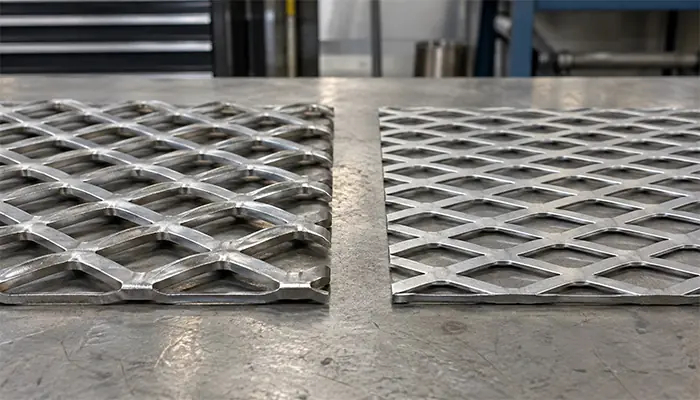
| Purchasing consideration | Raised expanded metal | Flattened expanded metal |
|---|---|---|
| سطح | Three-dimensional strand profile | Rolled, relatively flat profile |
| Mounting | Check strand orientation and overall depth | Check flatness and finished dimensions |
| Contact with adjacent components | Confirm available clearance | Confirm the required contact surface |
| Typical uses | Guards, enclosures and textured screens | Covers, partitions and flatter infill panels |
| Pattern specification | Identify the supplied raised pattern | Identify dimensions after flattening |
| Structural use | Verify data for the actual installation | Verify data for the actual installation |
Choose the form that meets the drawing and service requirements. If two quotations offer different profiles, ask both suppliers to explain the resulting dimensions and mounting implications before comparing prices.
For repeat orders, keep the approved sample and drawing revision together. This helps prevent a raised product being substituted for a flattened one simply because both have a similar diamond pattern.
Expanded Metal Materials and Surface Finishes
المعدن الممدد المصنوع من الفولاذ الكربوني
Carbon steel expanded metal is a common option for industrial fabrication because it combines strength with practical cutting, forming and welding options. It is often considered where material cost matters and a protective finish can be specified for the environment.
Specify whether the material will be delivered as an unfinished sheet or as a completed component. A quotation for bare mesh will cover a different scope from one that includes cutting, framing and coating.
Both carbon steel standard expanded metal and carbon steel flattened expanded metal can be considered, depending on the assembly.
المعدن الممدد المصنوع من الألومنيوم
Aluminum has a lower density than steel, helping reduce the weight of a panel with comparable geometry. Aluminum expanded metal is frequently considered for screens, cladding and other projects where handling weight and appearance matter.
The material name still needs supporting details. State the alloy and temper where required, together with mesh geometry, sheet size, finish and framing requirements. Have the complete panel assessed for its intended use.
Review YESON’s شبكة معدنية موسعة من الألومنيوم when discussing material options and custom dimensions. Confirm the required sheet format explicitly, especially for enquiries using “4×8.”
المعدن الممدد المصنوع من الفولاذ المقاوم للصدأ
Stainless steel expanded metal is often considered for applications involving corrosion resistance and repeated cleaning. Identify the required grade, such as 304 or 316, and describe the service environment, including exposure to moisture, cleaning chemicals or salts.
Also define the required surface condition and fabrication steps. Selecting a grade and approving the finished component are separate parts of the purchasing process.
Galvanized Expanded Metal
Galvanized expanded metal combines a steel substrate with a zinc coating. It can be specified alongside different mesh profiles, including raised and flattened products.
Ask whether galvanizing occurs before or after expansion and fabrication. Confirm how the selected route addresses cut edges, welds and finished dimensions. Coating requirements should be part of the purchase specification.
YESON’s galvanized expanded metal mesh is a relevant starting point for discussing the required mesh and finish. Request confirmation of the coating process for the actual order.
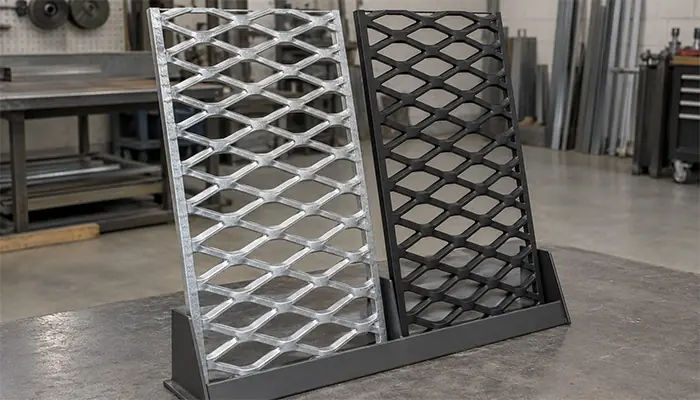
Powder-Coated and Other Coated Expanded Metal
For a coated panel, identify the coating system, color, gloss, preparation requirements and intended exposure.
Treat “rubber coated expanded metal” as a specific material request. Rubber, PVC and powder coatings are different systems. If a flexible or cushioning surface is needed, describe that requirement and obtain confirmation of a suitable process.
A finished sample is useful when appearance and fit both matter.
Expanded Metal Mesh and Sheet Sizes Explained
كيف يتم قياس المعدن الممدد؟
Expanded metal specifications distinguish the repeating mesh pattern from the clear opening and the dimensions of the whole sheet.
| المدة | المعنى |
|---|---|
| SWD | Short way of diamond; distinguish nominal designation from actual pitch |
| LWD | Long way of diamond; distinguish nominal designation from actual pitch |
| SWO | Short way of the clear opening |
| LWO | Long way of the clear opening |
| Strand width | Width of the metal forming a side of the opening |
| Strand thickness | Thickness of the strand material |
| Overall thickness | Total depth of the finished mesh profile |
| Sheet dimensions | Overall panel size, with mesh direction identified |
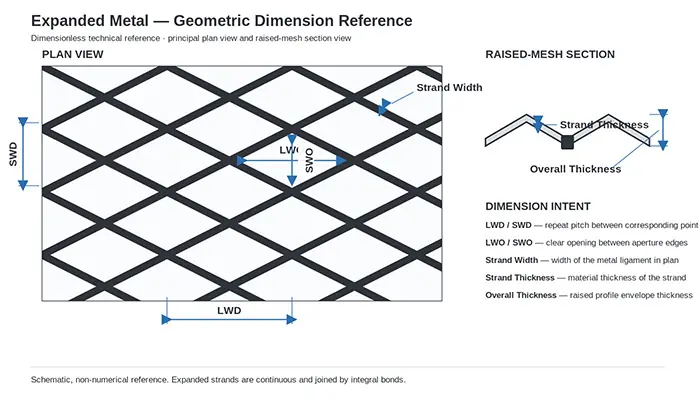
Pitch is measured between corresponding points on adjacent diamonds. Clear opening measurements describe the space between the strands. The NAAMM expanded metal guide explains these terms and product designations.
What Does 1/4-Inch Expanded Metal Mean?
A description such as “1/4-inch expanded metal” can identify a nominal pattern designation. It does not provide a complete purchasing specification or establish the exact clear opening.
Ask for the full style designation, material, raised or flattened form, strand dimensions and actual opening measurements. If the opening must pass or retain a particular object, specify the relevant clear dimension directly.
Expanded Metal Sheet Sizes and 4×8 Sheets
Sheet size describes the overall panel. It is separate from mesh size.
A 4×8 ft sheet converts to 1219.2×2438.4 mm. A sheet quoted as 1220×2440 mm uses different nominal dimensions. Confirm the supplier’s actual size and tolerance when fitting panels into existing frames.
Also mark which panel dimension runs in the short-way and long-way mesh directions. A length-and-width pair without orientation can leave an avoidable ambiguity.
How to Read an Expanded Metal Sizes Chart
Read across the complete row for the chosen product. Check material, profile, strand dimensions, opening dimensions, weight per unit area and supplied sheet format.
For example, a 1,000×2,000 mm panel size says nothing about its diamond openings. Likewise, a pair of mesh dimensions needs to be identified as pitch or clear opening before it can be used to compare products.
Ask for thickness in millimeters or inches alongside any gauge designation. When a distributor uses its own product code, attach the corresponding data sheet to the enquiry.
A chart is most useful when both buyer and supplier are clearly referring to the same finished product.
Common Applications of Expanded Metal
Different applications place different demands on the mesh. Use the intended function to decide which information needs to appear on the drawing.
| طلب | Information to confirm |
|---|---|
| Walkways, catwalks and flooring | Loading, support span, orientation and fixing details |
| Steps and access platforms | Tread dimensions, frame connections and service conditions |
| Security fencing and machine guards | Opening limits, frame layout and mounting arrangement |
| Facades and architectural screens | Panel pattern, visual effect, finish and support details |
| Filters and equipment components | Opening requirements, material and component tolerances |
| Plaster and stucco support | Specified lath type and assembly requirements |
For enclosure projects, the drawing may call for an alternative mesh construction. YESON’s welded wire mesh panels use joined wires and should be assessed against the same opening, framing and service requirements when alternatives are being considered.
For multi-panel installations, review the full layout before ordering. Panel edges, joints and fixing positions can matter as much as the appearance of an individual sheet.
How to Choose the Right Expanded Metal for Your Project
Define the Application
Describe what the mesh must do. Include drawings or photographs of the assembly and explain any existing constraints.
For a replacement order, identify the original component and record its dimensions. A sample with no installation context may leave essential requirements unanswered.
Choose the Material and Finish
State the service environment, appearance requirements and maintenance expectations. Ask suppliers to identify their proposed material and finish clearly in the quotation.
Specify the Mesh Geometry
Record openings, strand dimensions, overall thickness and panel orientation. Mark critical dimensions so the supplier knows which features determine acceptance.
Confirm Structural and Installation Requirements
For supporting surfaces, obtain a review of the complete arrangement, including the mesh, frame and connections.
For covers and infill panels, confirm fit, mounting access and the edge condition required by the drawing.
Compare Total Project Cost
Compare quotations on the same scope: material, processing, finish, inspection, packaging and delivery terms.
For example, one offer may include cut panels with finished edges while another covers full sheets only. Calculate the remaining fabrication work before deciding which offer provides better value.
Expanded Metal Fabrication and Custom Orders
Cutting, Bending, Framing and Finishing
Expanded metal may be supplied as sheets or processed into finished components. Describe every required operation, including trimming, bending, edging, frame attachment and finishing.
Specify open or closed diamond edges where relevant, along with overall dimensions, flatness and squareness requirements. For visible installations, show the intended pattern direction on each panel.
If parts will be coated after assembly, make that production sequence clear in the request.
What to Include in an Expanded Metal RFQ
A useful request for quotation contains enough information for suppliers to quote the same product.
| RFQ item | Details to provide |
|---|---|
| Product type | Raised, flattened, grating, architectural, micro mesh or lath |
| المواد | Metal and required grade |
| Mesh dimensions | Actual pitch and clear openings where critical |
| Strand dimensions | Width and thickness |
| حجم اللوحة | Finished dimensions, orientation and tolerances |
| ينهي | Coating system, appearance and preparation requirements |
| Fabrication | Cuts, bends, edge treatment and frame details |
| الكمية | Quantity by size or drawing reference |
| تقتيش | Required checks, documents and sample approval |
| Delivery | Packing, destination and requested delivery terms |
For repeat purchasing, maintain one approved specification rather than relying on an old invoice description. Record changes to drawings, materials or finishes so the next order remains traceable.
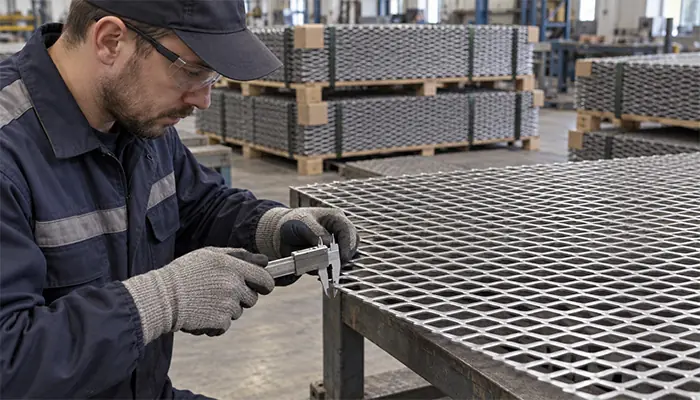
Before shipment, request evidence against the agreed inspection points. Useful records may include dimensional checks, finish inspection and photographs of the packed goods. Match identification labels to the packing list, particularly when a shipment contains several panel sizes.
FAQs About Expanded Metal
Does Standard Expanded Metal Mean It Meets a Specific Standard?
“Standard” commonly means the raised product form. A required technical standard, test method or certificate must be specified separately. The order should identify both the product type and any applicable project requirements.
Can Flattened Expanded Metal Be Used for Walkways?
Suitability depends on the specific product and supporting arrangement. Ask for data covering the proposed span, loads, direction and connections. A flat surface by itself does not establish that the mesh is suitable for pedestrian loading.
What Does 1/4 Expanded Metal Mean?
It can be part of a nominal product designation. Confirm the full specification and actual opening dimensions. Where a precise opening is essential, include that measurement and tolerance on the drawing.
Is a 4×8 Expanded Metal Sheet Exactly 1220×2440 mm?
No. Four feet equals 1219.2 mm and eight feet equals 2438.4 mm. Confirm whether the supplier uses an imperial or metric nominal sheet size, along with the delivery tolerance and mesh orientation.
Can Expanded Metal Be Galvanized or Coated?
Several finish options are available, but the appropriate process depends on the material, mesh geometry and service requirements. Ask the supplier to confirm the process, edge treatment and finished dimensions for your order.
What Is the Difference Between Expanded Metal and Perforated Metal?
Expanded metal is formed by slitting and stretching the sheet. Perforated metal is commonly produced by punching openings through it. When comparing patterns for screens or covers, review YESON’s perforated metal sheets alongside the specified expanded mesh.
Choosing the Right Expanded Metal for Your Next Order
A clear specification connects the product type to its intended use. Decide on the surface form, material, mesh geometry, panel size and finish, then confirm fabrication and installation requirements.
YESON supplies expanded metal products and supports enquiries for custom specifications. Send your drawing, quantity, application and delivery destination when you request an expanded metal quotation.
If the specification is still being developed, identify the requirements already fixed and the options still open. That gives the supplier a useful basis for discussing suitable products and preparing a quotation.


 AR
AR  EN
EN  DE
DE  FR
FR  ES
ES  PT
PT